



Wax Heaters for Argentine and Chilean Salons: The 2025 Import Rule Change and a Capacity Ladder
The Southern Cone looks like one market from a catalog and behaves like two from a customs desk. Argentina repealed its duplicate local electrical certification in February 2025, which shortened the path for imported appliances that already hold a recognized international certificate. Chile kept its mandatory SEC certificate exactly where it was. If you sell into both, the equipment can be identical — the file behind it cannot.

Ten heater platforms, 20 ml to 800 ml, all on chip-based temperature control — one 220 V line for both countries.
Two markets worth stocking together
Latin America is the fastest-moving wax region after Asia Pacific. Straits Research puts the Latin American hair removal wax market at USD 486 million in 2025, reaching about USD 909 million by 2034 at a 7.2% compound rate (Straits Research, 2025), while Global Market Insights projects the region at USD 1.8 billion by 2035 on a 9.9% CAGR and lists Argentina alongside Brazil and Mexico among the leading country markets (Global Market Insights, 2025; Verified Market Reports, 2025). Chile is smaller and steadier, with a salon sector that buys on quality rather than volume — and both countries run on 220 V / 50 Hz, which means a single heater platform, one voltage build and one spare-parts kit covers the pair.
USD 486 M
Latin American hair removal wax market, 2025, heading to ~USD 909 M by 2034 at 7.2% CAGR (Straits Research, 2025)
9.9%
Projected CAGR for Latin America to 2035, a USD 1.8 Billion region (Global Market Insights, 2025)
~100
Product categories on Chile’s mandatory SEC certification list, roughly 30 of which are tested to Chilean NCh standards (certification-industry guides, 2025)
Argentina: the duplicate certificate is gone — the standards are not
On 25 February 2025 Argentina’s Ministry of Deregulation and State Transformation published Resolution 16/2025, which repealed Resolutions 731/87, 524/98 and 169/18 — the rules that had required low-voltage electrical products sold in Argentina to carry a local certification. Under the new regime, products that conform to IEC standards, or that already hold CE, EAC, CCC, UKCA, NOM, SEC, INMETRO or UL certification, no longer need a separate Argentine certificate, and the decree also allowed products with non-Argentine plug geometry to be sold, while removing import controls on low-voltage equipment under 50 V (Argentine press reporting via official trade bulletins, February–March 2025). Days later, Resolution 5651/2025 retired the SEDI advance import data system, removing another filing layer. For a 220 V wax heater with a European file, that is a materially shorter and cheaper path than the one distributors were planning in 2024.
What did not change: the standards themselves, labeling in the local language, and the importer’s own customs and tax obligations. A Spanish-language manual and label copy stating voltage, frequency and power remain the practical minimum, an importer with a CUIT is still the counterparty on the entry documents, and duties plus IVA apply at the border — confirm current rates with your customs broker rather than a two-year-old invoice. Energy-efficiency labeling programs in both countries cover named appliance categories, so check whether your specific SKU is listed before you print packaging.
Chile: SEC certification is the gate, and a local entity holds the key
Chile’s framework is older and stricter in structure. The Superintendencia de Electricidad y Combustibles (SEC) derives its powers from Ley 18.410, and certification of listed products is governed by the Reglamento de Certificación de Productos Eléctricos y Combustibles (Decreto 298/2005): a product inside the mandatory list must be certified before it can be imported, sold or displayed. Certification-industry guides describe the list as roughly 100 product categories, about 30 of which must be tested to Chilean NCh standards with the remainder tested against IEC equivalents — household and similar appliances following the IEC 60335 series, which is where a wax warmer sits (certification-industry guides, 2025).
Three operational points decide the timeline. First, a foreign manufacturer cannot file alone — the application runs through a Chilean importer or legal representative who carries responsibility for the product in the market. Second, the mark matters as much as the certificate: approved products must carry the SEC mark, and since Resolución Exenta 2142/2012 that mark includes a QR code, with the product recorded in the SEC database. Third, approval is not the end of the process — SEC runs market surveillance, and non-compliant units can be stopped at the border or withdrawn. Guides describe the cycle as weeks of testing plus a review period, so start the file before you book production rather than after.
220 V in both countries, two cord decisions
Both markets run on 220 V / 50 Hz, so the electrical build is shared. The socket is not: Argentina’s standard outlet takes the three-flat-pin type I geometry, while Chile uses type C and L. Argentina now permits non-Argentine plug geometry on imported products, but a salon still expects a plug that fits the wall — a distributor who ships the wrong cord set has created a warranty conversation, not a compliance win. Specify the cord set and plug geometry on the purchase order, and keep the cord set as a separate line item so a re-order in one country does not disturb the other.
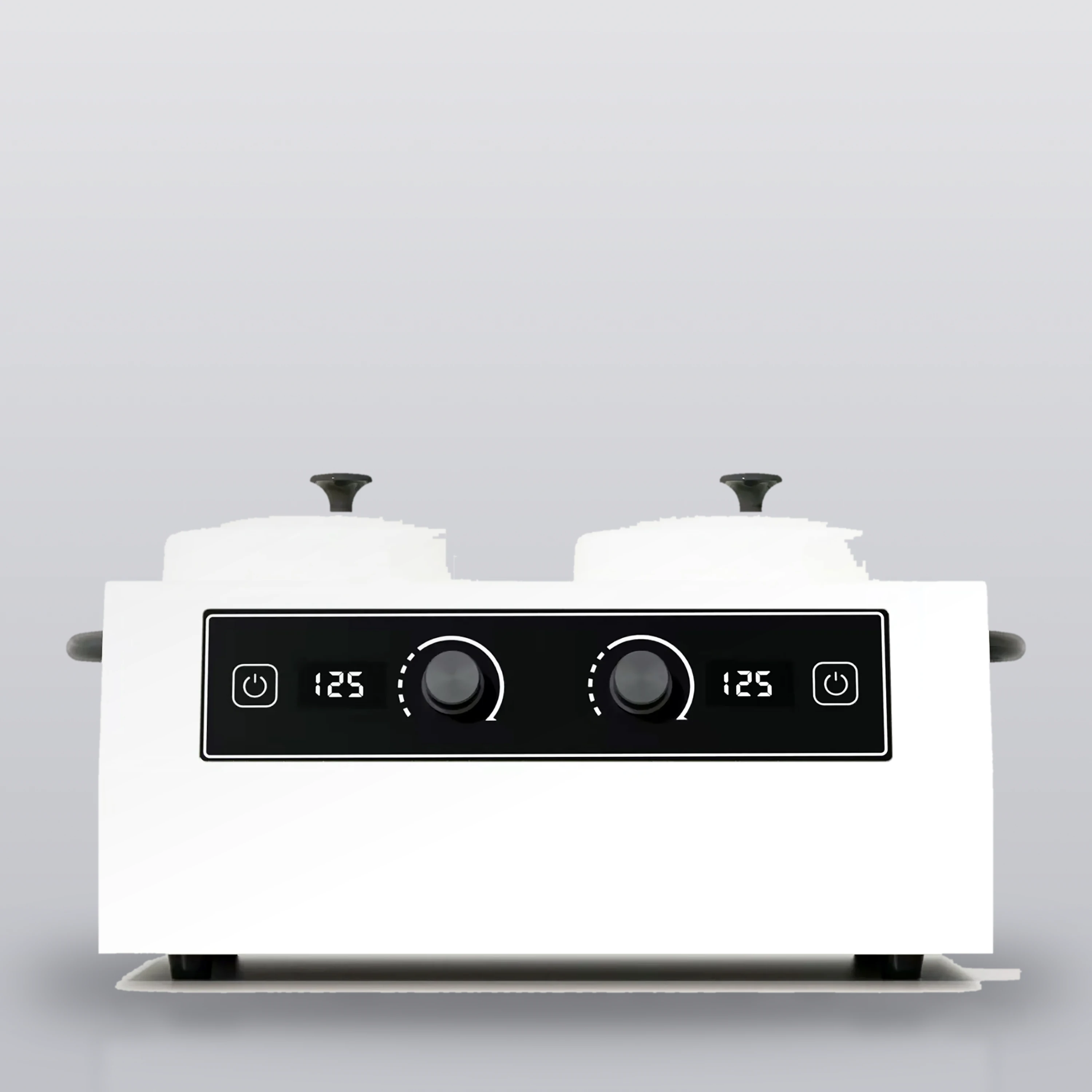
SW6B / 8B — the dual-pot salon station, 400 ml and 800 ml, for two temperatures in one footprint.
The capacity ladder that fits a Southern Cone treatment room
Our heater platform runs from a pocket unit to an 800 ml station, and all of it uses chip-based temperature control rather than a bimetallic thermostat — which is a cost argument before it is a technical one, because wax is the line item a salon feels every week:
- PW6 · 20 ml — pocket-size with graphene fast heating: brows, lip, touch-ups, mobile technicians.
- PW8 · 180 ml and PW2B · 250 ml — the compact pair for small rooms, single-chair studios and technicians who carry their kit.
- BWW5K · 450 ml — single rotary knob, 30–125 °C, no display: the price-entry workhorse for salons buying their first professional pot.
- W5 · 450 ml, W6 · 450 ml and W2 · 500 ml — the volume sellers, with W2 carrying a digital display for staff who need to read the set point at a glance.
- PW1B · 400 ml base-stand and SW1B · 800 ml large-capacity — back-bar pots for high-throughput rooms and leg waxing.
- SW6B / 8B · 400 / 800 ml — the dual-pot station: hard wax on one side, soft wax on the other, at two temperatures at once, without doubling the counter space.
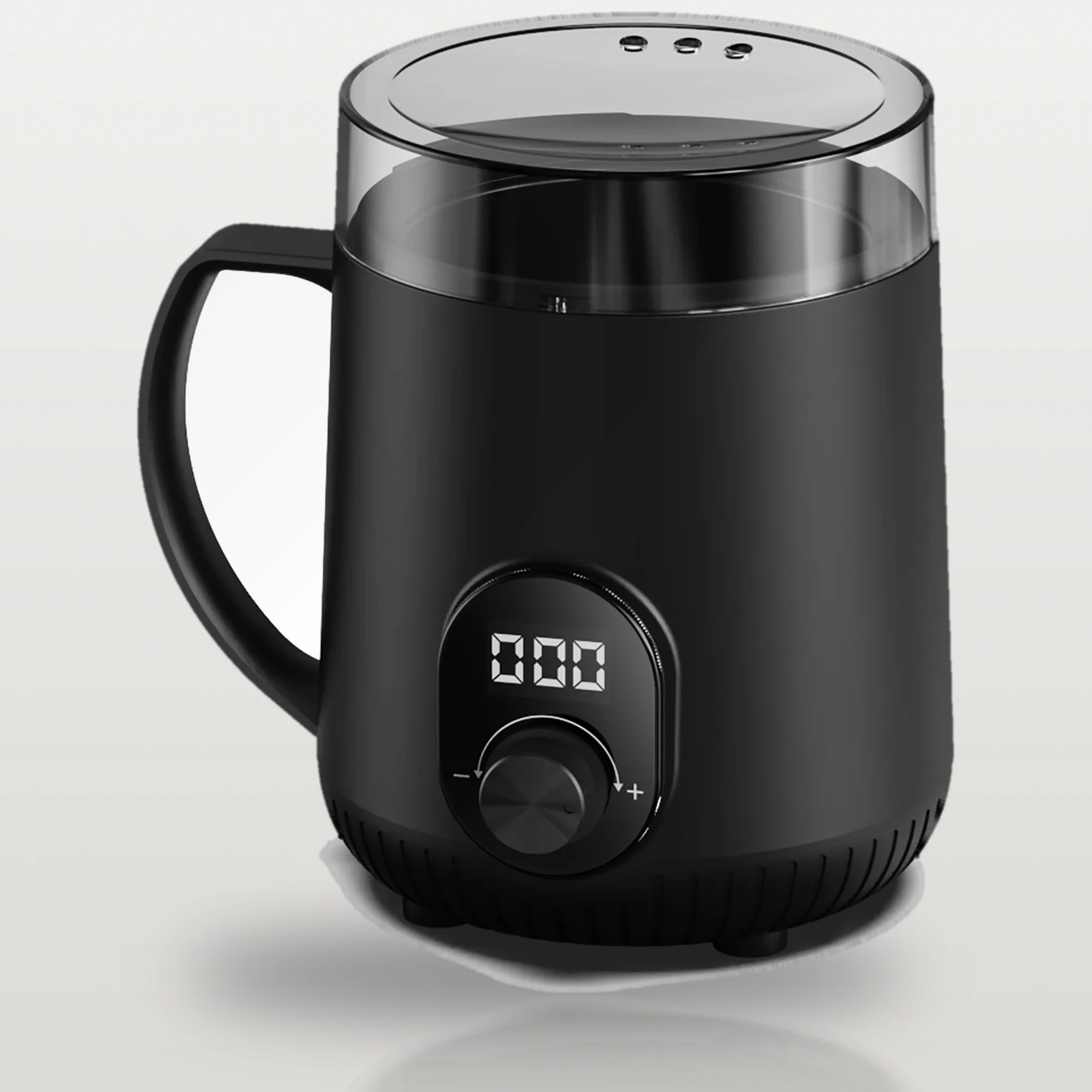
PW2B · 250 ml compact gripped — the small-room and mobile-technician size, on the same chip-controlled platform as the 800 ml station.
Why chip control pays in these two markets specifically: when a salon competes against discounted laser packages and at-home kits, the only costs it fully controls are wax consumption and technician minutes. A pot that holds its set point melts the film properly the first time, which means fewer second passes, less wax scraped back into the tin, and no burnt-through batches at the end of a long day. The capacity-planning logic behind those choices — how many pots one treatment room actually needs — is set out in our wax warmer capacity guide.
Terms for a first order into either market
White label or neutral units start at 3–5 pieces, with a single sample unit available for evaluation; custom branding on the housing, colorway or retail packaging starts at 300–500 units. Ship the sample with the test documentation your importer needs — for Chile that is what the SEC application is built on, and for Argentina it is what makes the 2025 recognition route work.
Quick FAQ
Do we still need IRAM certification to import wax heaters into Argentina?
What has to be in place before a heater can be sold in Chile?
Which capacities should a first order carry?
Next step
Tell us which country you are importing into, how many stations you are equipping and what your salons currently sell most of — hard wax, soft wax or both — and we will propose the two or three models that carry the mix, plus the document pack your importer needs. The platform is detailed on the wax heaters page, and the consumables side of the same order is on the wax formulas page. For a sample unit, a distributor price list or a private-label programme for Argentina or Chile, contact Miro Wu, Dedicated Account Manager — email miro.wu@beautome.com or WhatsApp +86 188 1393 3019.