






Hard Wax Private Label in the US: The Date You Print and the Number Behind It
There is no federal rule that requires an expiration date on a cosmetic sold in the United States. That is not a loophole, it is a handoff: the decision moves to whoever prints the label. Which means the date on a bag of hard wax is a voluntary claim, and every voluntary claim has to be defensible. The defensible part is never the date itself — it is the lot number underneath it.
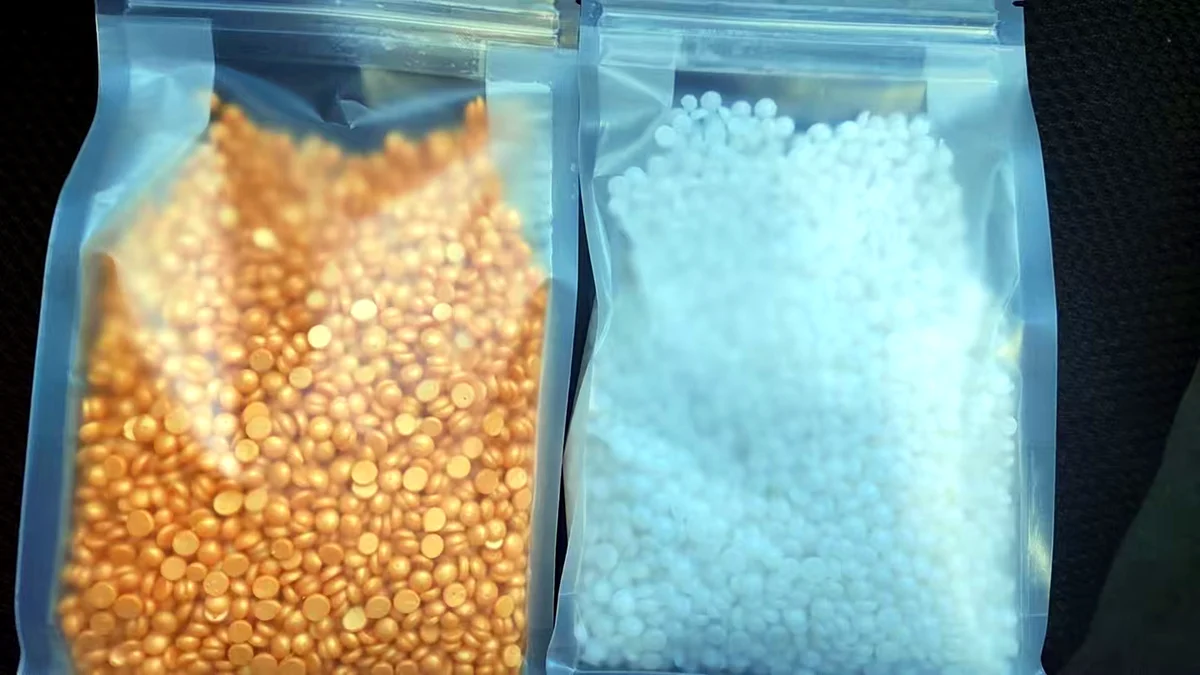
Unlabeled transparent bags save the printing cycle — but the lot code printed on the bag is the only thread back to the batch, so it has to survive the labeling step.
The rule is thinner than most buyers assume
US federal labeling law requires an identity statement, net quantity in both customary and metric units, the name and place of business of the manufacturer, packer or distributor, and an ingredient declaration in descending order of predominance, with color additives listed last. What it does not require is an expiration date or a period-after-opening symbol. The FDA’s position is that shelf-life determination is the manufacturer’s responsibility, not a labeling mandate — and that if a date is printed, it must be truthful and supported.
MoCRA, the 2022 modernization of cosmetics regulation, did not add an expiry requirement. It did add three things that land directly on a private-label wax brand: a US contact on the label for adverse-event reporting, disclosure of fragrance allergens once FDA finalizes the rule — a proposed rule has been expected in 2026 and is still not in force — and a requirement that products intended only for licensed professionals be clearly labeled as professional-use products. That last one matters here, because hard wax sold to salons is exactly that case.
120 days
Window after first commercial distribution to list the product, with annual updates — the clock starts when the label goes on
6 years
Record retention for the responsible person, 3 years for qualifying small businesses — batch records live inside this
15 days
Reporting window for a serious adverse event — unusable if you cannot trace a complaint back to a lot
Wax fails differently from a cream
Most cosmetic stability programs are built around water. Emulsions separate, preservative systems lose effectiveness, and microbial growth becomes the headline risk. Hard wax is anhydrous: no water, no preservative system, and almost no microbial pathway. Applying a cream-style stability protocol to it measures the wrong things and produces a date that means nothing.
What actually drifts in a bag of beads is chemistry and appearance. The resin and polymer blend can oxidize, which shows up first as a color shift in the Gold or Pink shade and second as a smell. Plasticizer migration changes how the film behaves at the edges — it stops tearing cleanly and starts stringing. And the melting range moves, which is the one that hurts: a rosin-free formula specified at 45–50 °C that drifts upward needs a hotter pot, and a hotter pot on a low-temperature wax is how a salon ends up with a film that grabs skin instead of hair.
So the stability program for a wax has four endpoints, not three: melting range by the same method used on the certificate, color against a retained standard, odor by a simple panel, and film behavior on a strip test — applied at the stated working temperature, peeled, and judged for flexibility and residue. Run those at an accelerated condition and at real time, and keep both curves.
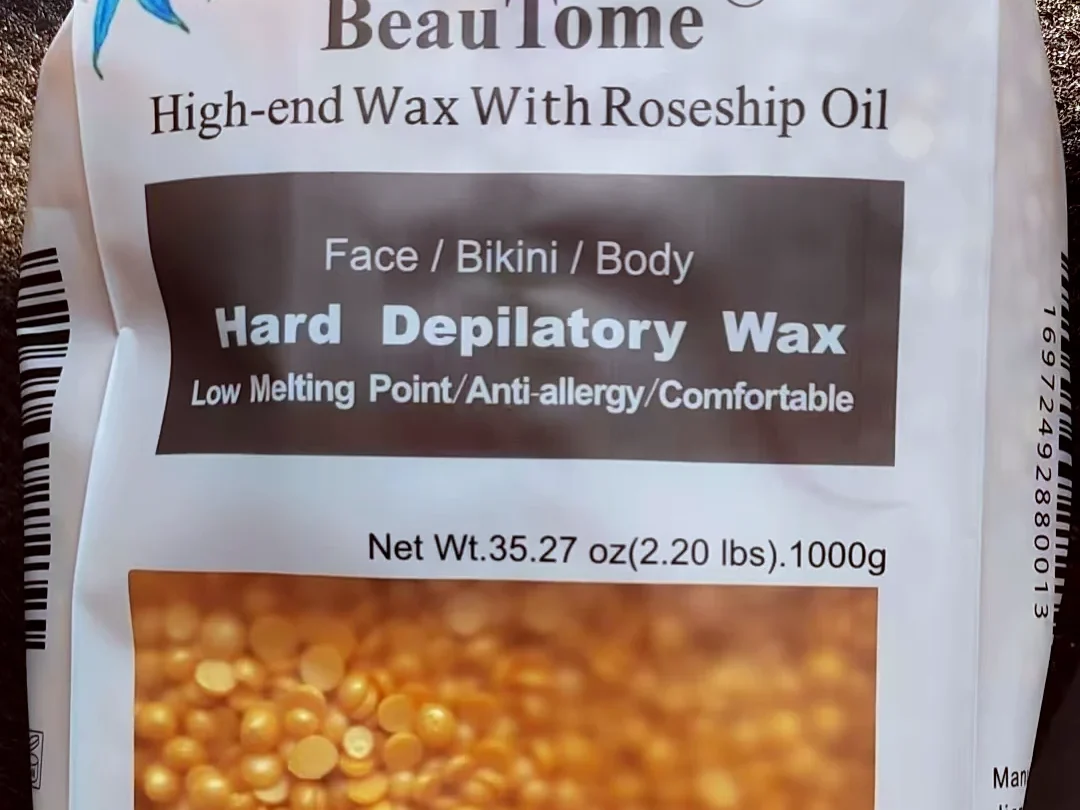
On a printed retail bag the lot code and the best-by share one panel. On a clear bag they have to be added by the brand — in a place the label artwork already reserves.
Build the lot code before the artwork
A lot code only works if it is designed, not improvised. The format we run is short and readable at arm’s length: year and month, then line, then shift — 2610-A-2 is October 2026, line A, second shift. It is enough to pull the batch record, and it is short enough to fit a 6 mm band on a bag seam without crowding the net-weight declaration.
Three placement rules follow. The code goes on the bag seam, not on a sticker that can be peeled. The same code goes on the shipping carton, so a pallet can be identified without opening it. And if a label is applied later, the label artwork must reserve a field for lot code plus best-by, printed by the labeler from the mapping table — not retyped from memory at the end of a shift.
This is the specific risk of the unlabeled transparent bag, which is otherwise the fastest route to market because there is no printing cycle and no plate cost at low MOQ. The bag arrives with a lot code and a production date and nothing else. If the brand then prints a label that omits the code, the product becomes untraceable at the exact moment traceability starts to matter. Reserve the field in the artwork; it costs nothing at design stage and cannot be recovered later.
Four documents, and a mapping table
- Batch record. Raw material lot numbers, charges weighed, measured melting range, color standard used, packing date, quantity by pack size. One page per lot.
- Retain sample. One sealed unit per lot, held for the shelf-life period plus a margin. This is what settles a color complaint in ninety seconds instead of a week.
- Certificate of analysis. Melting range, color, odor, film test, packed weight. Issued per lot, not per year.
- Stability file. Accelerated plus real-time data behind whatever date you choose to print.
Underneath those four sits the mapping table, and it is the document auditors actually ask for: lot to customer to quantity to ship date. We keep the factory half — what left the building, on which lot, to which consignee. The brand keeps the other half — which salon received which case. Neither half is sufficient alone, which is why the lot code has to be legible on the unit the salon opens.
Two hours is the only recall drill that counts
Pick one lot at random. Starting from the batch record, list every customer who received it and the quantity shipped, and stop when the list is complete. Time it. If the exercise takes two hours, the file works. If it takes two days, or ends with “we would have to ask the factory”, the file is decorative — and the fifteen-business-day adverse-event window does not wait for a decorative file to be rebuilt.
Run the drill once a year, before the audit rather than after a complaint, and write down where it stalled. The usual stall is not the factory side. It is the moment the brand has to answer “which of my customers still has stock from that lot”, which is a sales-record question, not a production one.
What the date means across four SKUs
One date does not fit the whole range, and pretending otherwise is how brands end up reprinting cartons.
- Formula A1, rosin-free. Working range 45–50 °C; standard shades Gold and Pink, with White made to order because it is the most demanding color to run. The tightest film in the range, so the melting-range endpoint is the one to watch on the stability panel.
- Formula A2, premium rosin salon wax. Cream White beads with high elasticity, built to grip short, coarse hair. Rosin-containing, so color drift reads differently — measure against the retained standard, not a photograph.
- Consumer-Grade Hard Wax. A 55–60 °C film wax for volume work and the retail shelf. Higher working temperature means a wider tolerance band, and it is the SKU most likely to sit in a warehouse through a summer, so storage discipline shows up here first.
- All-Purpose Soft Wax. 450 g cans, strip-based work. A different container and a different failure mode — check the seam and the lid, not only the wax.
Pack sizes are 300 g, 500 g and 1,000 g, and they map to shelf life as much as to price. An opened 1,000 g bag at a low-volume bench sits open for weeks and oxidizes at the surface; that size belongs where weekly throughput justifies it. 500 g is the working unit for most US studios, and 300 g is the trial and mobile size. Storage is 15–24 °C, dry and out of direct light — not refrigeration, which invites condensation the moment the bag is opened.
The range is set out on the wax formulas page, and the labeling and packaging route sits under OEM and ODM.
Quick FAQ
If the US does not require a date, why print one at all?
Who is the responsible person when we buy unlabeled bags and print our own label?
Can we use one label for salon and retail channels?
Next step
Send the pack size, the shades and the channel you are selling into, and we will come back with the lot-code format we will print, a sample certificate of analysis and the stability endpoints we test for that formula. Private label runs on unlabeled transparent bags at low MOQ, so the first order does not wait for a printing cycle — and the batch record travels with it. For a quotation, contact Miro Wu, Dedicated Account Manager — email miro.wu@beautome.com or WhatsApp +86 188 1393 3019. More market notes sit on the BeauTome blog.