



AI Smart Nail Lamp for Hong Kong Studios: The Certificate Behind the Socket
Hong Kong is one of the densest beauty markets in Asia and one of the simplest to enter on paper. Government statistics counted roughly 12,300 beauty and body-care establishments at the end of 2023, most of them small, owner-run studios tucked into shopping arcades and upper-floor walk-ups. There is no pre-market approval for a household appliance here. That does not mean the paperwork is optional — it means the certificate has to exist before the lamp is supplied, and the importer is the one who has to hold it.
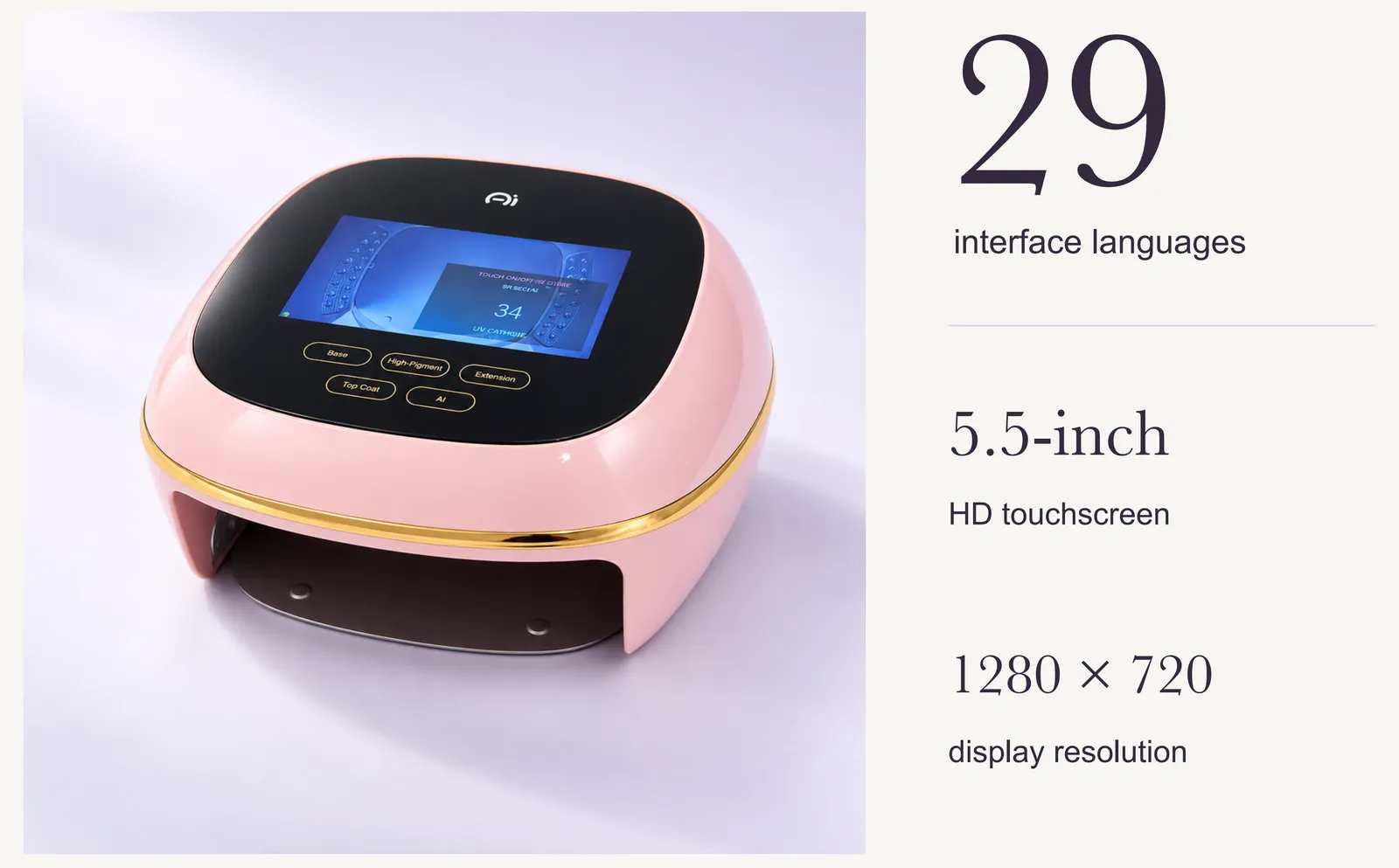
A bilingual console is not a luxury in a market where staff shift between Cantonese, Mandarin and English on the same day.
A market of small rooms and fast decisions
The Census and Statistics Department’s quarterly survey put the number of beauty and body-treatment establishments — a grouping that includes hairdressing — at about 12,300 units at the end of 2023, a level the government described as stable after the pandemic dip (Legislative Council reply, June 2024). Walk any district from Mong Kok to Causeway Bay and the structure of the market explains itself: one-technician nail studios above street level, two-chair salons in mall arcades, and a handful of multi-branch chains that look enormous only because everything else is so small.
For an exporter, that shape has two consequences. First, the typical order is one to five lamps, decided by the owner on her own bench, which makes a sample-first sales route the only sensible one. Second, the studio buys through an importer or a local distributor who handles the supply-side obligations — so the real sales conversation is often with the importer, and the question that importer asks first is not about irradiance. It is about the certificate.
~12,300
Beauty and body-care establishments in Hong Kong at end-2023, including hairdressing (Census and Statistics Department, via the June 2024 Legislative Council reply)
0
Pre-market approvals required — but a certificate of safety compliance must exist before supply (EMSD)
220 V
50 Hz on BS 1363 type G 13 A sockets — the same fused plug as the UK and Singapore
No approval, no exemption: how Cap. 406G actually works
Household electrical products supplied in Hong Kong fall under the Electrical Products (Safety) Regulation (Cap. 406G), enforced by the Electrical and Mechanical Services Department (EMSD). The rule is short and absolute: the supplier must ensure the product complies with the applicable safety requirements and holds a certificate of safety compliance before it is supplied. What Hong Kong does not have is a pre-approval or registration gate — EMSD states plainly that there is no requirement to register or obtain approval before a product is put on sale, and the department runs only a voluntary registration scheme covering a couple of dozen product categories.
That structure shifts the burden to documentation. For a non-prescribed product — which is what a nail lamp is — the regulation accepts a declaration of conformity issued by the manufacturer, supported by a certificate and test reports against the relevant international safety standard. The category of prescribed products (plugs, adaptors, lampholders, flexible cords, extension units, unvented storage water heaters) is stricter: their certificates must come from a recognized certifying body, which is why the moulded plug and cord set on your lamp deserve their own paperwork line. Since January 2011, household appliances have also been expected to meet an EMF safety standard (IEC 62233 or equivalent) on import — a point worth raising with the test lab before a shipment, not after.
Two numbers explain why importers are careful. A violation carries a fine of up to HK$100,000 and six months’ imprisonment. And EMSD is active: over the five years to 2024 the department ran roughly 19,600 retail inspections and prosecuted about 380 violations, alongside annual sampling that covered 300 household products across 26 types (Legislative Council reply, September 2025). A CE declaration alone does not automatically satisfy a Hong Kong importer — many will accept the underlying IEC test reports, but ask the question in writing and let the importer confirm what their file needs.
The socket, the plug and the bilingual bench
Hong Kong runs 220 V, 50 Hz on BS 1363 type G sockets with a 13 A fused plug — the same geometry as the UK, Singapore and Malaysia. For a manufacturer this is the easy part: the moulded type G cord set is a standard build, but it still belongs on the purchase order as its own line (“220–240 V, 50 Hz, BS 1363 type G moulded, 13 A”), and the fuse inside the plug is a genuine component with its own traceability, not an afterthought.
The console is the part that sells the second unit. Studios here run mixed teams — a Cantonese-speaking owner, a Mandarin-speaking technician, an English-language booking system — and staff churn is constant. A 29-language menu on a 5.5-inch touchscreen, locked at the factory to the two or three languages the studio actually uses, means a new hire reads the curing presets and the heat and light-decay warnings on day one without a training afternoon. Ask for the printed quick-start card in the same language set; the manual should match.
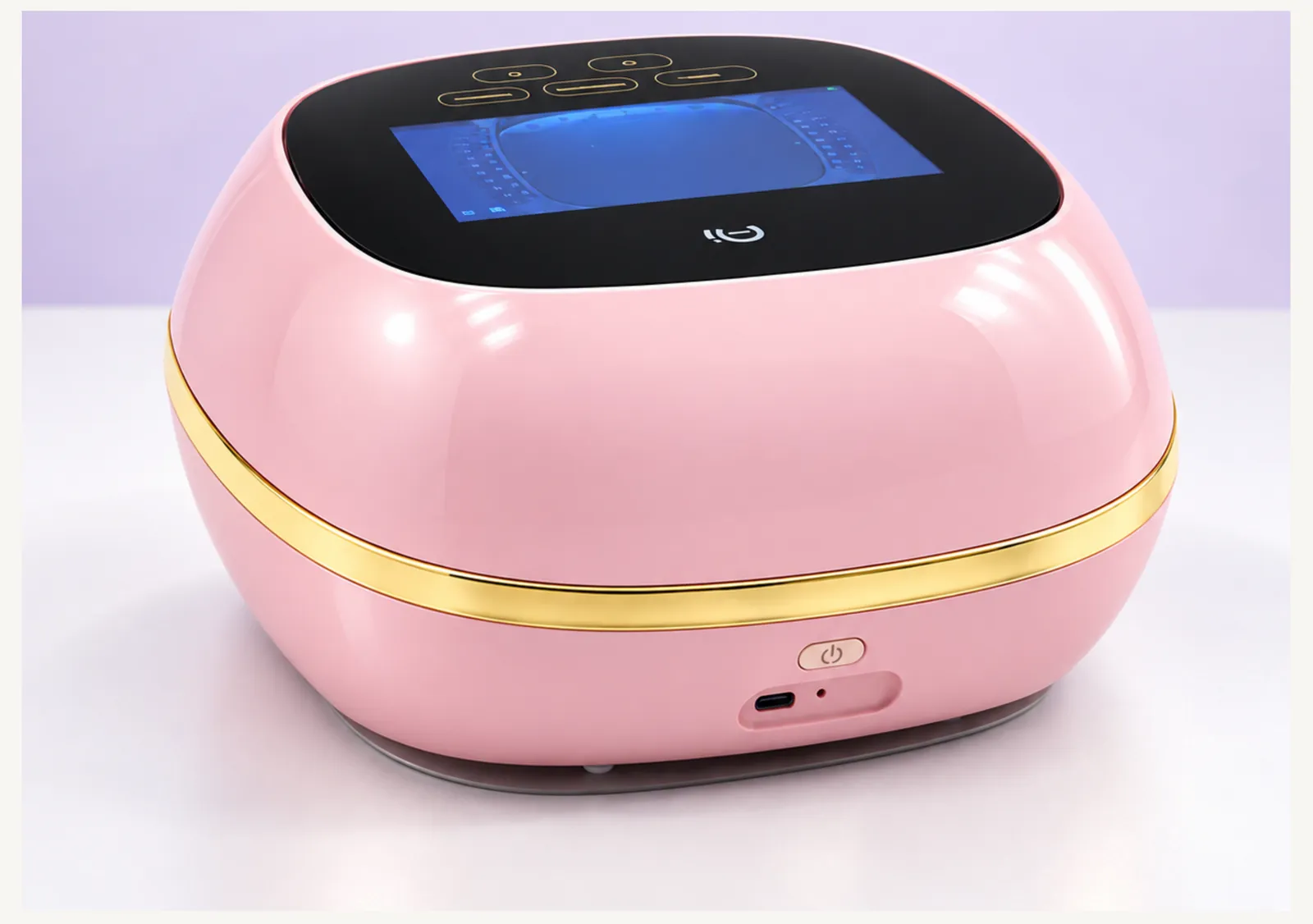
One lamp platform, one detachable inlet — only the moulded cord set changes between markets.
Where the light actually lands
The technical argument in a Hong Kong studio is not curing speed — gel cures in any professional lamp. It is the twenty minutes a client’s hand spends under a head that also lights the skin around it. The AI Smart Nail Lamp carries 136 dual-band emitters at 365–370 nm and 395–400 nm, curing gel with the same UVA output principle as every other professional LED lamp in the category. What differs is control: a 2-megapixel camera with 0.5 TOPS of on-device compute locates the nails in about 0.2 seconds and drives only the zones above them, so the surrounding skin receives less unnecessary light exposure across a working week. Clients who worry about their hands darkening ask about it directly, and being able to point at the zones is a better answer than a bigger number on a spec sheet.
Smart heat control closes the loop. The console reports head temperature and flags light decay before a set under-cures — and in a market where a redo eats a booked slot in a one-chair room, that warning is worth more than a marginal gain in peak irradiance.
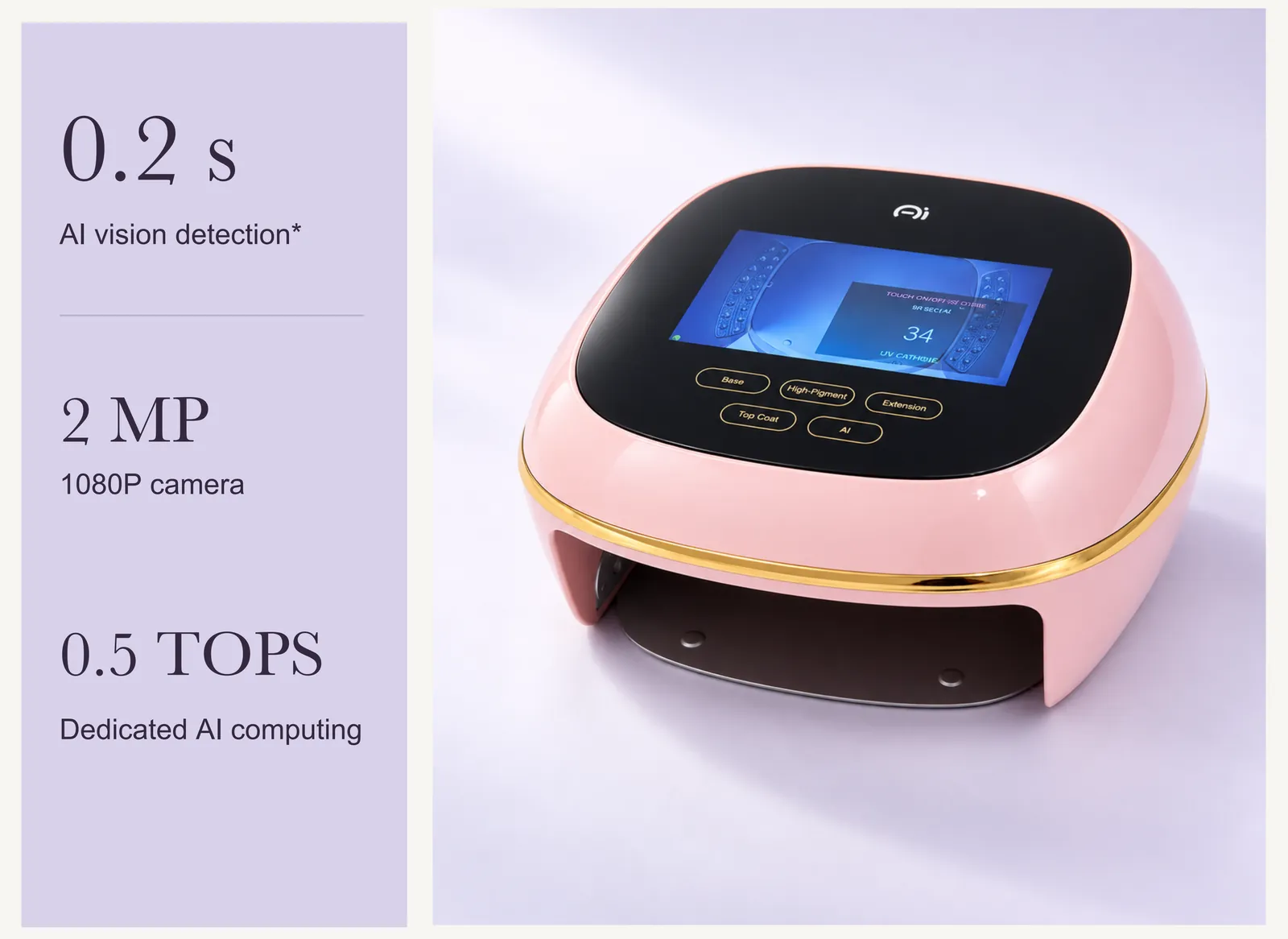
Zoned output is the feature Hong Kong clients ask about — put it in the demo script.
What goes on a Hong Kong order
Six lines settle most of it: the model number exactly as it appears on the rating plate; the cord set (BS 1363 type G moulded, 13 A); the certificate of safety compliance question answered in writing — who holds it, against which IEC standard, and whether the importer wants the manufacturer’s declaration plus test reports or a body-issued document; the language pack locked on the console with a matching quick-start card; the bilingual carton and manual; and, if the studio wants untethered mobile work, the 6,000 mAh battery pack, which is an option on request — standard units are AC-powered with no battery. White-label units start at three to five pieces and a single unit can ship as a paid sample, which is exactly what a demo in a two-chair arcade studio needs. Full custom branding starts at 300–500 units.
The full parameter set sits on the AI Smart Nail Lamp product page, the branding ladder is set out under OEM and ODM, and the curing-principle comparison with ordinary LED lamps is in this technical note.
Quick FAQ
Does a nail lamp need government approval before it can be sold in Hong Kong?
Is a CE declaration enough for a Hong Kong importer?
What should the cord set and console look like for Hong Kong?
Next step
Tell us which district your buyers sit in, whether they run corded or want the battery option, and the two lamps they are comparing, and we will send the irradiance report, the document set and a demo unit with the right cord set. Sample orders ship from three to five pieces, one unit at a time if that is what the decision needs. For a quotation, contact Miro Wu, Dedicated Account Manager — email miro.wu@beautome.com or WhatsApp +86 188 1393 3019. More market notes sit on the BeauTome blog.