







Wax Heaters for Greek and Cypriot Salons: The Peak-Week Pot Budget
Greek beauty businesses do not have a busy season so much as a compressed one. Bookings rose 13.75% between May and June 2026 — the fastest growth of any European market Treatwell operates in — and almost half of international bookings were made less than 24 hours before the appointment. You cannot schedule your way out of demand that arrives the night before. You can only own enough working pots to absorb it. That is the number this article is about.
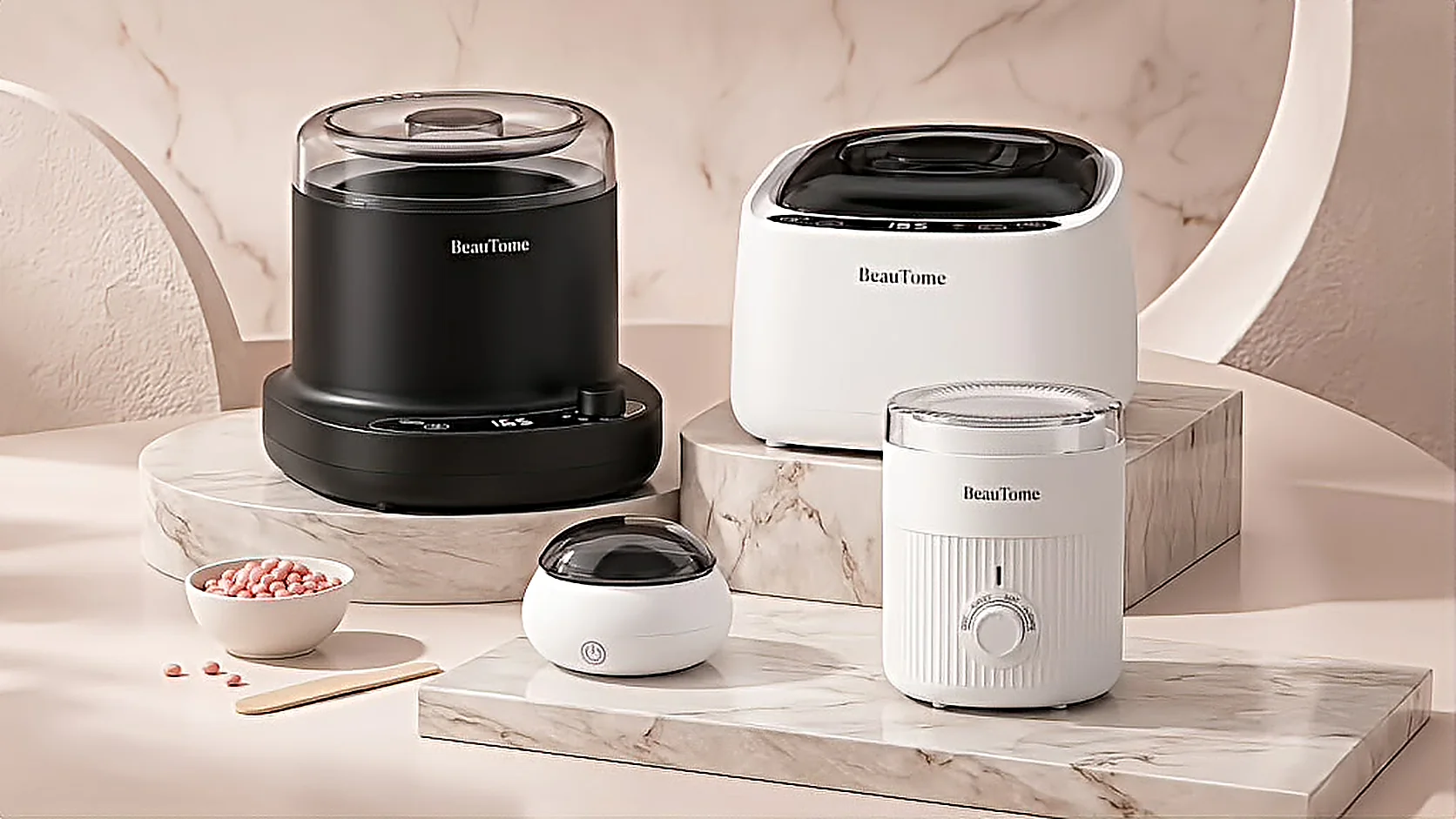
Ten heater models from 20 ml to 800 ml, including dual-pot stations for two-technician rooms.
A season that arrives without a booking calendar
The structural facts are worth putting in front of a buying committee, because they are not the ones usually quoted. Treatwell’s 2026 data for Greece shows appointment demand concentrated in the run-up to summer: pedicure bookings up 12.7% and manicure bookings up 11.3% in the May–June window, with 58.3% of clients returning to the same professional — a loyalty figure that matters, because it means the client who walks in at 21:00 on a Saturday in July is often a client who will be back next year if the room can take her.
IndexBox’s 2026 category analysis adds the other half: Greece is 85–90% import-dependent for razors, waxes and creams, sourced mainly from EU-27 suppliers, and seasonal tourism adds an estimated 15–25% uplift in tourist-heavy regions during peak summer months. Translate that into a treatment room and it stops being macroeconomics. A salon that serves eight waxing clients on a Tuesday in March serves ten to twelve on a Tuesday in July, from a client base that largely did not exist in the appointment book the day before.
+13.75%
Booking growth in Greece between May and June 2026, the fastest of Treatwell’s European markets
47%
Of international bookings made less than 24 hours before the appointment (Treatwell, 2026)
15–25%
Estimated summer uplift for hair-removal categories in tourist-heavy regions (IndexBox, 2026)
Count pots, not chairs
Most capacity plans in this market start with the chair count and then divide. It should be the other way round. A pot is the constraint, because a pot has a working temperature, a film thickness and a recovery time, and none of those scale with how many clients are waiting.
A workable planning rule for leg and underarm work on a 450 ml pot is two to three clients per hour per pot, once you account for application, set time and the minutes the pot needs to come back to temperature after a refill. Push the same pot to four and the wax goes on thin, the strip tears, and the technician re-waxes a patch she has already charged for. That is the real cost of a thin pot budget: not the heater, the redo.
So build the budget from the peak week rather than the average one:
- One pot per technician in any room where two services at different temperatures run at once — a VIO at a low working temperature and a leg at a film temperature cannot share a dial setting.
- A second pot for overflow before a second chair. A 180 ml unit on a trolley shelf takes the facial and underarm volume off the main pot, which is what usually collapses first on a Saturday.
- A dual-pot station where back and chest services are on the menu, so one technician runs two temperatures from one outlet instead of two plugs and two timers.
- Small pots as surge capacity. A 20 ml unit for brow and lip work is not a luxury in a peak week; it is the difference between a five-minute top-up service and a queue behind a leg wax.
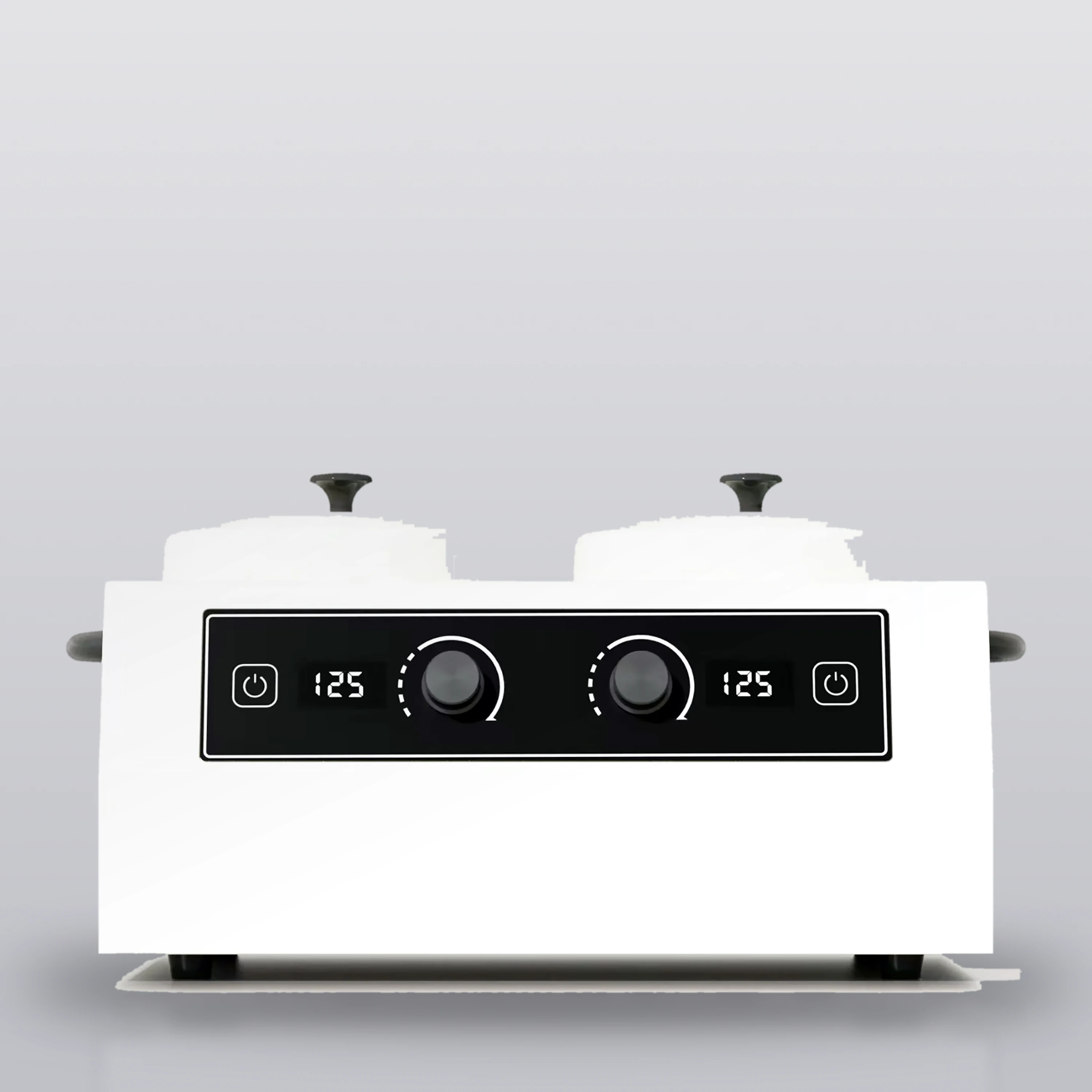
The SW6B and SW8B dual-pot stations — two temperatures, one outlet, which is what a peak-week room actually needs.
Mapping ten models to a Greek service menu
The range runs from 20 ml to 800 ml, and the reason it is that wide is that a Greek salon’s menu is unusually mixed: island studios run brow, underarm, leg and VIO from one or two rooms, while city salons in Athens and Thessaloniki carry the full body menu alongside nails. The PW6 at 20 ml is a graphene-bodied unit for brow, lip and nose work. The PW8 at 180 ml covers facial and underarm volumes and fits a trolley shelf. PW2B at 250 ml and PW1B at 400 ml fill the gap between a single-service pot and a full leg pot. The 450 ml group — W5, W6 and the entry-level BWW5K — is the workhorse capacity; the BWW5K is deliberately plain, a single dial across 30–125 °C at 100 W with no display, which is what you fit in a room with high staff turnover. The W2 at 500 ml adds a digital readout, the SW1B at 800 ml covers back and chest work, and the dual-pot SW6B and SW8B give one technician two temperatures without two plugs.
A typical Greek starting configuration is one 450 ml pot per treatment room, one 180 ml for facial work, one 20 ml for brow, and a dual-pot station where back and chest are on the menu. Price that as a fleet, not as individual purchases, because the spare-parts conversation changes at that volume.
230 V, two plug standards, one sea
Greece runs 230 V at 50 Hz on the Schuko (type F) outlet. Cyprus runs the same voltage and frequency on a type G outlet — the British rectangular-pin pattern — which means a single “Greece and Cyprus” purchase order needs two cord sets, not one. This is the sort of detail that gets discovered at unpacking, three weeks before the season starts, when there is no time to re-mould anything.
Island supply adds a second consideration that mainland buyers rarely raise. Sections of the distribution network run at the end of long feeders, and in smaller islands generation is often supplemented locally, so the supply can sit below nominal for minutes at a time, especially in August when air-conditioning load peaks. Ask what the controller does at the bottom of the input range: a unit that browns out and resets mid-service costs a client, and a heater that simply holds a stable temperature through a dip does not.
The EU file, and the part most suppliers skip
Heaters are mains appliances, so the CE route runs through the Low Voltage Directive 2014/35/EU, the EMC Directive 2014/30/EU and RoHS 2011/65/EU, with the declaration of conformity and the technical file held by the manufacturer. Three importing details decide whether the first pallet clears without argument:
- Greek-language instructions and safety information, plus the marking required for the product, in the language of the member state of sale. A Cypriot distributor selling to Greek-speaking clients will usually want the same file.
- Producer responsibility and WEEE. Electrical equipment places producer-responsibility obligations on the party that first places it on the market. If you import, confirm the registration route with your compliance adviser before the first invoice rather than after the first audit.
- General Product Safety Regulation (EU) 2023/988, applicable since 13 December 2024. GPSR is written around consumer products. A heater sold exclusively business-to-business may sit outside it, but the moment the same model is also offered to walk-in retail — and in this market it often is — treat it as in scope and put the EU-based responsible operator’s details where the regulation requires them.
The spares kit is part of the specification
An island salon cannot wait three weeks for a heating element in July. Greek industry slows in August, ferry schedules thin out, and a distributor who has to air-freight a single controller has lost the margin on the original order. Build a first-order spares kit into the purchase: 230 V heating elements, inner pots, controllers and dials for each capacity you stock, sized to the number of units in the field rather than to a guess.
Two smaller points belong in the same conversation. Ask for the recovery time after a full pot is emptied and refilled — that is the figure that tells you whether a Saturday needs a third pot. And ask whether the inner pot is a standard size you can re-order, because a pot that only fits one supplier’s body is a pot you cannot replace in August.
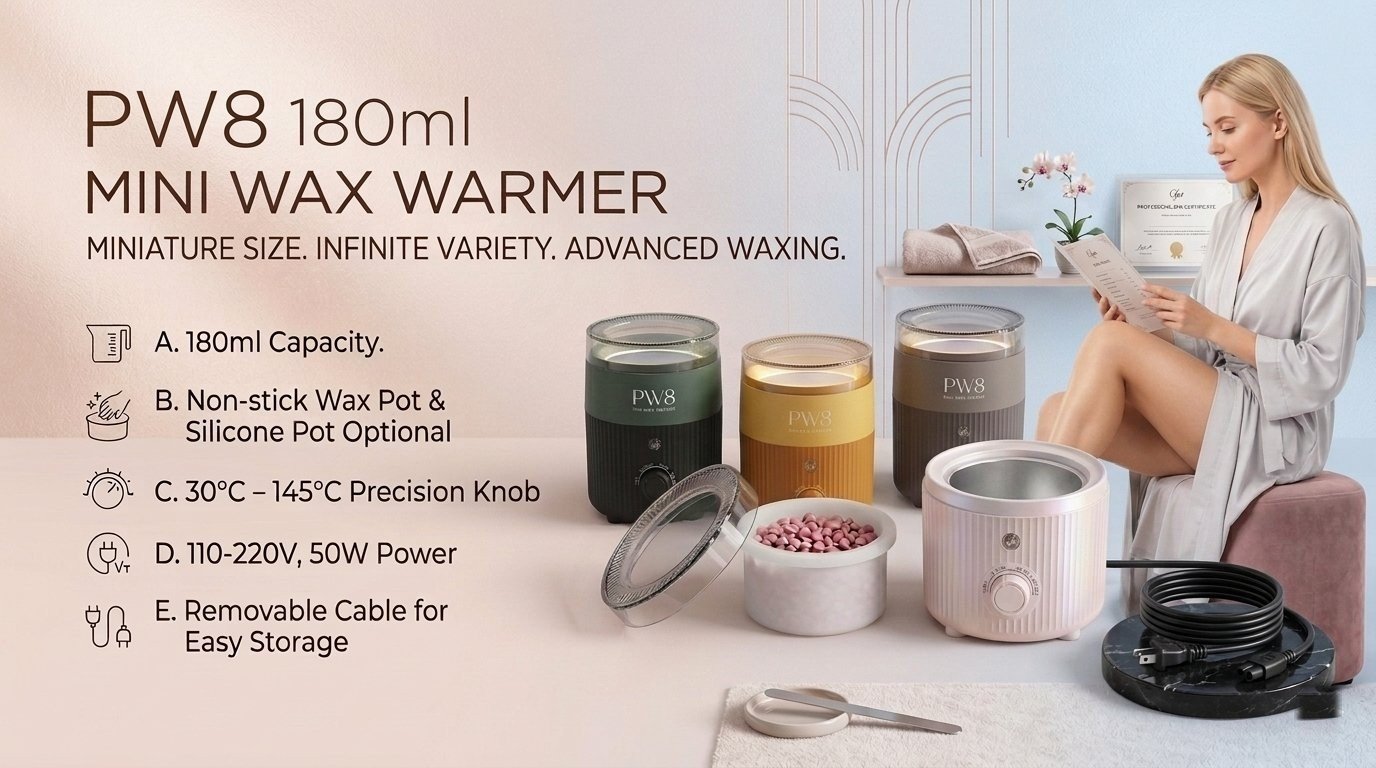
The 180 ml PW8 — the overflow pot that keeps a leg wax from queuing behind a lip wax in peak week.
Quick FAQ
How many heaters does a two-room Greek salon actually need?
Can one order cover both Greece and Cyprus?
Does the General Product Safety Regulation apply to professional heaters?
Next step
Send us your room plan, the number of technicians working at once, and whether you also supply Cyprus, and we will come back with a pot configuration, a plug schedule and a first-order spares list. The wax heater range carries every capacity from 20 ml to 800 ml, and the hard wax formulas page covers the consumables that run in them. For a quotation, contact Miro Wu, Dedicated Account Manager — email miro.wu@beautome.com or WhatsApp +86 188 1393 3019.