




Hard Wax for Japanese Salons: Rebuilding the Menu Around Legs, Backs and VIO
Something structural happened in the Japanese treatment room this summer, and it was not about price. Record heat pushed “Cool Biz” into shorts, shorts pushed leg hair into view, and men who had never booked a body treatment started booking them. By August, a men’s clinic chain with 23 outlets was telling Reuters that appointments at its Ginza branch had become hard to get, and that demand had moved off the face and onto the rest of the body. A menu built for brows and VIO does not serve that client well. This is how to rebuild it.
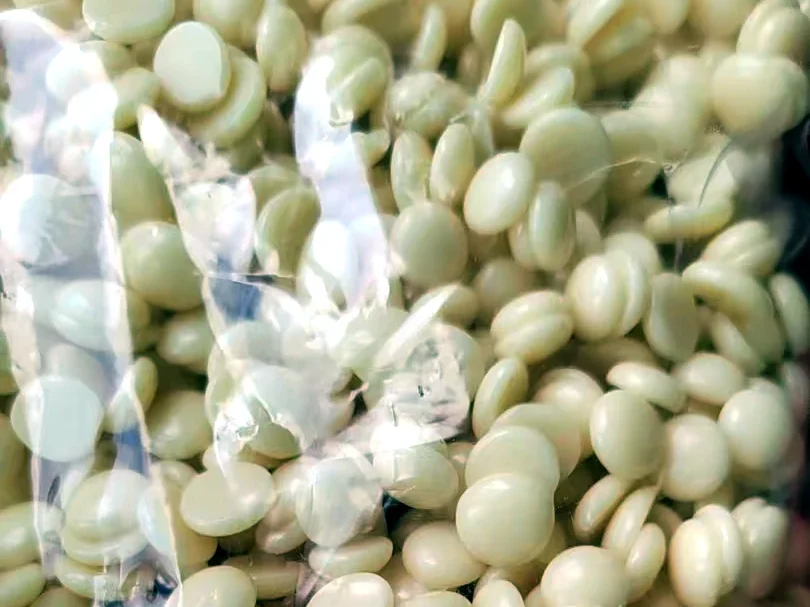
Formula A2 in cream white beads — the elastic, high-grip wax that carries back and chest work in a Japanese menu.
The summer that moved the menu
The trigger was weather, and the numbers are unusually concrete. Japan recorded an all-time high of 41.8 °C, Tokyo’s long-running Cool Biz campaign was extended to encourage lighter clothing, and Hot Pepper Beauty reported that just over a quarter of the men it surveyed had received lower-leg hair removal in the previous twelve months. Gorilla Clinic, which runs 23 outlets nationally, told Reuters that facial hair removal had once been its most requested treatment and that demand had since spread to other body areas — with appointment slots at its Ginza branch now filling completely, something the director says rarely happened when the clinic opened eleven years ago.
The category size is modest by global standards and the growth is steady rather than explosive: Deep Market Insights puts Japan’s hair removal wax market at USD 0.36 billion in 2025, reaching USD 0.55 billion by 2034 at a CAGR of about 4.92%, with Japan contributing roughly 2.5% of the global market. Two details in that same analysis matter more than the headline. First, soft wax dominated in 2025 and is forecast to grow fastest — legs and arms in Japan are largely strip-wax territory, and it would be a mistake to sell a hard-wax-only range into this market. Second, the value sits in mix, not volume: a 4.9% market rewards salons that add services and price them properly, not salons that cut consumable cost.
41.8 °C
Japan’s recorded high, cited by Reuters in its August 2026 report on male hair removal
1 in 4
Men surveyed by Hot Pepper Beauty who had lower-leg hair removal in the past 12 months
4.92%
Forecast CAGR for Japan’s hair removal wax market, 2026–2034 (Deep Market Insights, 2026)
Two wax families, two jobs
The practical consequence of that soft-wax dominance is a split most imported ranges get wrong. Legs and arms are large-surface, fast-turnaround work: a 450 g can of All-Purpose Soft Wax applied with a strip removes hair across a full leg in a fraction of the time a bead-by-bead technique takes, and the consumable cost per service is lower. That is the right product for the volume the new male client is buying.
Hard wax earns its place where the skin is sensitive and the hair is dense: VIO, underarm, brows, nape, and the back and chest work that is now arriving. Those are the services where a film that sets and is lifted without a strip protects the skin, and where grip matters more than speed. A Japanese menu that carries only one family either leaves money on the leg or burns clients on the VIO.
Mapping four SKUs to a Japanese menu
Our range is built as four products, and each one has a specific seat in the menu:
- Formula A1 — rosin-free. A low-temperature film wax with a working range of 45–50 °C, which is the range that matters for VIO, first-time clients and anyone with reactive skin. Standard colors are Gold and Pink; White is a custom color made to order, and it is the most demanding of the three to run because of the pigment load.
- Formula A2 — premium rosin. Cream white beads with a high elastic pull, formulated to grip short, dense hair. This is the back and chest product, and it is also the answer for the leg client whose hair grows back blunt and coarse between appointments.
- Consumer-Grade Hard Wax. A 55–60 °C film wax for high-volume hard-wax work where speed and cost per service decide the price list — underarm, lower leg, and the express services a mall-adjacent salon runs at lunchtime.
- All-Purpose Soft Wax in the 450 g can, for the strip work that carries arms and full legs.
Note what that structure implies about equipment. A1 works at 45–50 °C and the consumer-grade film at 55–60 °C. Those are not the same pot setting, and a technician who re-dials one pot between clients will eventually apply one of them at the wrong temperature. A two-temperature room is the correct configuration: a 450 ml pot for the film wax, a second pot — 180 ml or a dual-pot station — for the rosin-free line. The wax heater range covers both from 20 ml upward.
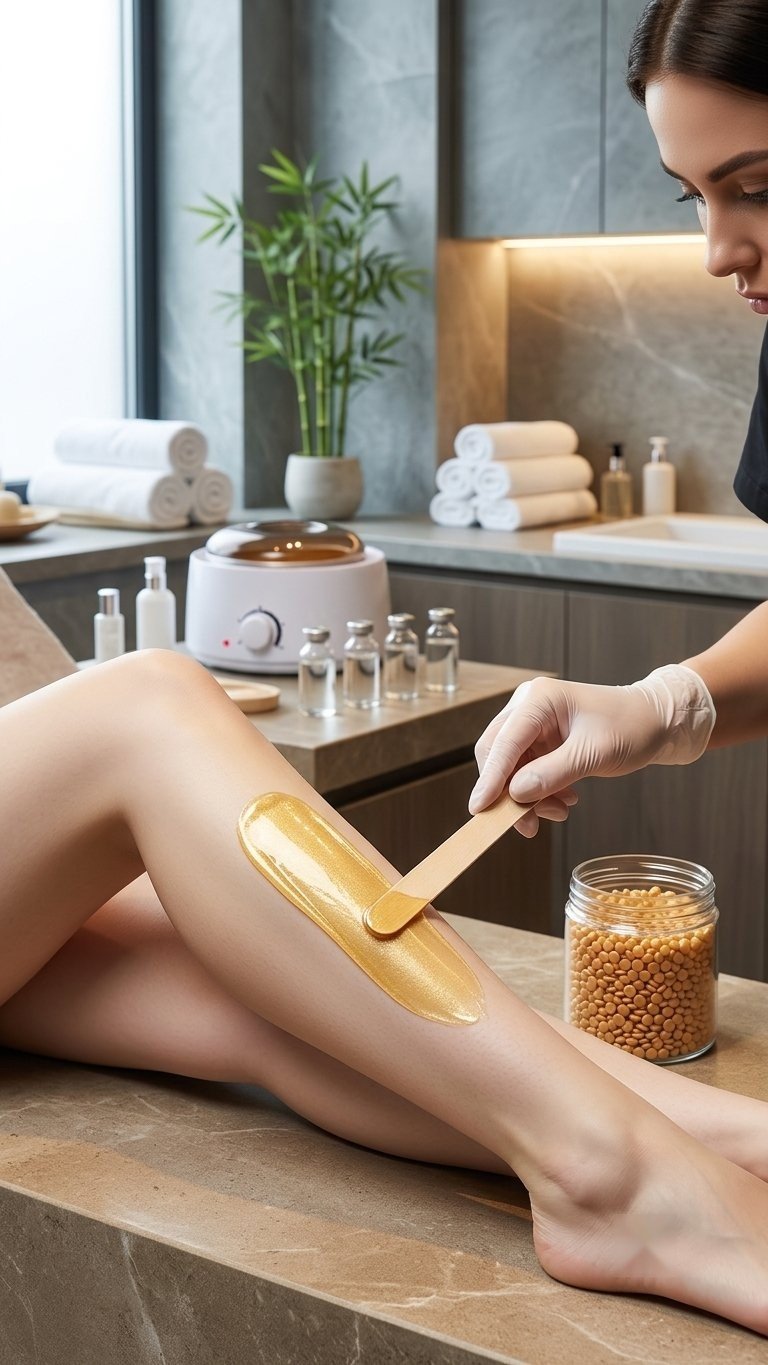
Film wax applied thin and lifted without a strip — the technique that makes leg and back work repeatable at salon speed.
What the menu earns per service
A Japanese price list gives a useful anchor. Listings on Hot Pepper Beauty in 2026 commonly show a nape wax at around ¥3,850–4,400, a women’s VIO wax at ¥5,000–8,800 with a soothing finish, and men’s VIO work at ¥8,800–15,000. Those are retail prices with the room, the linen and the technician already in them.
Now put the consumable next to them. A VIO service typically uses somewhere in the region of 40–70 g of hard wax once you account for the patch test and the trim-and-top-up round — measure it against your own logs rather than trusting the estimate. At that consumption a 1 kg bag covers roughly 15 to 25 services. Run the arithmetic on your own price list and the conclusion is consistent: at these menu prices, the wax is not the line that decides whether the service is profitable. The technician’s minutes and the redo rate are. Which is why a film that releases cleanly and a pot that holds temperature are worth more than a bead that costs 8% less per kilo.
Packaging, and the label question
Three bag sizes — 300 g, 500 g and 1000 g — map onto how a Japanese salon actually consumes product: 300 g for a single-room salon testing a new formula or for mobile work, 500 g as the standard back-bar unit, 1000 g only where weekly volume is already proven and the storage is cool and dry. Store between 15–24 °C and let a bag come back to room temperature before opening it in a humid room, or condensation will do more damage than the heat did.
Most of the brands we ship to Japan start with unlabeled transparent bags and apply their own label. It is the fastest route to a first order because there is no print run and therefore no printing lead time, and private-label volumes are deliberately kept low so a salon group or a small distributor can test a formula before committing to a container. Standard colors ship as standard; White is made to order.
One compliance paragraph, and a link
Japan is the most document-heavy of our five wax markets, and the classification question — cosmetics or quasi-drug — turns on the claims you make rather than on the wax itself. All-ingredient labeling in Japanese, the responsible entity and the factory registration all sit with the Japanese party placing the product on the market, and we supply the manufacturing and ingredient documentation they need to file. The full checklist is in our earlier piece on the Japanese document route; treat it as the starting point for your regulatory conversation, not as a substitute for it.
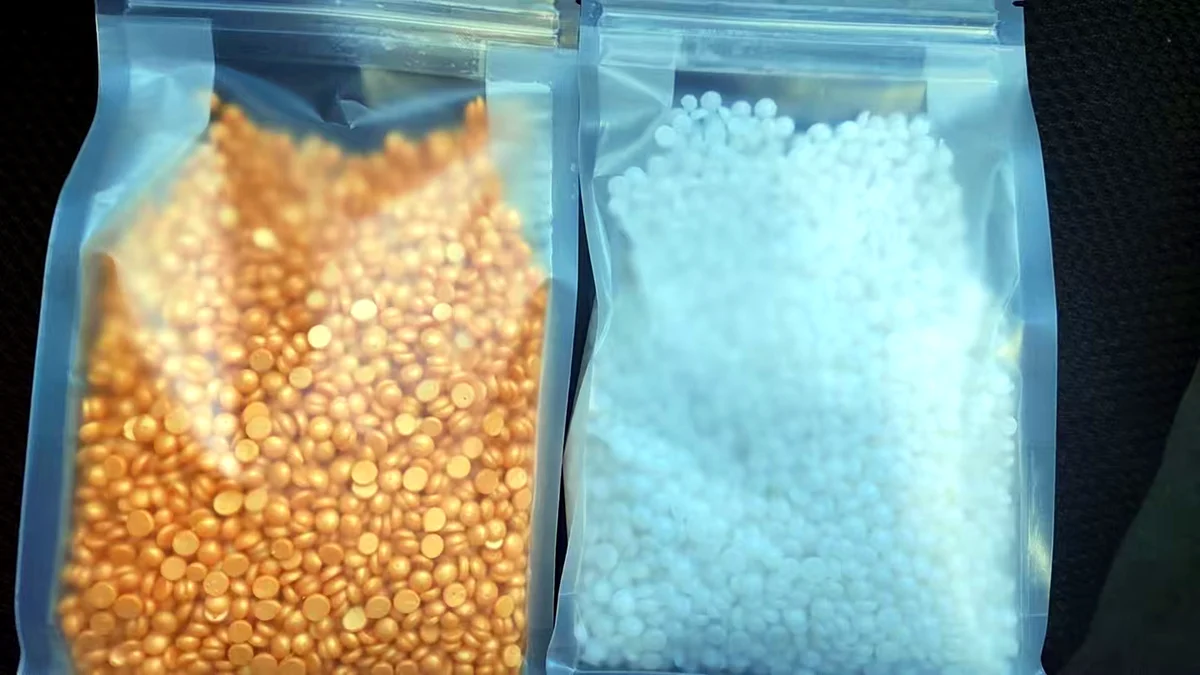
Unlabeled transparent bags — no print run, no printing lead time, and the label becomes your own.
Quick FAQ
Should a Japanese salon carry both hard and soft wax?
Why does Formula A1 have a temperature range instead of one number?
What is the minimum for a private-label order?
Next step
Send us your current menu with the services you want to add, and we will map it to a four-SKU range, a two-pot configuration and a sample plan. The wax formulas page carries the full specification for A1, A2, the consumer-grade film and the soft wax, and the heater range covers the pots they run in. For pricing, contact Miro Wu, Dedicated Account Manager — email miro.wu@beautome.com or WhatsApp +86 188 1393 3019.