

UV Nail Lamps and AI Smart Nail Lamps: Same Curing Principle, Different Control
Industry nickname aside, today’s “UV lamps” and “LED lamps” cure gel the same way: LED chips emit long-wave ultraviolet light (UVA) that sets the gel. So the honest comparison is not UV versus no UV — it is wavelength spacing, emitter count, and how tightly the light is aimed at the nail. Here is the plain-language version for salon brands and distributors.
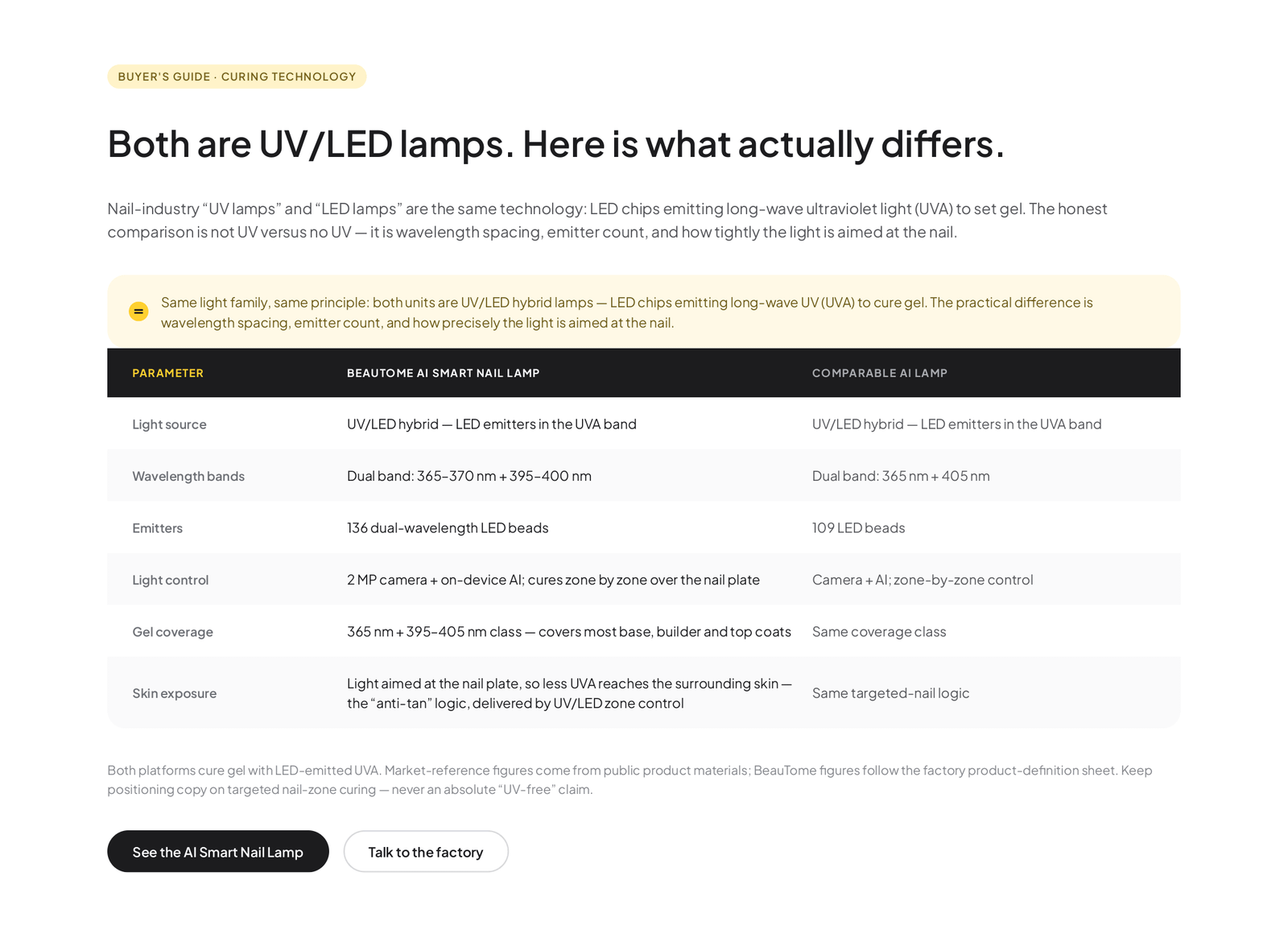
Same curing principle — the practical difference is wavelength spacing, emitter count, and how precisely the light is aimed at the nail.
First, clear up the naming: “UV lamp” and “LED lamp” are the same light source
In professional nail equipment today there is no separate “UV technology” and “LED technology”. Mainstream units — from entry salon lamps to AI-guided platforms — use LED chips that emit long-wave ultraviolet light (UVA) to cure gel. That is the UV/LED hybrid source the industry buys every day.
Two wavelength bands do the work: around 365 nm (the band classic UV gels were formulated for) and 395–405 nm (the band LED fast-cure gels rely on). A lamp that covers both bands works with the vast majority of base coats, builder gels and top coats on the market. So when a client says “UV lamp” and a buyer’s spreadsheet says “LED lamp”, they are describing the same physics — the difference lives in the spec sheet, not the science.
How AI-guided zone control changes the UV you actually deliver
Both the BeauTome AI Smart Nail Lamp and comparable AI lamps follow the same control logic: a camera reads the hand and nail contour, and the firmware drives the LED zones above the nail plate — light on the nail, far less UVA on the surrounding skin. That is the “anti-tan” positioning clients ask about, and it is delivered by UV/LED zone control, not by removing UV from the equation.
Light source
UV/LED hybrid on both sides of the comparison — LED emitters in the UVA band. Our platform documents it as a dual-wavelength LED array (365–370 nm + 395–400 nm); a comparable AI lamp (market reference) runs a similar dual band, 365 nm + 405 nm.
Emitters
136 dual-wavelength LED beads on the BeauTome platform versus about 109 on the market reference. More emitters is not automatically “better curing” — but it does mean finer zones and more even coverage across the hand.
Zone control
On both platforms a camera plus on-device AI reads the finger contour and cures zone by zone. Ours reads the nail area in about 0.2 seconds (2 MP camera, on-device NPU — no cloud, no app).
Heat management
Heat spikes remain the top client complaint in gel services. A low-heat ramp curve brings the energy up progressively — noticeably calmer on thick bases, high-pigment colors and extension work.
Client conversation
The professional positioning — used by the leading AI lamp brands — is “focused on the nail, gentler on the skin”. It is specific, defensible, and does not require claiming the lamp emits no UV at all.
Fleet operation
For multi-station salons, 29-language touchscreen firmware and a standard AC-powered build (optional battery on request) make one SKU deployable across markets and technicians.
How to talk about it without overclaiming
A warning for private-label buyers: resist the shortcut of marketing an LED lamp as “UV-free”. The 365–400 nm curing band is UVA-class light — knowledgeable buyers, retailers and regulators will read an absolute “no UV” claim as either ignorance or risk. The claims that survive scrutiny are the specific ones:
Say this
“Camera-guided curing that focuses light on the nail area.” · “Reduces unnecessary light exposure of the surrounding skin.” · “Dual-wavelength LED array tuned to major gel systems.”
Not this
“Contains zero UV.” · “Safe for unlimited exposure.” · “Replaces sunscreen.” Absolute health claims invite disputes — and they are simply not what the technology does.
Our own marketing follows the factory product-definition sheet: the platform is named AI Smart Nail Lamp, the light source is documented as a dual-wavelength LED array, and every performance statement maps to a testable specification. That is also the standard we recommend to our OEM partners when they write their own packaging copy.
Quick FAQ
So is an LED lamp a UV lamp?
In practice, yes — both names describe the same light source. Mainstream professional units cure gel with LED chips emitting UVA-class light; the industry simply kept the “UV lamp” nickname from the early tube era. What separates a basic unit from an AI-guided one is not the physics, it is the control: camera-guided zone curing, dose management and heat control.
Will our existing gels work?
The dual-wavelength array covers the standard UV/LED curing spectrum used by major gel systems, and the AI adjusts dose within that range. Send us your gel brand list and we will confirm the curing profile before you order.
How small can a first order be?
Neutral / white-label units start at 3–5 pieces (a single sample unit is fine for evaluation), and fully custom branding starts at 300–500 units per configuration.
See the difference on your own bench
The fastest way to evaluate camera-guided curing is a sample on your own bench with your own gels. Contact our dedicated account manager Miro Wu — email miro.wu@beautome.com or WhatsApp +86 188 1393 3019. You can also review the AI Smart Nail Lamp specification page or our OEM & ODM program first.