





AI Smart Nail Lamp for Russia and CIS Distributors: Language, Parameters and a Ladder from Sample to Own Brand
The nail equipment trade across Russia, Kazakhstan, Belarus, Uzbekistan and the wider CIS runs on distributors who know their channel: beauty retail chains, professional salon suppliers and a very large installed base of gel services. Selecting a vision-guided lamp for that channel is less about chasing the newest headline feature and more about four practical questions — does the interface speak to every technician, do the curing parameters hold up against the gel systems sold locally, what does the unit cost to keep in service, and how does a first container grow into your own brand. This guide works through each one.
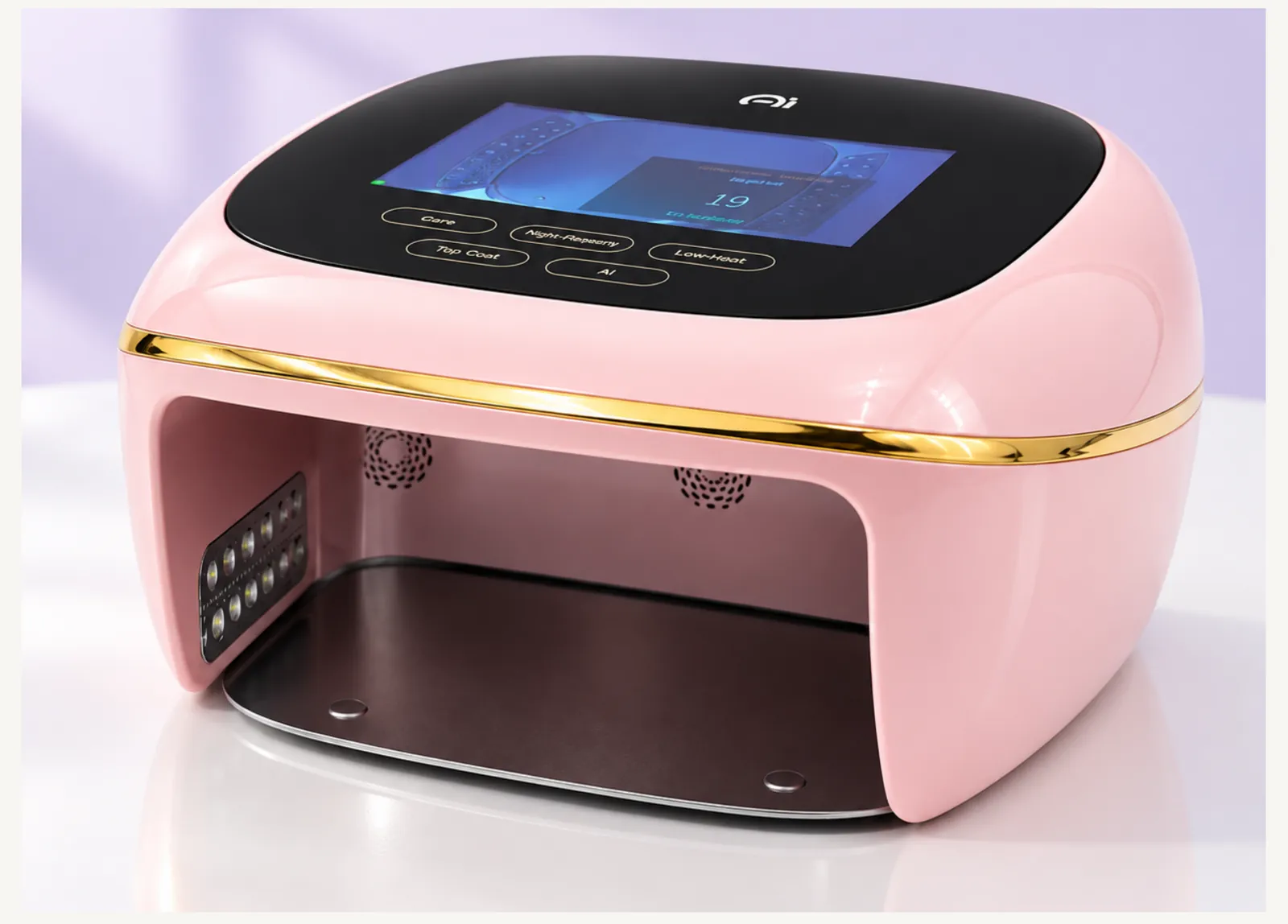
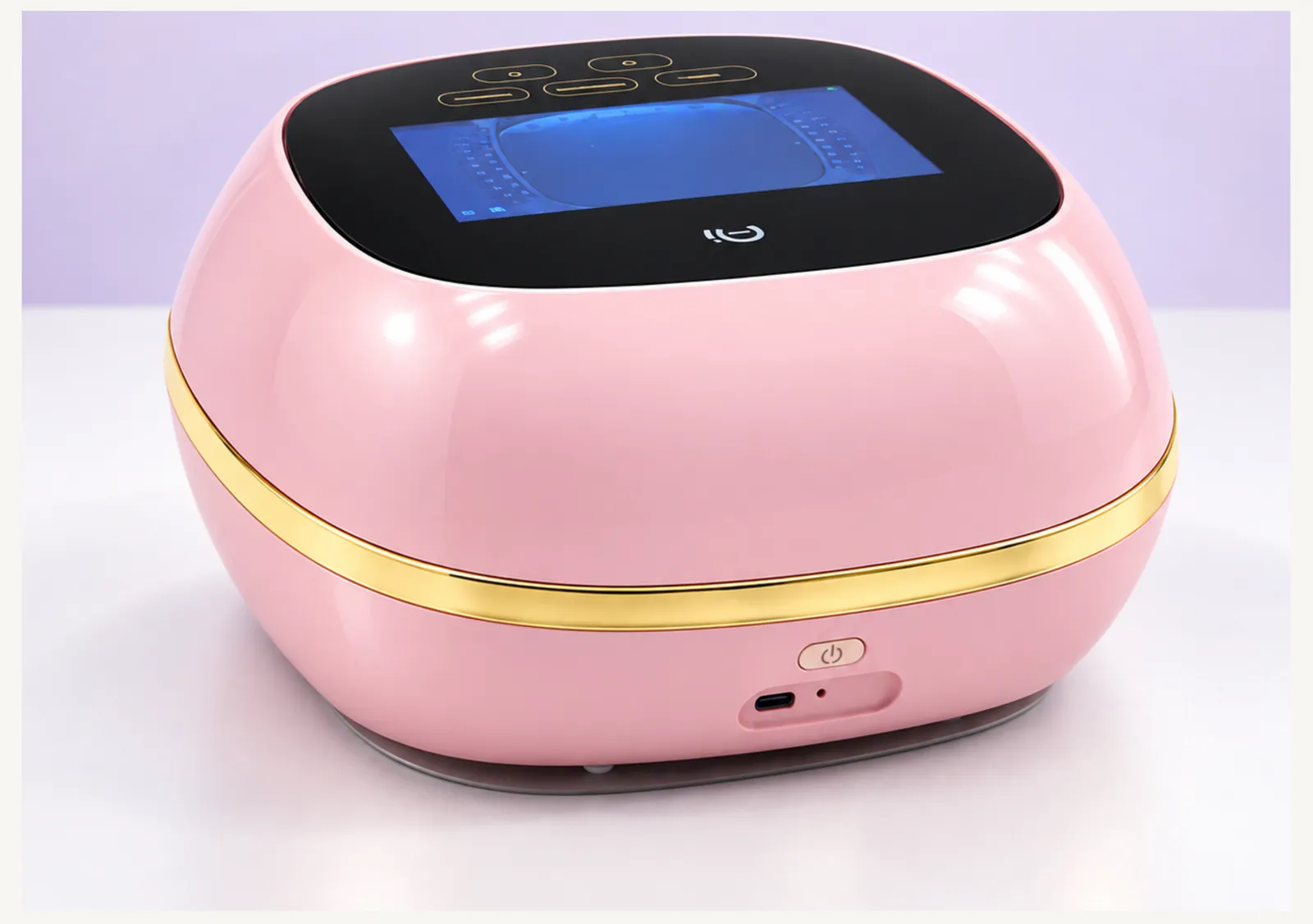
The AI Smart Nail Lamp: front and side LED arrays, 136 emitters across two UVA bands, camera-guided zoning.
What the CIS channel actually selects on
Distribution in the region is layered. A national importer sells to beauty retail; a professional distributor sells to salon chains and independent studios; and increasingly both carry a house brand. Whichever layer you sit in, the selection conversation converges on the same four points.
First, the interface. A lamp that only speaks English pushes training onto your clients. Second, the curing parameters — LED count, wavelength bands and how the light is delivered, because the local market runs an enormous variety of gel systems. Third, serviceability: what happens in month fourteen, when the unit has done a year of daily four-handed work. Fourth, the branding ladder — how a trial order becomes a labelled product on your shelf. Everything below maps to those four.
Same curing chemistry — the difference is control
It is worth being precise here, because your resellers will be asked about it at every counter. Professional gel nails cure because photoinitiators in the gel absorb long-wave ultraviolet light — UVA — and polymerise the coating. That is true of every lamp in the professional category: the units marketed as “UV lamps” and the units marketed as “LED lamps” both work by LED chips emitting defined UVA bands. We do not claim otherwise, and a distributor should be suspicious of any supplier who does.
What separates this lamp is where the light goes. A conventional unit floods a fixed area for a fixed time, so the fingertip, knuckle and surrounding skin receive the same dose as the nail plate. A camera-guided lamp maps each nail and lights only the segments that matter, which reduces unnecessary light exposure of the surrounding skin. That is an honest, demonstrable advantage — and an easy demonstration to run on the shop floor of any wholesale showroom.
The parameters to put on your quotation sheet
The AI Smart Nail Lamp carries a 2 MP camera with an on-device neural engine rated at 0.5 TOPS. A hand goes under the head, the model locates each nail in roughly 0.2 seconds, and the array responds dynamically — no timer buttons, no repositioning, no missed little finger. The lamp houses 136 LEDs across two wavelength bands, 365–370 nm and 395–400 nm, with front and side arrays so four nails plus a thumb cure evenly without the client rotating the hand.
For comparison context on the category: the first wave of vision-assisted lamps published specifications around 109 LEDs covering 365 nm and 405 nm from a single front-facing array. The two-band, front-and-side architecture is the parameter set worth quoting when your retail partners ask what has changed — broader photoinitiator coverage across gel brands, and more even delivery across the hand.
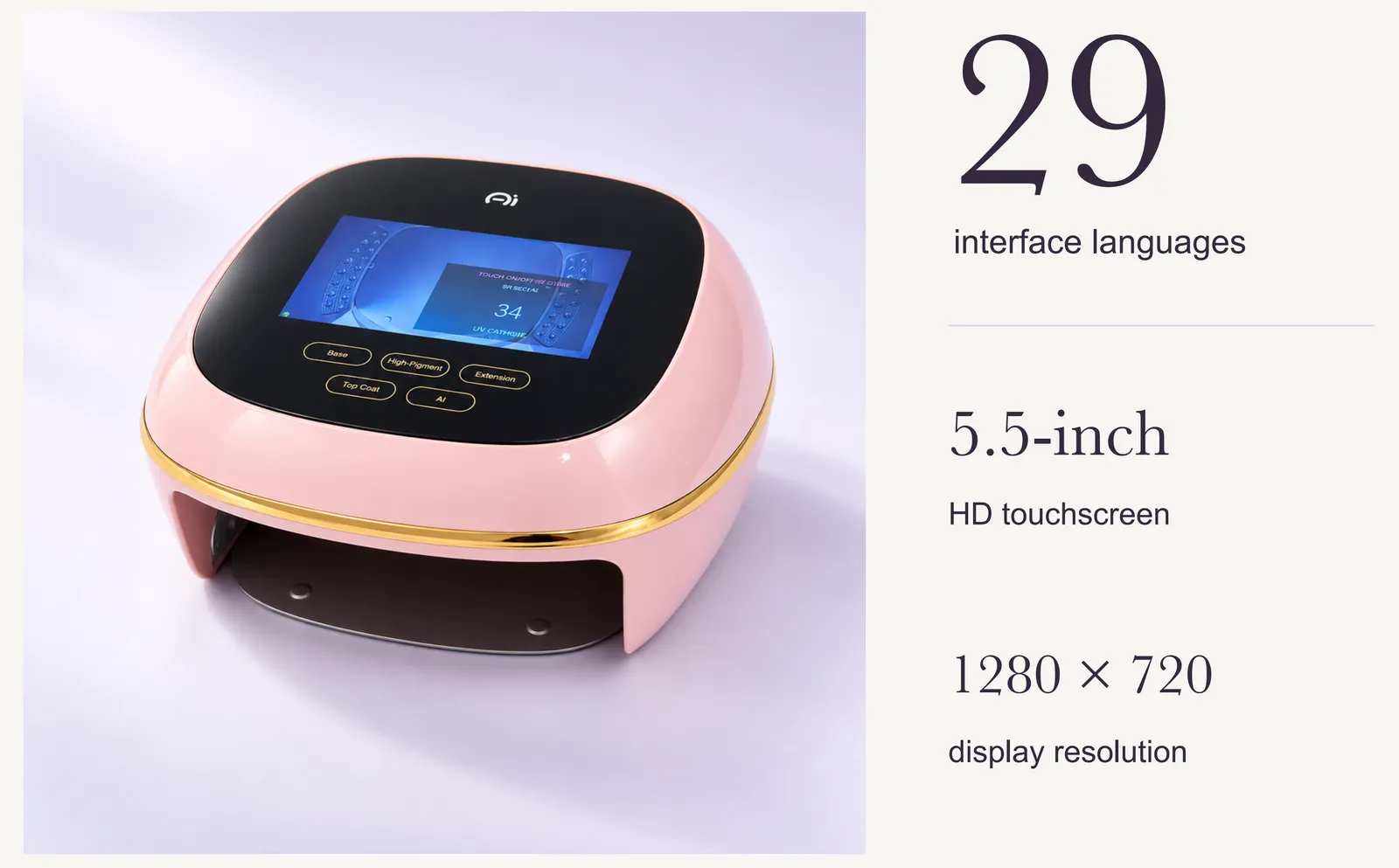
The 5.5-inch, 1280×720 touchscreen runs 29 interface languages — one SKU across the whole CIS region.
One SKU for a multilingual region
The 5.5-inch touchscreen runs 29 interface languages, Russian included, which is the single most commercial specification on the unit for CIS distribution. A lamp that a technician from Moscow to Almaty can operate in her own language removes the training cost that usually kills mid-range equipment launches: no printed Russian manual to maintain, no video tutorials to produce, the screen is the training document. Tempered glass also survives the alcohol-based disinfection routines of a busy salon — the detail your service department will thank you for in year two.
Power, service and after-sales reality
Standard configuration is AC powered, supplied without a battery, which suits fixed salon sites and keeps the unit price down for volume orders; a 6000 mAh battery version is optional for mobile technicians and event work. The lamp ships in a compact form factor — roughly 24×24×11.5 cm — which keeps freight and shelf costs civil on a container programme. Confirm the plug type for each destination market when ordering, and put a light-decay warning to work in your after-sales model: the lamp alerts the salon when the array drifts out of specification, which turns a vague “gels not curing” complaint into a clear maintenance ticket instead of a warranty dispute.
Rear detail: power control and USB-C port. Standard configuration is AC powered; the battery version is optional.
From one sample to your own brand
The commercial ladder is deliberately short. Evaluate with a single sample unit; start neutral-brand resale at 3–5 pieces; move to your own branding from 300 units for a silk-screen logo on the standard colourway (matte white shell with purple chrome trim), with custom shell and trim colours from 500 units and printed retail boxes from roughly 500 pieces. Early orders can ship in the standard box with multi-language manuals while your packaging is in production, so branding never delays a launch. The OEM framework behind these terms is set out on the OEM & private label page.
Next step for CIS buyers
Full specifications, packaging options and the accessory list are on the AI Smart Nail Lamp product page. If your team is still comparing lamp categories, the explainer on curing principle versus light control is written to be forwarded to resellers, and regional sourcing guides for other markets sit in the market insights hub.
For a sample unit, a wholesale quotation or a private-label plan for Russia and the CIS, contact Miro Wu, Dedicated Account Manager — email miro.wu@beautome.com or WhatsApp +86 188 1393 3019.