






AI Smart Nail Lamp for Saudi Salons: 60 Hz Power, SABER and a Console Built for the Rush Season
Saudi Arabia is the Gulf’s largest nail market and one of the few where demand arrives in waves: quiet weeks, then Ramadan, Eid and the wedding season back to back. Two things break a chain rollout here that have nothing to do with the lamp’s price — a 60 Hz grid that most spec sheets quietly ignore, and a two-certificate import route that only the Saudi importer can open.
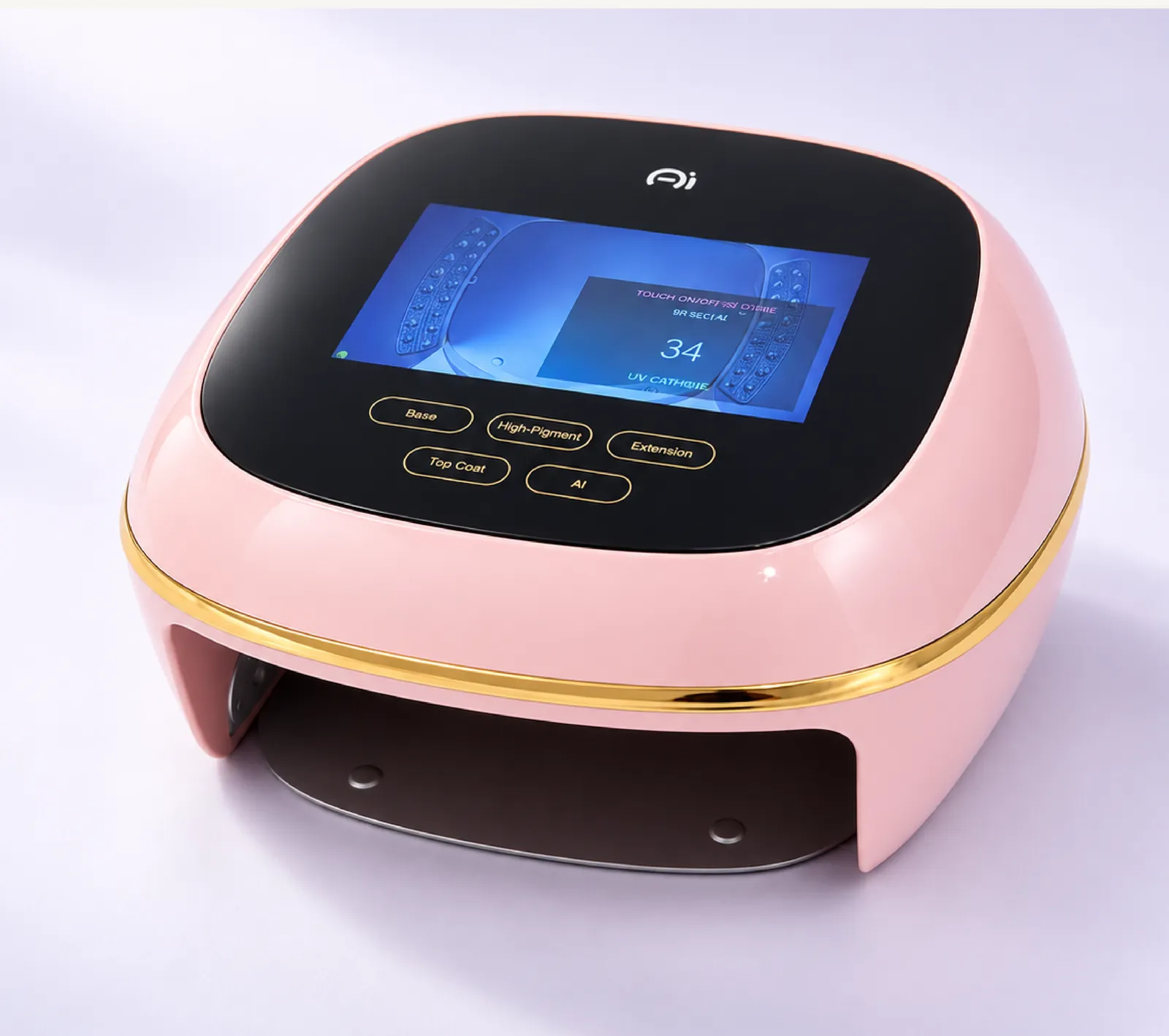
The AI Smart Nail Lamp — a 5.5 inch console, a 2 MP camera and 136 dual-band LEDs in one compact body.
A market that buys in seasons, not in months
TechSci Research puts Saudi Arabia’s nail care market at USD 663.95 million in 2025, rising to USD 953.08 million by 2031 at a 6.21% CAGR (TechSci Research, 2025). The professional side is where the equipment spend sits: IndexBox estimates the Kingdom’s gel polish retail value at SAR 800 million to 1.1 billion (roughly USD 215–295 million) in 2025, with soak-off gel at 70–75% of volume and a professional salon base of 18,000–22,000 outlets (IndexBox, 2025).
USD 664 M
Saudi nail care market, 2025, forecast to USD 953 M by 2031 (TechSci Research, 2025)
18–22k
Estimated professional salons using UV-cured gel across the Kingdom (IndexBox, 2025)
+25–35%
Typical salon-visit lift during Ramadan, Eid and wedding season (IndexBox, 2025)
That last number is the operational one. A chain that runs 80 chairs in Riyadh and Jeddah does not need 80 lamps in January — it needs 80 lamps that all behave identically in the three weeks when every chair is booked and no technician has time to troubleshoot. Consistency is the product being bought. The lamp is just how it is delivered.
60 Hz: the spec that is missing from most quotations
Saudi Arabia runs a 230 V nominal supply at 60 Hz, usually written as 220 V in trade documents, on BS 1363 (type G) sockets. Almost every lamp on the market is designed around 50 Hz and described as “220–240 V” without a frequency figure. For a switch-mode driver that is usually harmless. For anything with a motor, a transformer or a timing circuit referenced to mains frequency, it is not.
So ask for the boring document, in writing, before the purchase order: the rated input range including frequency, stated as 220–240 V, 50/60 Hz. Then check that the safety test report covers the same range. A certificate issued only at 50 Hz is not wrong — it is simply describing a different operating condition from the one the salon will create, and that gap is what a customs laboratory or an insurance assessor will find later.
Two smaller electrical details matter as much. Specify the plug geometry at order time, because a type G adaptor in a salon drawer is a resistance point under continuous load. And ask what the driver does on restart after an outage: a lamp that comes back cleanly is worth more in a mall with generator changeover than one that needs to be unplugged and reset while a client waits.
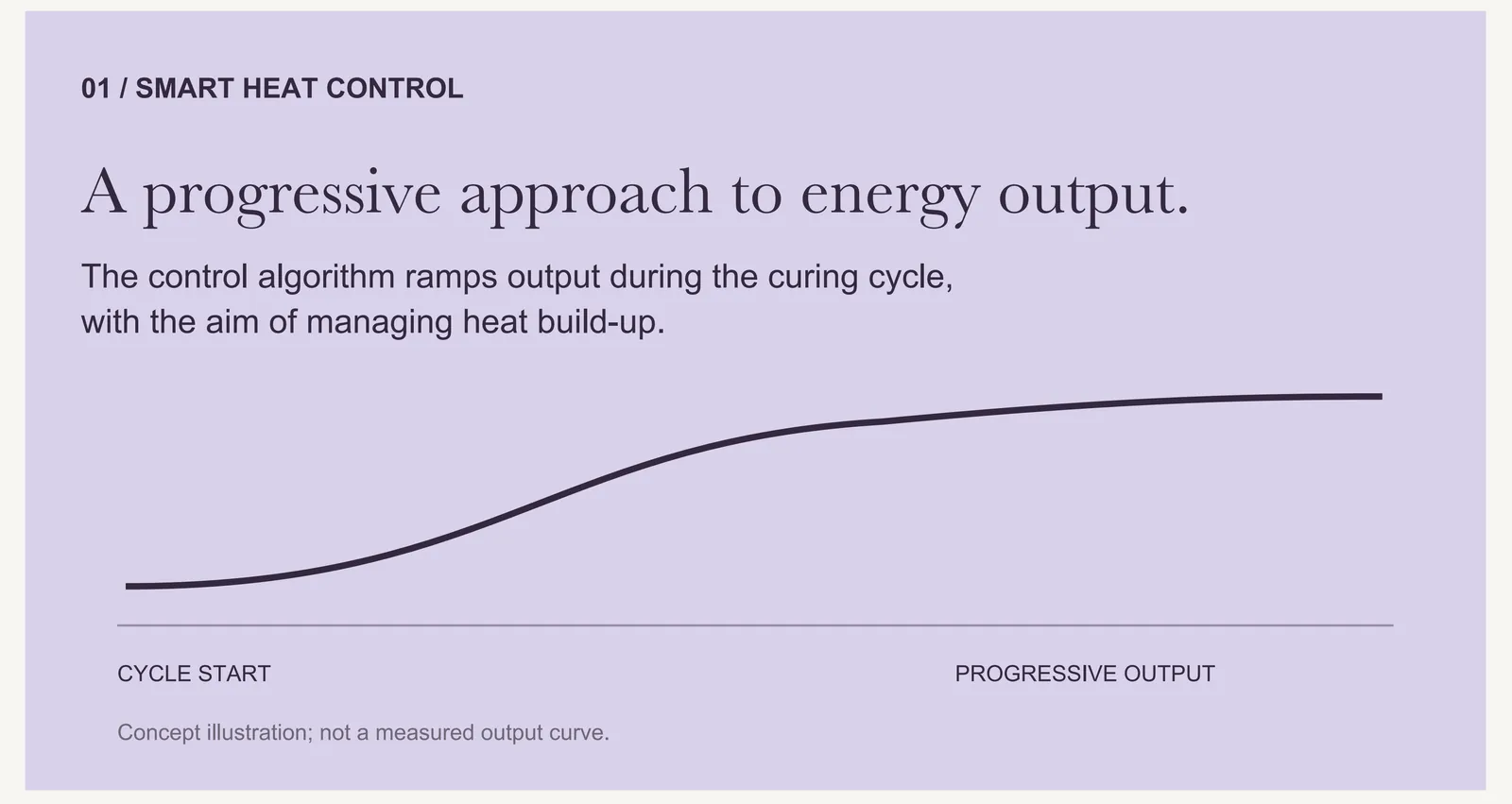
Thermal control and a light-decay warning — the two readouts that matter when ambient temperature sits above 40 °C.
SABER: two certificates, and only your importer can file
Electrical appliances enter Saudi Arabia through SABER, which issues two separate documents. The PCoC (Product Certificate of Conformity) is product-level, typically valid for one year, and covers a model across multiple shipments. The SCoC (Shipment Certificate of Conformity) is per consignment, applied for before the goods arrive; a certificate applied for after arrival does not rescue the container. Since 1 January 2025, the older undertaking-letter route is no longer accepted, and applications must be initiated by a company registered in Saudi Arabia — in practice the importer, not the factory (SASO/SABER guidance as summarized by certification bodies, 2025).
Technically, household electrical appliances are assessed against the SASO IEC 60335 series, with EMC requirements alongside. Risk classification decides whether a model needs a self-declaration, a type-test file, or factory inspection — which is exactly why the classification conversation should happen before the price conversation. Labeling is bilingual: Arabic and English warnings on the product and the packaging, with the country of origin marked, and the model reference on the nameplate matching the certificate character for character.
What we can hand your importer is the technical file: test reports, bill of materials, circuit and layout documentation, nameplate and packaging artwork, and a model declaration. What we cannot do is file in their name. Plan four to six weeks for the product certificate and a few working days per shipment certificate, and do not announce a launch date before the PCoC number exists.
What the rush season actually tests
When bookings rise by a third for three consecutive weeks, three things fail first: throughput, cure consistency, and the technician who is suddenly working on a client type she has not been trained for.
The AI Smart Nail Lamp addresses them in one mechanism. A 2 MP camera with 0.5 TOPS of on-device compute locates the nails in about 0.2 seconds; the lamp then lights only the zones above them, using 136 dual-band LEDs at 365–370 nm and 395–400 nm, instead of flooding the whole hand for the full cycle. For the client, that means less unnecessary light on the skin around the nails — the mechanism behind the anti-tanning question Saudi clients ask most often. It is not a zero-UV claim, and it should never be sold as one: the lamp cures by LED chips emitting UVA in defined bands, the same principle as any gel lamp. The difference is where the light is pointed.
For the chain, the same mechanism is a throughput tool. A technician does not have to reposition the hand three times, and a junior does not have to judge exposure by feel. Add the 5.5 inch touchscreen with 29 languages — Arabic is on the list, but confirm rendering and right-to-left layout on a physical sample before you print training material — and onboarding becomes a menu rather than a week of shadowing. The body is 24 × 24 × 11.5 cm.
Heat is the other seasonal variable. In a mall unit where the air conditioning is fighting a 45 °C afternoon, a lamp that reports its own thermal state and warns when LED output has decayed is doing maintenance work that nobody has time to do manually. Under-cured sets in the peak week are not a quality complaint; they are a refund, a review and a lost rebooking.
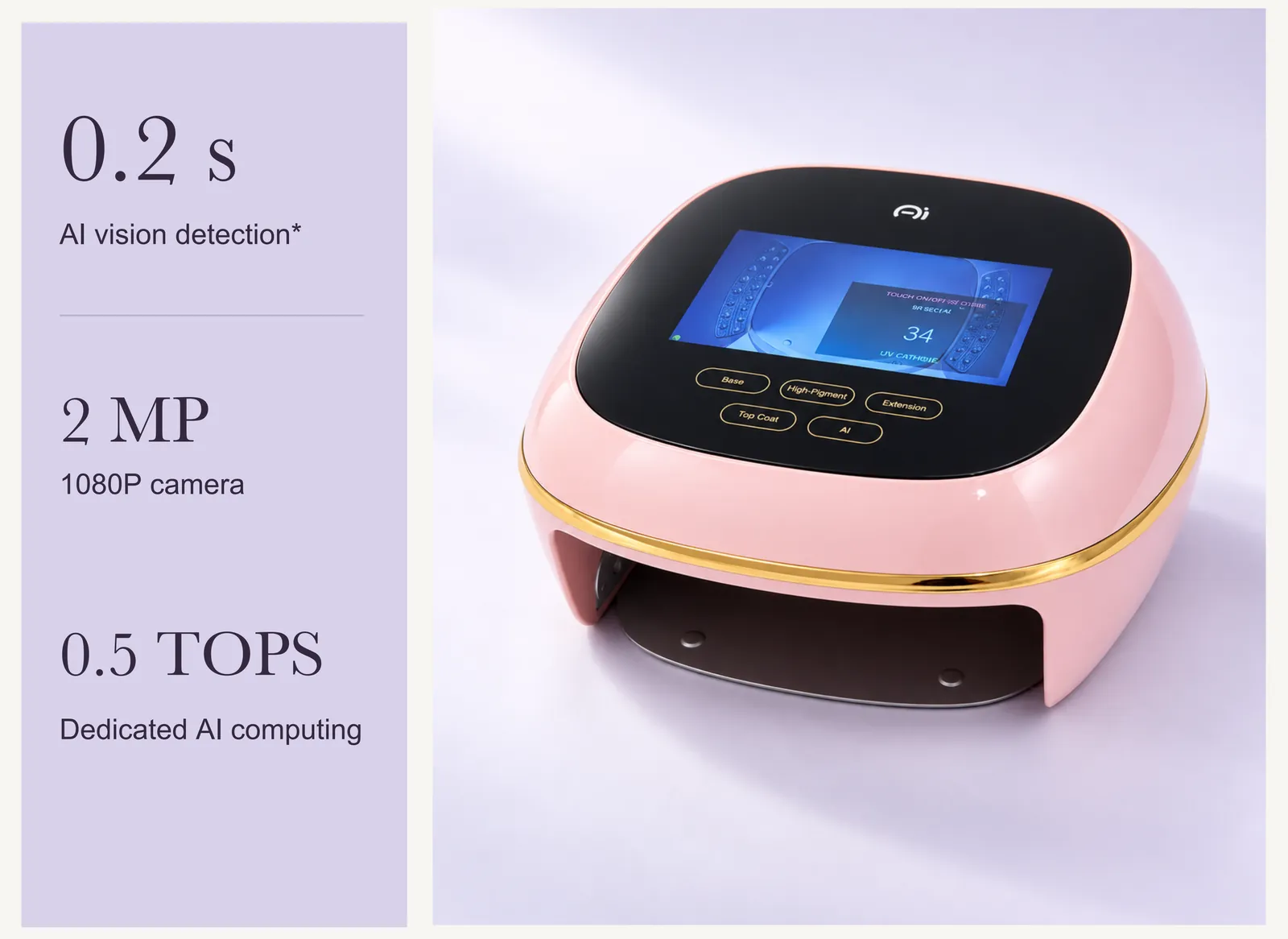
Vision detection in 0.2 seconds — the step that decides which LED zones switch on.
Power options and the commercial ladder
Standard shipments are AC powered and ship without a battery. A 6000 mAh lithium version is available on request, and in Saudi it earns its place in two situations: mall units with generator changeover, and home-service or majlis setups where there is no dedicated circuit at the chair. Quote it as a separate line rather than bundling it — most chains want AC for the back bar and a handful of battery units for mobile work.
The entry points are deliberately low. White-label and neutral units start at 3–5 pieces, and a single sample unit can ship for evaluation. Custom branding — logo, colorway, retail packaging — starts at 300–500 units. For a Saudi distributor the sensible sequence is one sample on a real chair in Riyadh, then a 3–5 unit trial across two branches, then a branded order once the SABER file is settled.
Quick FAQ
Can the factory apply for SABER certification on our behalf?
Is the lamp rated for a 60 Hz supply?
Can we start with one unit before committing to a chain order?
Next step
Tell us how many chairs you are specifying, which cities they sit in, and whether the branding is yours or neutral, and we will send the model sheet, the stated input range and the document list your Saudi importer will need for SABER. Specifications are on the AI Smart Nail Lamp product page; the curing principle is explained alongside conventional lamps in this comparison; private-label routes are on the OEM and ODM page. For a sample unit or a chain quotation, contact Miro Wu, Dedicated Account Manager — email miro.wu@beautome.com or WhatsApp +86 188 1393 3019.