




AI Smart Nail Lamp for Swiss Studios: Type J, Three Languages and the Recycling Line
Switzerland is small, concentrated and expensive to run. A registry scrape from April 2026 counts 1,502 beauty salons in the whole country, and three cantons hold more than four out of five of them. That is not a market you enter with a volume argument. It is a market where three unglamorous details decide whether a lamp can be sold at all — the shape of the plug, the language on the console, and a recycling contribution that never appears on a quotation.
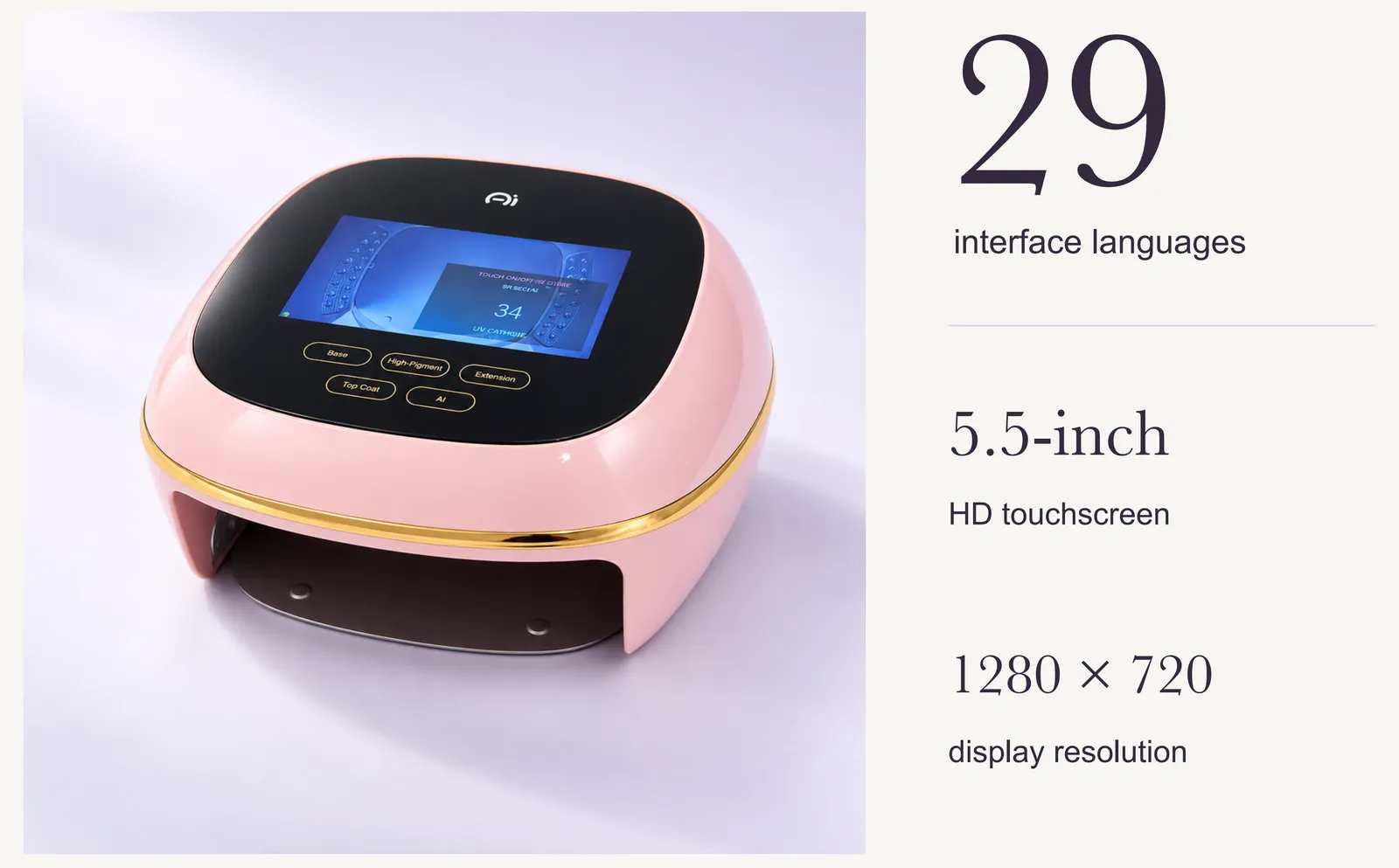
The console is the part of the lamp a Swiss buyer will actually touch on a demo — in the language of whoever is on shift.
A market of 1,502 salons, four fifths of them owner-run
The same April 2026 dataset puts 87.48% of Swiss beauty salons under single ownership and gives an average business age of five years and three months (Rentech Digital, April 2026). Canton Zürich holds 509 salons, Geneva 408 and Vaud 343 — roughly 84% of the national stock inside three cantons, one of which is French-speaking and one of which runs a mixed French-German border trade.
Nail-specific counts depend heavily on definition. The same registry tracks 774 nail salons with an online presence, while a separate business database lists just over 5,000 nail businesses nationally (POIData, May 2026) because it also captures home studios and one-chair rooms that never built a website. The gap between the two numbers is itself the point: a large share of Swiss capacity sits in rooms too small to appear in a directory, and those rooms buy one or two lamps at a time.
What follows from that structure is a buying process that looks nothing like a chain tender. The decision-maker is the owner, the evaluation happens on her own bench, and the questions are practical: does the lamp run on the socket in the wall, can the person on shift read the menu, and what does it cost to put on the shelf in a country where everything imported carries a surcharge.
1,502
Beauty salons in Switzerland, 87.48% single-owner, average age five years three months (Rentech Digital, April 2026)
84%
Share of salons in Zürich (509), Geneva (408) and Vaud (343) — two language regions in three cantons (Rentech Digital, April 2026)
230 V
50 Hz on type J sockets to SN 441011 — a plug geometry found nowhere else in Europe
One: the plug is a moulded part, not an adapter
Swiss sockets take the type J plug defined by SN 441011, the standard that replaced SEV 1011 and has applied since 2022: three pins in a flat hexagon, 10 A in the common T12 and T13 variants, with 16 A versions for heavier loads. It is not compatible with Schuko, with the French type E, or with the Italian type L, and every one of those sits within a two-hour drive of Zürich.
This matters at the order stage for a reason that has nothing to do with safety. A salon cannot legally or practically run a professional appliance through a travel adapter on a bench that sees twenty clients a day; the adapter gets lost, overheats, or fails a landlord’s inspection. The cord set has to leave the factory with a moulded type J plug, and that plug is itself a certified component. Put it on the purchase order as its own line — “230 V, 50 Hz, type J moulded, 10 A” — rather than as a note in an email. If the same order also ships to France or Germany, split the cord sets by destination instead of shipping one compromise cable for all three.
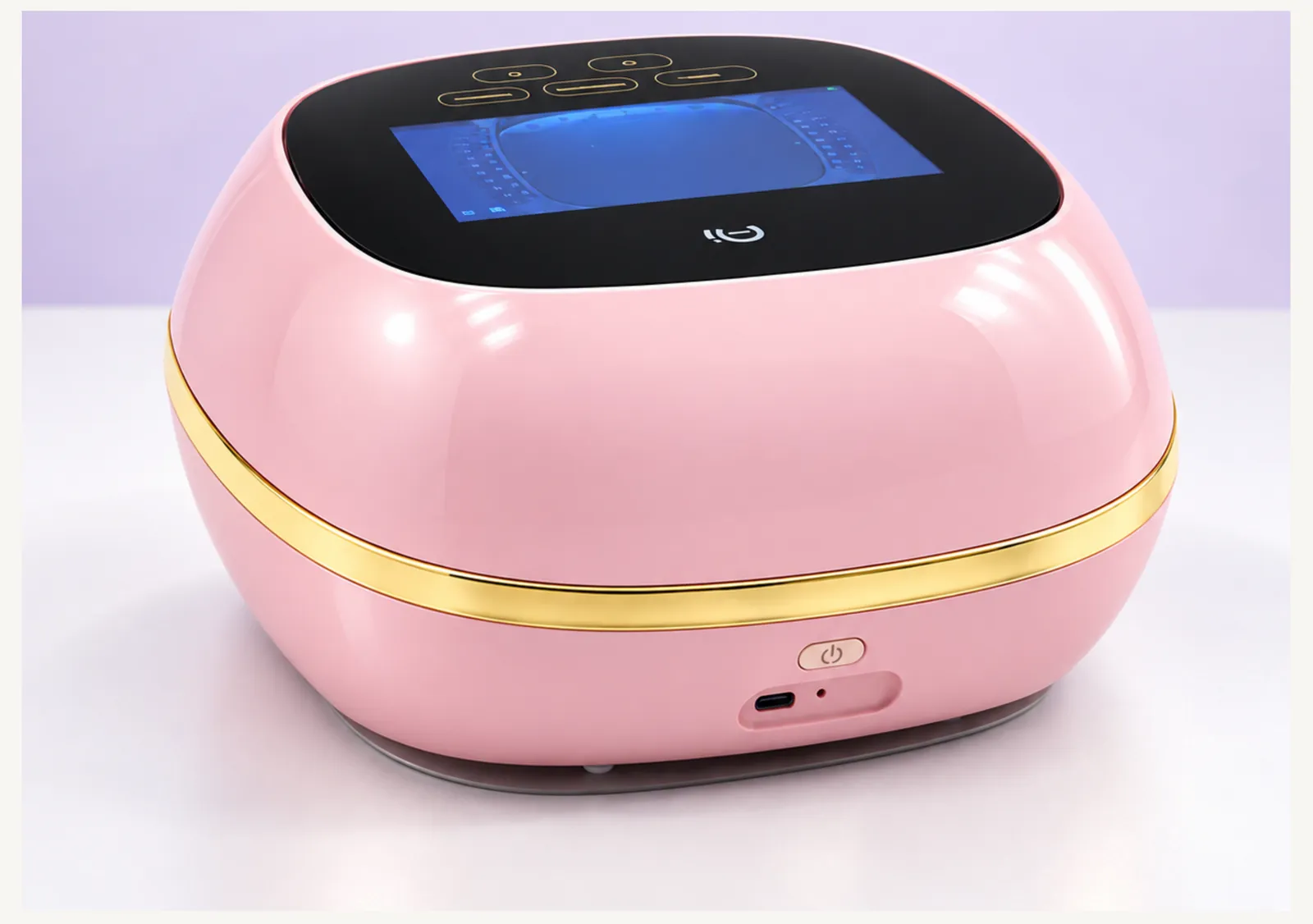
A detachable inlet is what makes one platform serve three plug regions without a second SKU.
Two: three languages, one console, and a team that crosses borders
German, French and Italian are the three official languages used in commercial documentation; Romansh is national but rare on a shop floor. In practice a salon in Geneva may have a French-speaking owner, a Portuguese-speaking technician and a German-speaking client, while a Zürich studio recruits across the German border and a Ticino studio hires from Italy. Staff turnover in a high-wage market is expensive precisely because a new technician takes weeks to reach full speed.
That is where a 29-language console stops being a specification and becomes an operating tool. The lamp menu, the curing presets and the heat and light-decay warnings can all be read by the person holding the hand, in the language she thinks in, on her first day. Ask for the language pack to be locked at the factory to the two or three languages a studio actually needs, and ask for the printed quick-start card in the same set — a screen that a new hire can read is cheaper than a training afternoon.
Two smaller points belong on the same page of the order. First, the manual and safety information have to reach the user in a language she reads; for a Swiss importer that usually means German, French and Italian documentation as a set, not a single English booklet with a translation sheet. Second, the console is a 5.5-inch panel on a 24×24×11.5 cm body — check that the text at the smallest language setting is still legible under salon lighting, because a menu that needs reading glasses will be left in English.
Three: the file Switzerland actually asks for
Switzerland is not in the EU, but it is close enough that the same technical work carries over. Low-voltage equipment placed on the Swiss market falls under the Low-Voltage Electrical Products Ordinance (NEV, SR 734.26), with ESTI as the federal inspectorate. Because a mutual recognition agreement covers electrical equipment, a CE declaration of conformity backed by a technical file is normally the working route — the lamp’s LVD, EMC and RoHS documentation is the same document set a German importer would ask for, with two Swiss additions: the plug, and the instruction languages.
There is one commercial question that is not settled by the directive. Some Swiss channels ask for the ESTI S+ safety mark on top of the CE declaration, and some do not. Get the answer from the importer in writing before the rating plate and carton artwork are tooled, because adding a mark later means a new plate and a new carton.
The line that catches almost every first-time exporter is different, and it is financial rather than technical. Under the Ordinance on the Return, Taking Back and Disposal of Electrical and Electronic Equipment (VREG, SR 814.620), whoever first places an appliance on the Swiss market owes a free take-back obligation and pays an advance recycling contribution, collected through the SENS eRecycling system and passed down the chain to the end user. For an own-brand product, the brand placing it on the market counts as the producer even when the factory is on the other side of the world. Put the contribution into the landed-cost sheet before you quote a retail price: it is small per unit, but it is a permanent line, and a distributor who discovers it after signing will renegotiate everything else.
Where the light actually lands
The clinical argument in a Swiss studio is not about curing speed; gel polish cures in a lamp at any price. It is about the twenty minutes a technician spends with a client’s hand under a head that is also lighting the back of that hand. The AI Smart Nail Lamp carries 136 dual-band emitters at 365–370 nm and 395–400 nm, the same UVA curing principle as any professional LED lamp in the category. What differs is where the output goes: a 2-megapixel camera with 0.5 TOPS of on-device compute locates the nails in about 0.2 seconds and drives only the zones above them, so the surrounding skin of the hand receives less unnecessary exposure over a working week. Clients who are worried about their hands darkening ask about it directly, and a technician who can point at the zones has an answer that a flat always-on array cannot give.
Smart heat control belongs in the same conversation. The console reports head temperature and flags light decay, so a technician sees a warning before a set under-cures and a client feels a heat spike. On a market where a redo costs a full slot in a booked week, that warning is worth more than a marginally higher peak irradiance figure.
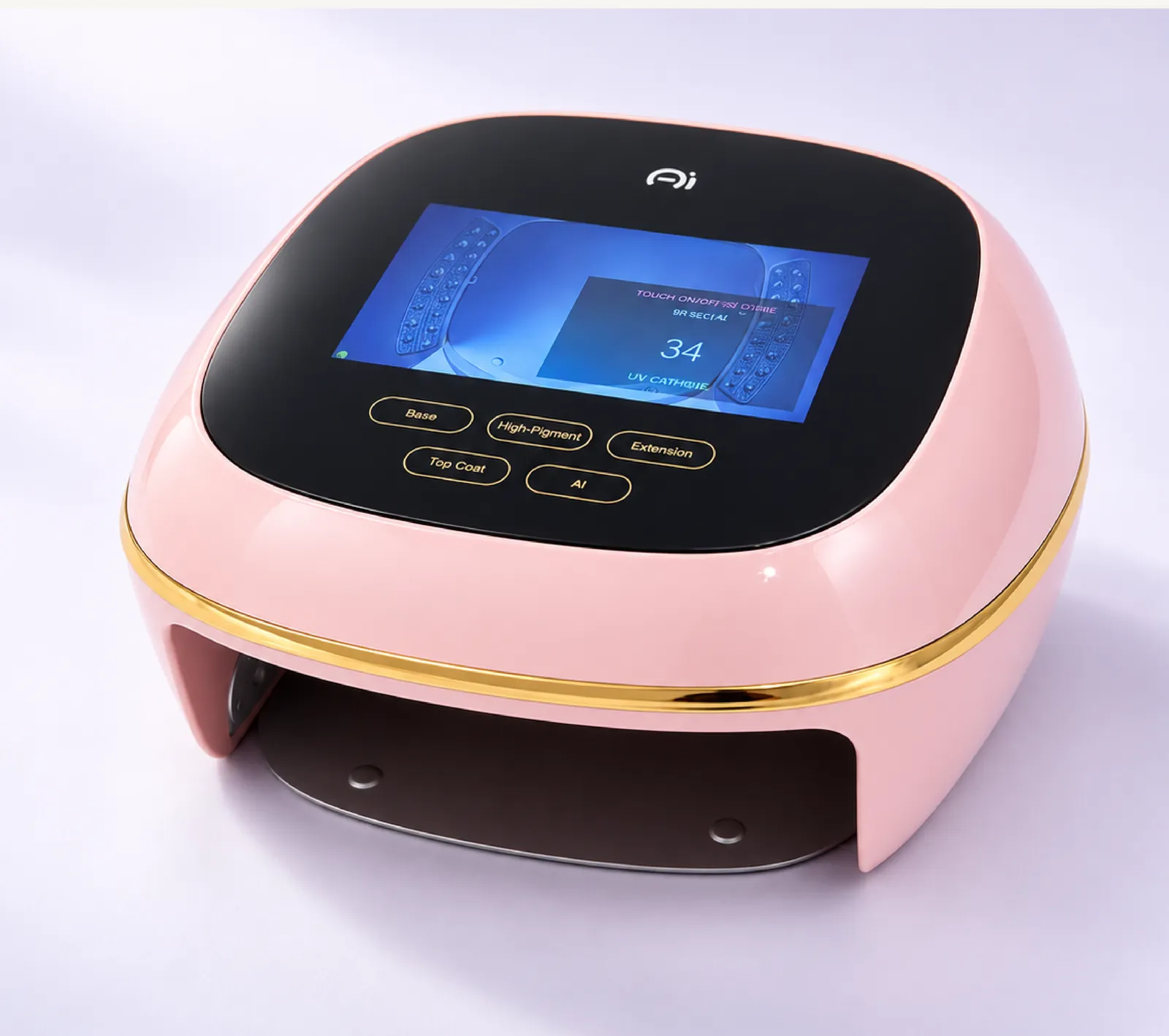
24×24×11.5 cm, rear power inlet, detachable cord — the housing is what makes three plug regions one platform.
What goes on a Swiss order
Five lines do most of the work: the model number exactly as it appears on the rating plate; the cord set (230 V, 50 Hz, type J moulded, 10 A); the language pack locked on the console plus the three-language document set; the S+ mark question answered in writing; and the recycling contribution declared by whoever places the product on the market. White-label units — no logo, no retail carton — start at three to five pieces and a single unit can ship as a paid sample, which is exactly what a demo in a one-chair studio needs. Full custom branding starts at 300–500 units. Standard units are AC-powered with no battery; a 6,000 mAh pack is available on request for mobile technicians who work in clients’ homes.
The full parameter set sits on the AI Smart Nail Lamp product page, the branding ladder is set out under OEM and ODM, and the curing-principle comparison with ordinary LED lamps is in this technical note.
Quick FAQ
Can we ship one cord set for Switzerland, France and Germany?
Is a CE declaration enough for Switzerland, or do we need a separate approval?
Who pays the Swiss recycling contribution on a private-label lamp?
Next step
Send us the canton you are selling into, the socket on the wall and the two lamps you are currently comparing, and we will come back with the model’s irradiance report, the document set and a demo unit with the right cord set. Sample orders ship from three to five pieces, one unit at a time if that is what the decision needs. For a quotation, contact Miro Wu, Dedicated Account Manager — email miro.wu@beautome.com or WhatsApp +86 188 1393 3019. More market notes sit on the BeauTome blog.