





Wax Warmer Capacity Planning for French and Benelux Studios: How Many Pots Does a Treatment Room Need?
Most equipment mistakes in professional waxing are capacity mistakes, bought the wrong way round. A studio buys one large pot because it looks like better value, then discovers its technicians are reheating wax all afternoon; or it buys a shelf of small pots and spends the week refilling them. In France, Belgium, the Netherlands and Luxembourg — where a full-leg hard wax service is a standard menu item and studio real estate is expensive — the pot plan is worth an hour of arithmetic before the first order. Here is the arithmetic.
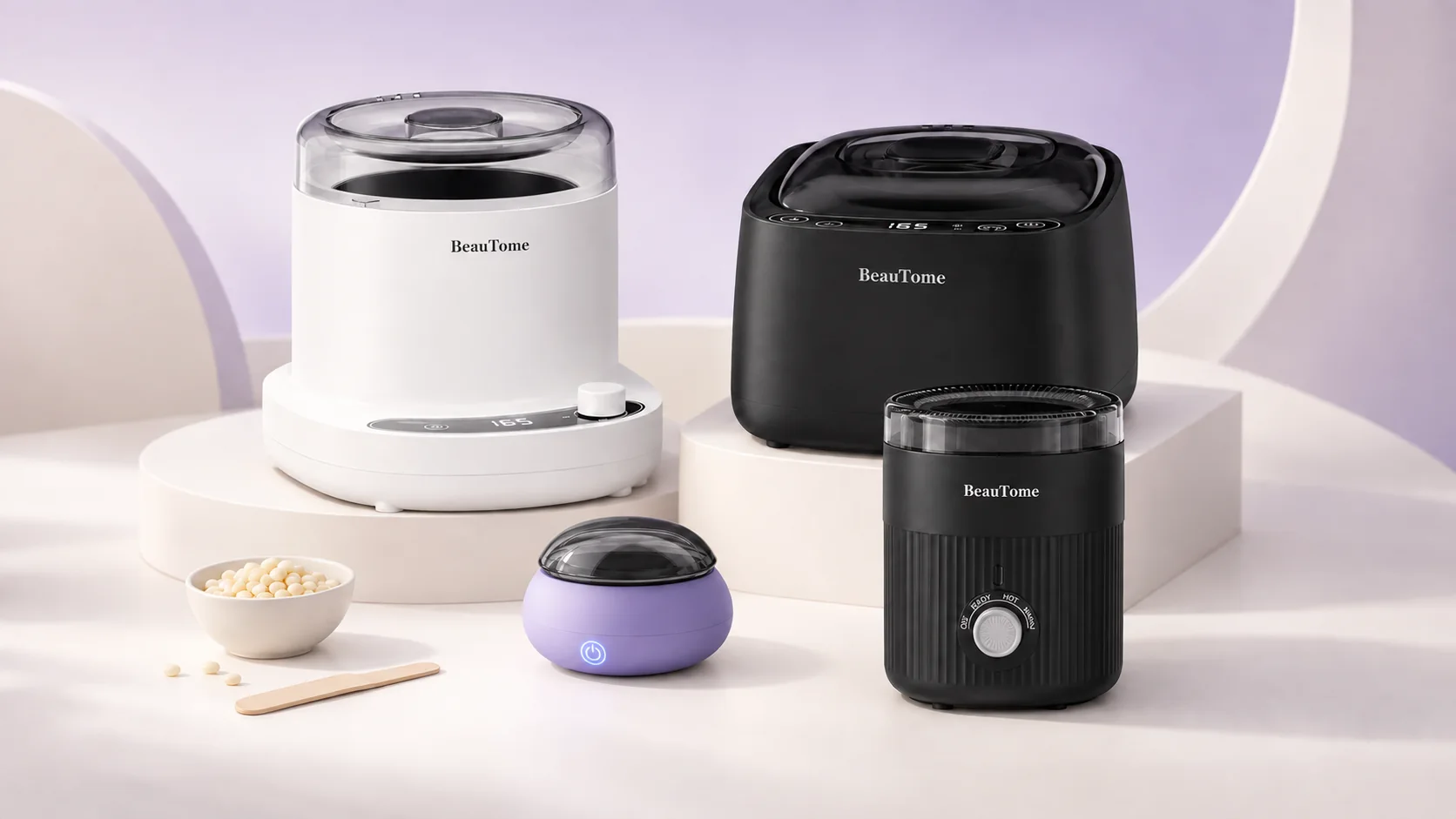
One platform, ten units: the size ladder from 20 ml detail work to 800 ml back-bar volume, plus dual-pot stations.
Start from the service list, not the catalogue
Capacity planning fails when it starts with products instead of services. Write down what the room actually sells in a week, and group it into three workloads.
Detail work — eyebrows, upper lip, fingers, touch-ups between full services — consumes millilitres, not grams. A small pot, melted fresh for each client, is more hygienic in the client’s eyes and more honest in yours: most of a large pot’s contents never get used in a day of brows. Zone work — underarms, bikini, forearms — sits in the middle. Full-body and full-leg work, the backbone of French and Benelux studio menus, is where volume lives: a full-leg service alone can consume a meaningful share of a small pot, and a day of four or five full-body clients will empty anything undersized.
The capacity ladder, mapped to the room
A professional range should be read as a ladder of working volumes. The BeauTome platform runs from 20 ml to 800 ml across nine chip-controlled models, plus the BWW5K entry unit with a 450 ml aluminium pot and a single 30–125 °C knob — ten platforms in total.
In practice: a mini class unit (well under 200 ml) per treatment bed covers brows, lips and touch-ups without holding melted wax all day; a mid-class pot covers the zone-work menu of a one- or two-bed studio; a large pot (500–800 ml class) belongs in a studio running full legs all day, where the pot must hold working temperature across a back-to-back schedule; and the 180 ml PW8 — precise 30–145 °C knob control, detachable power cord, 110–220 V — is the unit that travels between rooms or into clients’ homes. Several models in the line use graphene heating for fast, even warm-up, which matters more than raw wattage when the first client of the morning is already on the bed.

A single-pot unit covers the zone-work menu of a one- or two-bed studio — the workhorse tier of the ladder.
The dual-pot case: two waxes, two temperatures
Here is where most single-pot studios lose money without noticing. Hard wax and soft wax want different working temperatures — and a studio that offers both on one pot either holds the wax too cool for one product or too hot for the other, stretching service times and degrading the wax. A dual-pot station holds hard wax and soft wax at two independent temperatures on the same footprint, so the technician switches products, not settings, mid-service.
For a two-bed studio doing mixed menus, the dual station is usually the better buy than two separate single pots: one socket, one service surface, and a technician who never walks across the room to change wax.

A dual-pot station: hard wax and soft wax at two independent temperatures on one footprint.
The throughput math, in one table
Capacity planning is really a reorder question: how fast does wax leave the pot, and how often does someone stop service to refill or remelt? Three numbers settle it.
Clients per day per bed. A full-leg service is the heaviest consumer on the menu; brows and lips are nearly free in wax terms. Grams per service. Zone work runs on tens of grams; full-body work runs into the hundreds. Effective pot volume. A pot is never used to the last gram — technicians remelt, top up and discard at day’s end, so a 500 ml pot is not 500 ml of billable wax. Run those three numbers against your price list and the fleet size falls out on its own: most one-bed studios land on one mid pot plus one mini; three-bed mixed-menu studios land on one dual-pot station plus a mini per bed for detail work; high-volume full-leg studios run a large pot per bed with a shared mini station.
The profit side is the same arithmetic in reverse. When the pot is correctly sized, the technician’s only waiting time is the client’s — and every minute of remelting taken out of a service is a minute returned to the schedule. At typical French and Benelux service pricing, the recovered time from one properly specified station pays for itself quickly; the wax savings from not overheating and discarding product are the quiet second win.
A five-line fleet checklist
Before ordering, put the plan on one line per bed: service mix (zone or full-body), pot class (mini / mid / large / dual), control type (chip-controlled set points for consistency, single knob for entry tiers), portability (detachable cord for mobile and room-to-room work), and branding. On that last line — the whole fleet can carry your own brand: custom branding starts at 300 units for a silk-screen logo on the standard colourways, with custom colours and retail packaging quoted against volume. A distributor building a house brand across Benelux or France can put the same logo on every pot in the ladder, which is what turns a product range into a brand line.
Next step
The full ten-platform range with capacities and control options is on the professional wax heater page, and the complete catalogue — including consumable wax to fill those pots — is under Products. Pairing decisions by studio type sit in the Knowledge Centre, including the guide to choosing a mini wax warmer for home and mobile work.
For a fleet plan, a wholesale quotation or private-label units for France, Belgium, the Netherlands or Luxembourg, contact Miro Wu, Dedicated Account Manager — email miro.wu@beautome.com or WhatsApp +86 188 1393 3019.