






AI Smart Nail Lamp for Brazilian Salons: Dual Voltage, Cordless Options and the INMETRO File
Brazil is the largest nail market in Latin America, and the fastest-growing segment inside it is gel. That combination puts two very practical questions in front of any salon chain or distributor: will the equipment run on a 127 V socket in one state and a 220 V socket in the next, and what has to be in the import file before a container clears customs? This article covers the lamp specification that fits Brazilian salons, the cordless option, and the Brazilian conformity route — in plain terms.
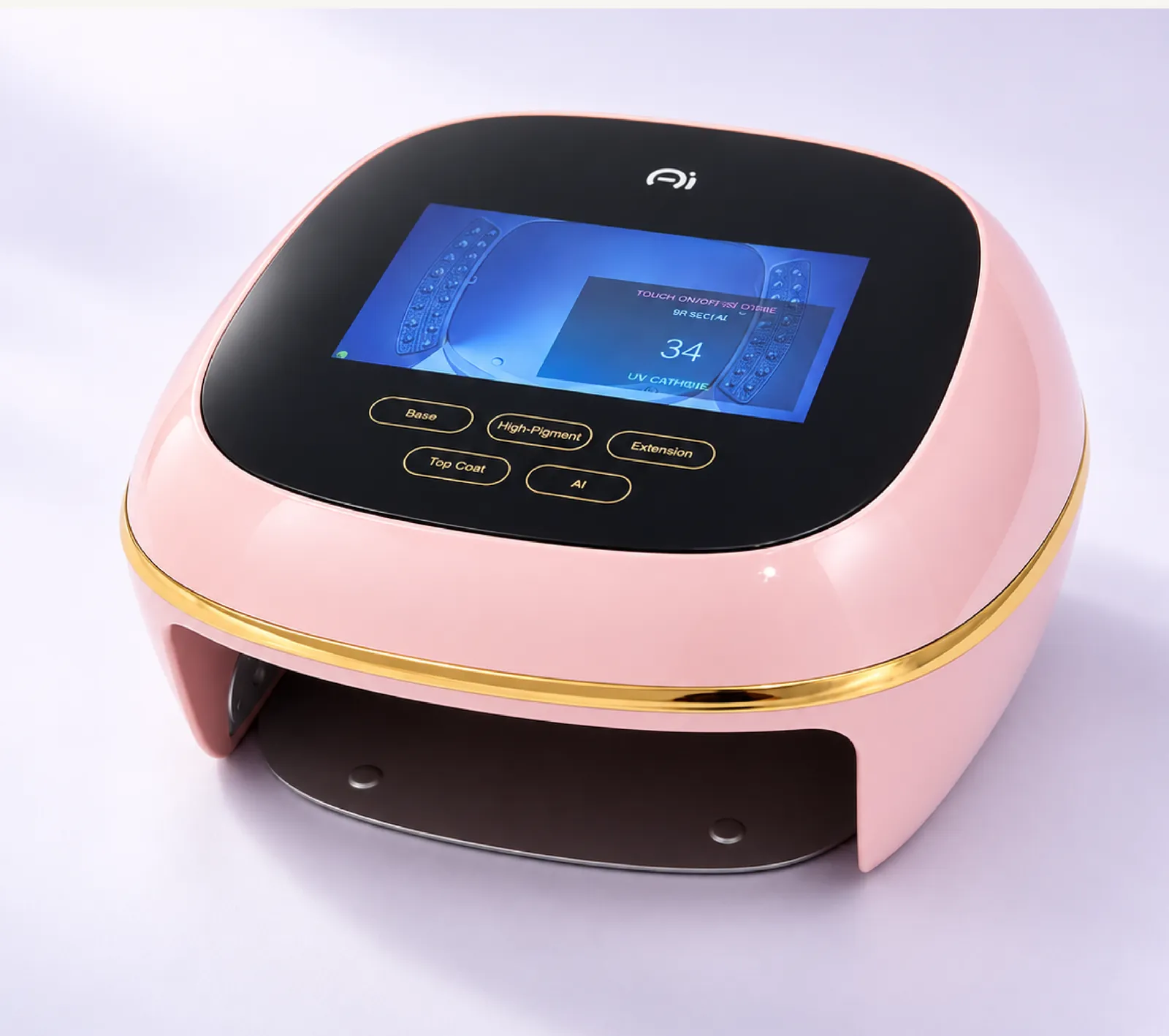
One SKU covers a dual-voltage market: a 24 × 24 × 11.5 cm body, a rear power inlet and an optional battery pack for mobile technicians.
A large, premium-leaning nail market with a gel problem to solve
Brazil is not a market you enter with a single generic lamp. It is a market where nail care is embedded in everyday grooming culture, where technicians charge meaningful prices for gel services, and where the installed base of lamps is old enough that a genuine step up in control is easy to demonstrate. Industry research puts the Brazilian nail polish market at USD 390.5 million in 2025, on a path to USD 602.7 million by 2033 at a compound rate near 5.6%, and identifies UV gel polish as the fastest-growing type segment in the country. Brazil also sits inside a beauty market that ABIHPEC ranks as the world’s third largest consumer market for cosmetics, toiletries and fragrances, at USD 37.4 billion in 2024.
USD 390.5 M
Brazil nail polish market, 2025 — forecast to USD 602.7 M by 2033 at 5.6% CAGR (Grand View Research, 2025)
UV gel
The fastest-growing product type in Brazil — the segment that depends on a controlled curing lamp (Grand View Research, 2025)
127 / 220 V
Brazil runs a dual low-voltage grid at 60 Hz, so one lamp SKU has to be specified for both (market practice, 2025)
The commercial opening is not the entry-level lamp. It is the mid and premium tier, where a studio competes on how consistent a gel set looks at the end of a long day, and where a chain competes on whether two different technicians in two different states produce the same result. That is a specification problem before it is a price problem.
What the lamp actually has to do in a Brazilian studio
Gel services at volume expose three weaknesses in a conventional curing lamp, and the AI Smart Nail Lamp is built around them.
- Where the nails are. A 2 MP camera with 0.5 TOPS of on-device compute locates the hand and the individual nails in about 0.2 seconds, before the LEDs come up. The lamp does not need the technician to position the hand in a fixed box.
- Which LEDs light, and when. 136 dual-band LEDs at 365–370 nm and 395–400 nm are driven in zones rather than as one flat panel. Only the segments over the nails are driven, which is what makes the next point possible.
- How much light reaches skin. Because the light path is zoned to the nails, exposure of the surrounding hand is reduced — the practical benefit technicians describe as avoiding a tanned hand after months of gel work. This is a property of how the light is delivered, not a claim about a different curing chemistry: like every professional LED curing lamp, ours uses LED chips that emit long-wave ultraviolet light in the UVA range, and gel polish is formulated to cure under it. The difference is targeting and duration, not the mechanism.
Two further specifications matter for a chain rather than a single chair. A 5.5-inch touchscreen carries 29 interface languages, so a group operating across states — or onboarding technicians whose first language is not Portuguese — can standardize the menus instead of retraining on a different console. And smart heat control with a light-decay warning means the lamp reports a drop in output instead of quietly curing slower, which is how a chain keeps results consistent across dozens of units at different ages. Confirm the exact language set you need, including Brazilian Portuguese, with your account manager at order stage so the firmware is fixed before production.
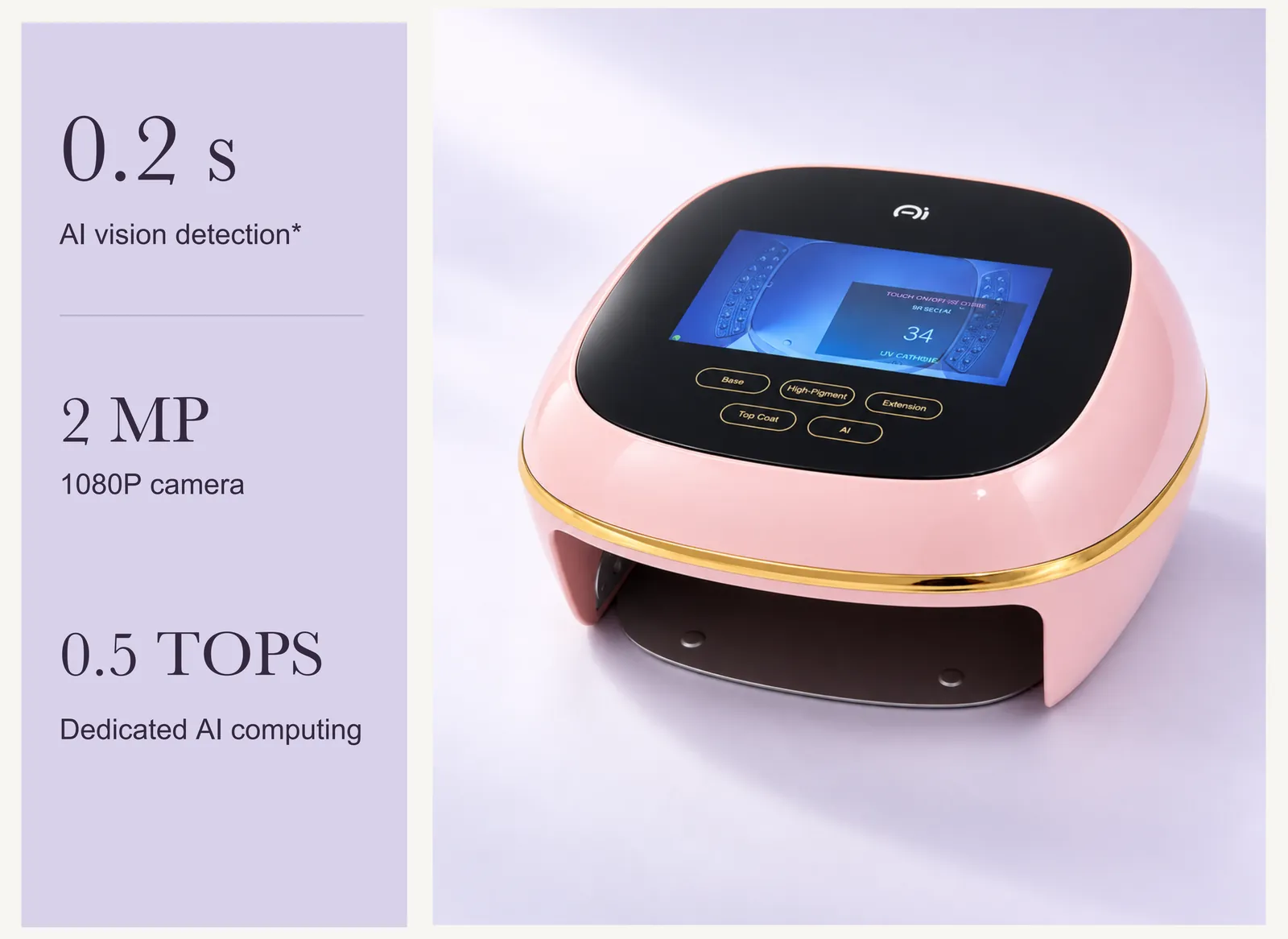
Detection at 0.2 s, 2 MP camera, 0.5 TOPS on the device — the step that happens between the client’s hand going in and the LEDs coming up.
Two voltages, and the option that sells to mobile technicians
Brazil’s dual grid is the most avoidable import mistake in the country. A lamp specified for one voltage will not serve a distributor whose territory spans states that deliver the other, and a technician who moves between the two needs an answer that does not involve a transformer in her kit bag.
Our standard shipment is AC powered with no battery, with a wide-input supply specified for the destination market and the correct local plug. For Brazil, specify the voltage coverage you need and the plug type at order stage — this is set during production, not after arrival. Separately, a 6000 mAh lithium battery version is available on request. That option is not aimed at the salon chair; it is aimed at the mobile and at-home segment, which is a real and growing part of the Brazilian market, and at studios with limited sockets at the station. A rear power inlet, a compact 24 × 24 × 11.5 cm body and USB-C support round out the specification.
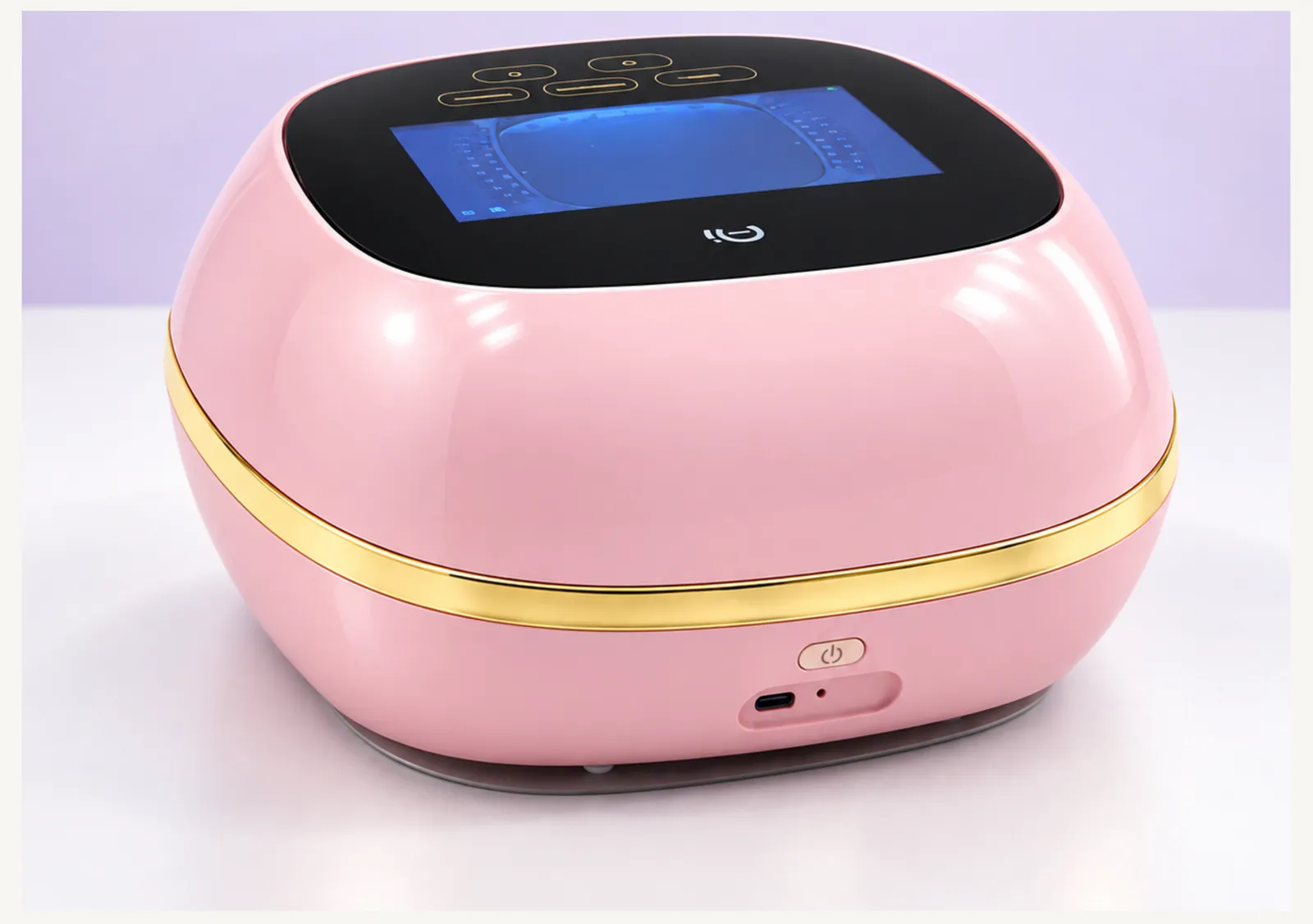
Standard configuration is AC with no battery; the 6000 mAh pack is quoted on request for mobile and at-home use.
The Brazilian import file, without the guesswork
Brazil regulates electrical and electronic products for safety through INMETRO, its national institute of metrology, quality and technology. For products inside the compulsory scope, conformity certification — issued by an accredited certification body, an OCP — is required before customs clearance, and the certificate must be held by a Brazilian legal entity. Portuguese-language documentation and instructions are part of the requirement, the plug must meet Brazilian requirements rather than a US or European standard, and the compulsory list is periodically revised, with IEC 60335-1:2016 cited as the updated baseline for household-appliance safety testing.
Two clarifications save buyers time. First, ANATEL type approval applies to equipment with a radio or telecom interface — Wi-Fi, Bluetooth and similar. A curing lamp without a wireless module normally does not fall into that regime, though the classification must be confirmed for the specific configuration you order. Second, INMETRO scope is defined by product family and NCM code, so the correct first step is not to ask a supplier for a certificate but to have your NCM code checked against the current compulsory list. What we provide to support that filing is the technical set: test reports from an accredited laboratory, circuit and component documentation, Portuguese-language manual source files, and labeling artwork. The certification itself is held by your Brazilian entity or importer, which is also the party the regime expects to carry it.
Sourcing ladder: sample, then range
There is no reason to commit to a container before the lamp has been in front of Brazilian technicians. The commercial structure is built for that:
- Sample units: a single lamp can be shipped for evaluation, and white-label or neutral (unlabeled) orders start at 3–5 units, which is enough to equip one station or run a comparison against what the studio uses today.
- Custom branding: logo, colorway and retail packaging are quoted from 300–500 units, depending on how much of the shell and packaging is customized.
- Distributor range: the lamp sits alongside the wax programs most Brazilian beauty distributors already carry, so a single supplier can cover both sides of the range.
Full specifications are on the AI Smart Nail Lamp product page, and the customization process — from artwork to first production batch — is set out on the OEM & ODM page.
Quick FAQ
Does one lamp cover both 127 V and 220 V in Brazil?
Do you provide the INMETRO certificate?
Is the battery version suitable as the main lamp in a busy salon?
Next step
For a sample lamp, a mixed shipment of AC and battery units, or a private-label discussion for the Brazilian market, contact Miro Wu, Dedicated Account Manager — email miro.wu@beautome.com or WhatsApp +86 188 1393 3019. Send your target voltage, plug type and the language set you need for the interface, and you will get a quotation with those items already specified.