




Wax Heaters for Nigerian and Kenyan Salons: SONCAP, PVoC and a Grid That Won’t Hold Steady
Lagos and Nairobi are the two Anglophone entry points into a continent adding salon capacity faster than it is adding equipment standards. Both run a pre-shipment conformity programme, both use British-pattern sockets on a 230 V supply, and both will test a wax heater on a circuit that was never designed for it.

Ten models, 20 ml to 800 ml — the same 230 V platform across the range.
Why these two markets, and why now
Global Market Insights puts the Middle East and Africa nail salon market at USD 1,553 million in 2025, rising to USD 3,877 million by 2035 at a 9.6% CAGR — second only to Asia Pacific for pace (Global Market Insights, 2025). The buying pattern in Lagos and Nairobi is distinctive: smaller treatment rooms than a Gulf chain, English-language documentation, an owner who signs the order personally, and a strong preference for equipment that can be repaired locally rather than replaced. That last point is the commercial opening — a distributor who can supply a heating element in a week owns the account.
Nigeria: SONCAP is two certificates, not one
Regulated products entering Nigeria need the Standards Organisation of Nigeria Conformity Assessment Programme (SONCAP), and it runs in two steps buyers routinely confuse. First the Product Certificate (PC), proving the model complies; then, for every shipment, the SONCAP Certificate (SC) — the document customs actually asks for (SON, 2025).
The PC comes in three forms, chosen by shipping frequency:
- PC1 — unregistered: six months, single use, inspection every shipment. Sensible for a first container with several models.
- PC2 — registered: one year, reusable, inspection on a share of shipments. The usual route once a range is settled.
- PC3 — licensed: one year, unlimited use, factory audit and ISO 9001 required. For high-risk categories shipping often.
Testing must come from an ISO/IEC 17025-accredited laboratory, and the file has to hold together across documents: product name, model designation, ratings and photographs must match from test report to PC to SC. The importer then applies for a Form M against the PC — valid 180 days, extendable — and the SC is issued per shipment, typically within about a business day once documents are complete. In 2025 Nigeria moved the programme to an electronic certification system linked to customs (NICIS), which shortened clearance and made inconsistencies more visible (SON, 2025).
Two mechanical requirements matter for a heater. The unit must be built for 230 V / 50 Hz and supplied with British-pattern plugs — BS 1363 or BS 546 — not a Schuko with an adaptor in the box. And product or packaging is expected to carry the SONCAP mark and the Nigerian importer’s address. Build that panel into the artwork before the first print run.

The 450 ml single-knob format — the workhorse in a two-room studio.
Kenya: the CoC has to exist before the ship sails
Kenya runs the Pre-Export Verification of Conformity (PVoC) programme through the Kenya Bureau of Standards. The sequence starts locally: the importer obtains an Import Declaration Form, and that number is what the exporter’s appointed PVoC agent needs to open a file. Testing is at an ISO/IEC 17025-accredited laboratory against Kenyan standards or their IEC/EN equivalents, and existing CB or CE reports can often be used as a base with difference testing rather than a full retest (KEBS, 2025).
The Certificate of Conformity must be issued before shipment; a container that arrives with the file still open goes into destination inspection, which is slower and costlier than doing it at origin. Validity on the general route is typically around three months, so time the certificate to the sailing, not to the production run. Since 2025 Kenyan importers have also reported a Certificate of Origin requirement alongside the CoC, with full enforcement reported from 1 October 2025 — confirm the current position with your clearing agent, because it sits with the importer, not with us (KRA and KEBS, 2025).
Electrically Kenya matches Nigeria — 230 V / 50 Hz, British-pattern sockets — so one production configuration serves both. Worth saying plainly to a distributor weighing two launches: the electrical file is shared, the conformity file is not.
The grid is the real specification
Wax heaters are resistive loads, which sounds forgiving and is not. A 450 ml pot rated at 100 W draws a little under half an amp at 230 V — modest, until it shares a circuit with two hairdryers, a kettle and an extension reel, which is a normal Saturday in a four-chair studio. What the equipment actually sees is a supply that dips in the evening, returns with a spike after an outage, and changes source when the generator takes over.
- Wide input tolerance. Ask for the stated input range in writing. A heater specified only as “220 V” is specified for a laboratory.
- Control electronics, not a bimetallic strip. A chip-controlled thermostat holds the set point and recovers after a dip; a mechanical strip drifts, overshoots on recovery and scorches wax. On the BWW5K — 450 ml, 100 W, a single 30–125 °C knob, no screen — that is the difference between a pot a technician trusts and one she keeps re-checking with a spatula.
- Restart behavior. It should come back cleanly at changeover, without tripping the salon circuit or defaulting to full power.
The practical advice is unglamorous: put the heater on its own point or a stabilizer, keep extension leads off the floor, and never run an 800 ml pot and an air conditioner on the same circuit. Failures in these markets are usually installation failures first.
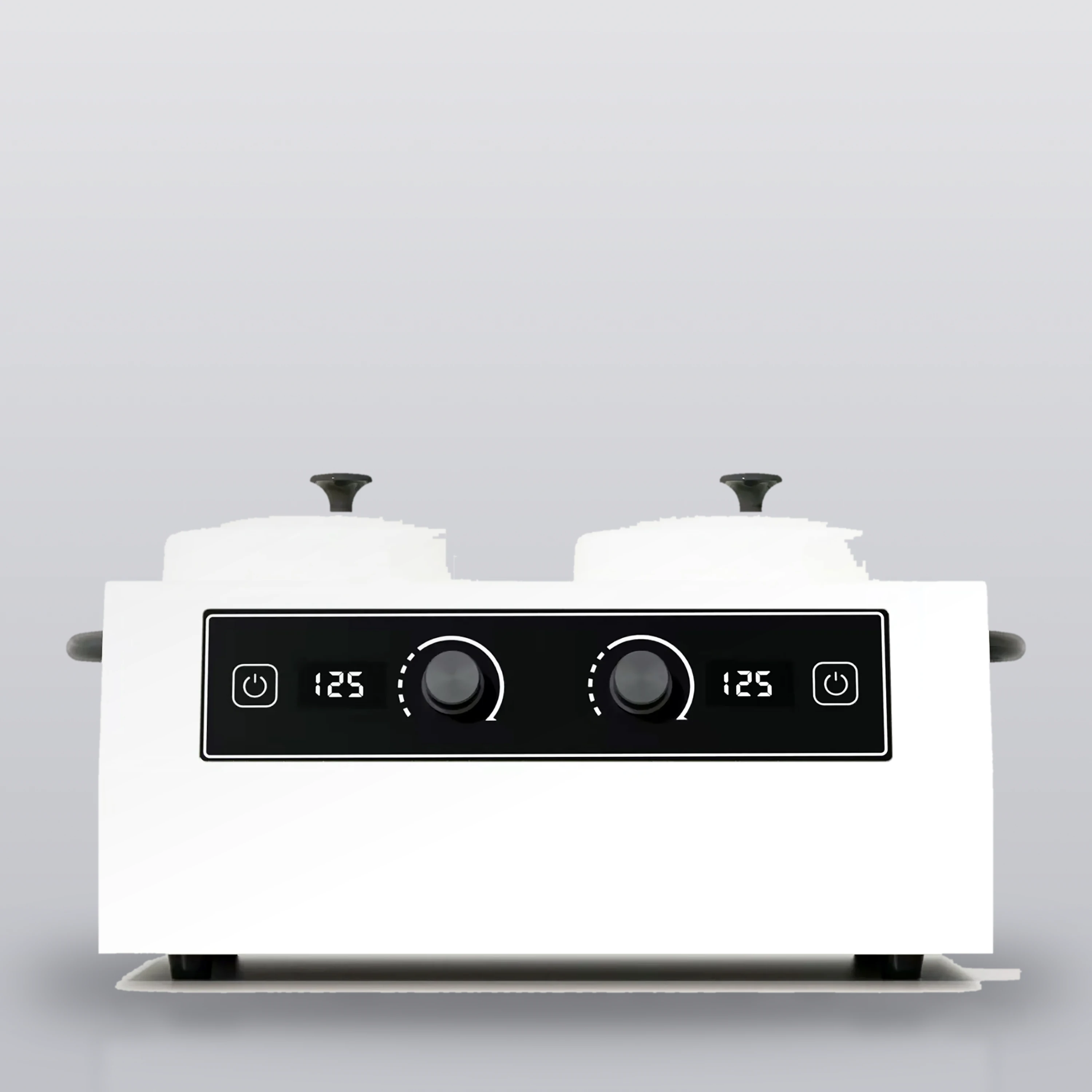
Twin 400 ml and 800 ml pots — for the salon running two wax types at once.
A capacity ladder that fits the rooms
Ten models from 20 ml to 800 ml let a distributor open an account small and grow it without changing supplier: the 20 ml PW6 for nose and spot work, the 180 ml PW8 mini for brow and face, the 250 ml PW2B and 400 ml PW1B for a single technician, the 450 ml W5, W6 and BWW5K as the volume format, the 500 ml W2 with a digital set point, and the 800 ml SW1B plus SW6B and SW8B twin-pot stations for high-throughput rooms. Order the ladder rather than the hero product: one 800 ml station sells to a dozen salons; the 180 ml, 450 ml and twin-pot formats sell into every room size in the city.
Spares are the margin
Heating elements, inner pots and control knobs are the three parts that fail, and all three are replaceable. A distributor holding a small spares kit per format turns a warranty conversation into a service call, and a service call into a relationship. Specify the 230 V element explicitly when ordering — a 110 V element in a 230 V market is not a small mistake. Private-label buyers can start neutral and move to custom logo and packaging once volume justifies it, with the conformity file updated to the branded model designation.
Quick FAQ
Can one heater model serve both Nigeria and Kenya?
How long does the Nigerian paperwork take before a first shipment?
Will a chip-controlled heater last longer on an unstable supply?
Next step
Tell us which formats you intend to stock, whether the branding is neutral or yours, and which port you ship into, and we will send the model sheet, the 230 V element confirmation and the technical file your conformity agent will ask for. The range is on the wax heaters page, and the wax that goes in the pots is on the wax formulas page. For a distributor quotation or a spares kit, contact Miro Wu, Dedicated Account Manager — email miro.wu@beautome.com or WhatsApp +86 188 1393 3019.