







Wax Heaters for Spanish and Portuguese Wax Bars: Cold-Start Minutes, Idle Watts and the EU File
A wax bar in Madrid or Lisbon does not buy heaters the way a single-room studio does. It buys them by station, against a service menu that runs from brow to full leg, and it replaces them on a schedule rather than when they fail. Which means the specification that matters is not the cabinet price — it is three numbers a supplier should be able to give you before you sign: how many minutes from cold to working temperature, how many watts the pot draws while holding, and how far the wax overshoots on the first cycle of the morning.
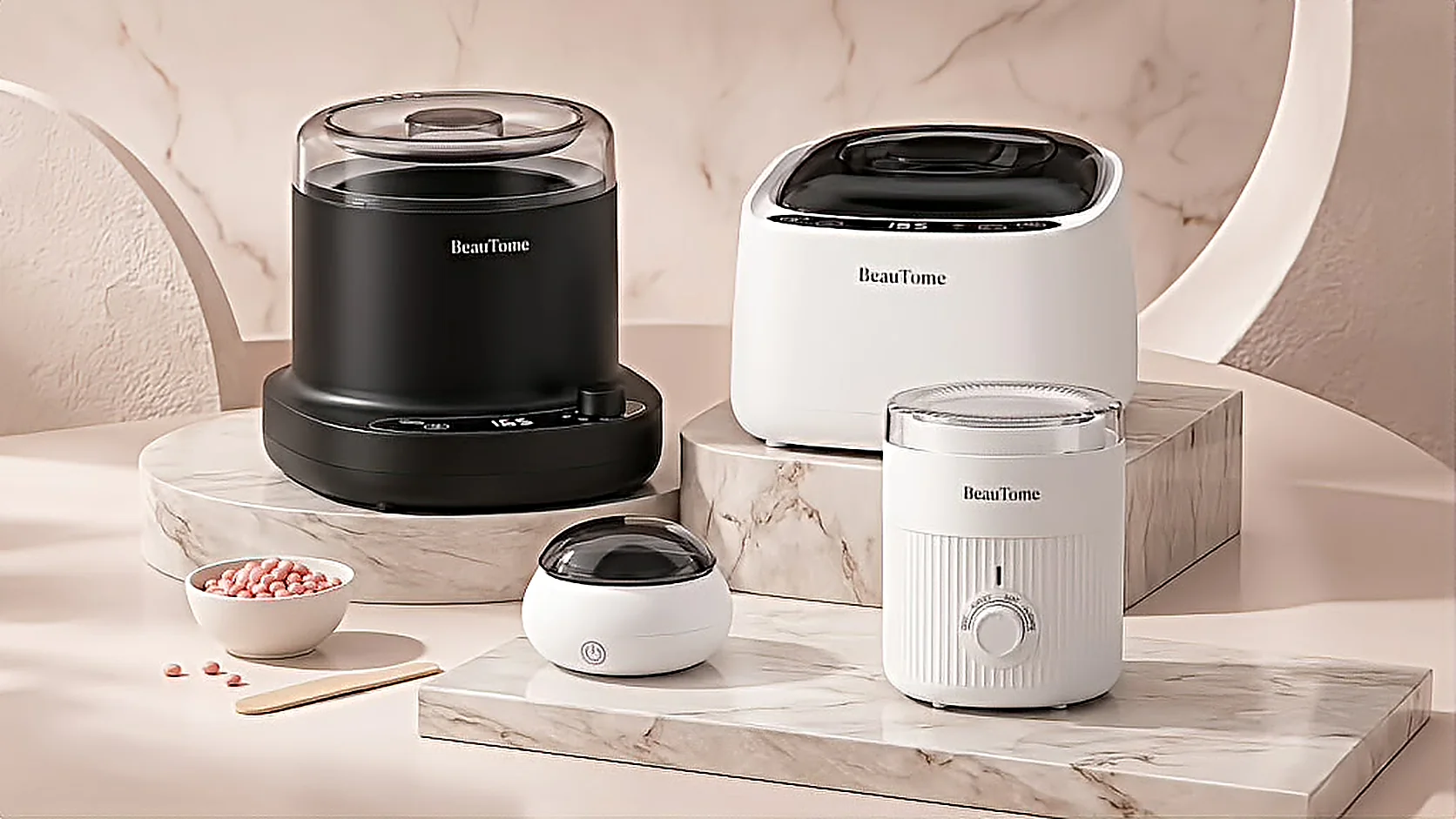
Ten heater models from 20 ml to 800 ml, including dual-pot stations for two-technician rooms.
A station-by-station market
Iberia’s waxing business has consolidated into formats: high-street chains with four to eight treatment rooms, hotel and spa contracts, and neighbourhood salons that added a wax menu to a nail or hair business. That shape changes the buying unit. A single-room studio asks which pot to buy. A wax bar asks how many pots per station, which capacity sits on which trolley, and what happens when a technician calls in sick and the room has to be re-planned at 09:00.
Electricity is part of that calculation, and Iberia is the cheapest large market in Western Europe for it. Eurostat’s non-household band for small and medium consumers (band IB, 20–500 MWh a year) put prices including taxes and grid fees at about €0.16/kWh in Spain and €0.17/kWh in Portugal in the first half of 2026, with the energy-only component near €0.10 in both. Use your own contract figure — but use it, because the arithmetic below is more interesting than most buyers expect.
The idle watts are small. The scorched wax is not.
Take a 450 ml pot with a 100 W element, switched on at 08:30 and holding temperature for ten hours with a duty cycle of roughly 35% between clients. That is about 0.35 kWh a day, or roughly 105 kWh a year: at €0.16–0.17 that is €17–18 per pot per year. A ten-pot bar spends maybe €175 a year heating wax. It is real money, and it is not the reason to choose one heater over another.
The money sits in the wax itself. A 450 ml pot holds roughly 400 g. If the top of the pot scorches and the technician skims a film each morning, ten grams a day is about 3 kg a year per pot — and in a ten-pot bar that is 30 kg of product going into the bin, plus the labour of skimming it. Add the sets that get re-waxed because the film went stringy at the wrong temperature, and the difference between a heater that holds ±2 °C and one that swings across a wide band stops being a specification detail.
€0.16–0.17
Per kWh for SME-band consumption in Spain and Portugal, taxes and grid included (Eurostat, 2026 H1)
≈€18
Annual energy for one 450 ml, 100 W pot at ten hours a day and 35% duty
3 kg
Wax skimmed per pot per year if a 10 g film is removed each morning
Cold start is the number nobody asks for
First-client timing is where a wax bar loses money quietly. A pot that needs 35 minutes from cold has to be switched on before the first technician arrives; a pot that needs 18 minutes can be started when she clocks in. Multiply the difference by 300 opening days and by the hourly cost of a technician standing in a room waiting for wax, and the cheap cabinet is no longer cheap.
So ask three questions of any supplier, and ask them for each capacity you are considering:
- Minutes from 20 °C ambient to working temperature, measured with the pot loaded, not empty. An empty pot tells you about the element; a loaded pot tells you about the element, the inner bowl wall thickness and the insulation.
- Overshoot on the first cycle. Mechanical thermostats commonly swing across a band of several degrees before settling. On a film wax worked at 55–60 °C, a wide swing at the top of the first cycle is what scorches the surface layer.
- Recovery time after a full pot is emptied and refilled mid-afternoon. This is the number that decides whether a busy Saturday needs a third pot or a second room.
Test all three on your own bench with a probe at the center of the wax, not with the dial. A dial reads the heater; a probe reads the product, and the two are not the same instrument.
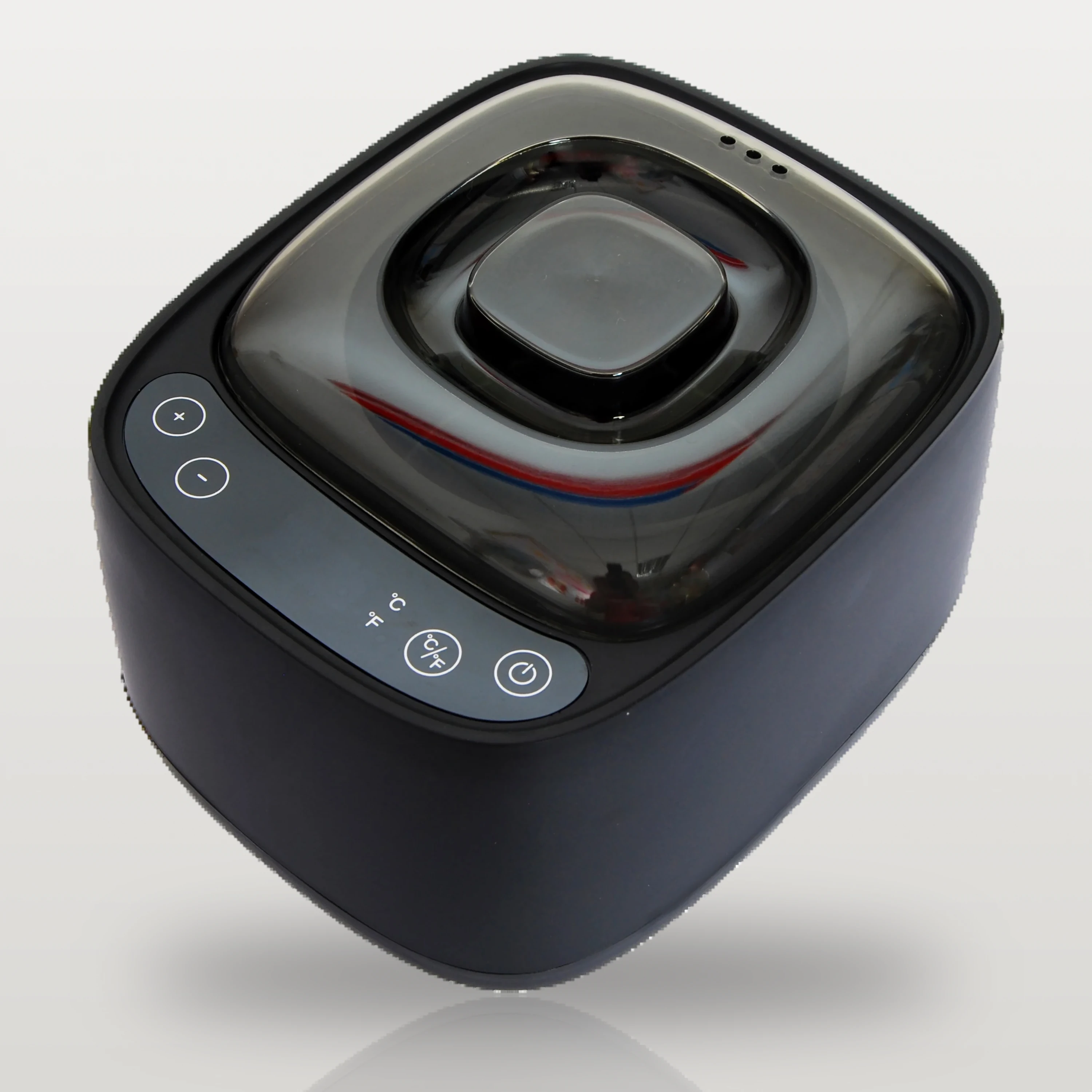
The W5 450 ml unit — the capacity most Iberian treatment rooms standardise on for leg and underarm work.
Mapping the range to a service menu
Ten models, and the point of ten is that a wax bar’s stations are not identical. The PW6 at 20 ml is a graphene-bodied unit for brow, lip and nose work, where a full pot would be waste. The PW8 at 180 ml covers facial and underarm volumes and fits a trolley shelf. PW2B at 250 ml and PW1B at 400 ml fill the gap between a single-service pot and a full leg pot. The 450 ml group — W5, W6 and the entry-level BWW5K — is the workhorse capacity; the BWW5K is deliberately simple, a single dial across 30–125 °C with 100 W and no display, which is what you put in a room where staff turnover is high. The W2 at 500 ml adds a digital readout, the SW1B at 800 ml covers back and chest work, and the dual-pot SW6B and SW8B give one technician two temperatures without two plugs.
For an Iberian bar the usual starting configuration is one 450 ml pot per treatment room, one 180 ml for facial work, one 20 ml for brow, and a dual-pot station where back and chest services are on the menu. That is four to six units per site, and it is the configuration to price as a fleet rather than as individual purchases — because the spare-parts conversation is different at that volume.
The EU file, in the order it gets checked
Heaters are mains appliances, so the CE route runs through the Low Voltage Directive 2014/35/EU, the EMC Directive 2014/30/EU and RoHS 2011/65/EU, with the declaration of conformity and technical file retained by the manufacturer. Two points are specific to importing rather than manufacturing:
- An EU-established economic operator is required. Under Regulation (EU) 2019/1020, in force since 16 July 2021, products covered by Union harmonisation legislation need a responsible economic operator established in the EU, and that operator’s details belong on the product or its packaging. If you are the importer, that is you — and it is a named obligation, not a forwarding address.
- Language and registration. Instructions, safety information and marking have to be in the language of the member state of sale: Spanish for Spain, Portuguese for Portugal. Separately, electrical equipment carries producer-responsibility obligations under the WEEE regime, and the importer is normally treated as the producer for that purpose. Confirm the registration route with your compliance adviser before the first invoice.
Do not assume an energy label applies. Ecodesign and energy labeling under the 2009/125/EC framework are category-specific, and a wax heater is unlikely to sit inside a current implementing regulation — but that is a question to ask, not a conclusion to carry into a catalog.
What to put in the purchase order
Iberia is 230 V, 50 Hz, with type C and F sockets; specify the plug and the cord length, and specify the element as a line item with its part number and unit price. Elements are the consumable in this category, and a distributor who cannot supply one in 48 hours loses the account to whoever can. The same applies to inner bowls and to the dial or controller: ask for the spare-parts list at quotation stage, not after the first failure.
Full specifications sit on the wax heater product page, and the OEM and ODM page covers private-label housings and branding for chains that want their own cabinet. For formula-side planning, the wax formulas page lists the four product lines the heaters are designed around.
Quick FAQ
Is a 100 W heater cheaper to run than a 200 W one?
Can I import directly and be the EU responsible operator?
How many pots does a four-room wax bar need?
Next step
Send us your station plan — rooms, services, and the capacities you are considering — and we will come back with a fleet configuration, the spare-parts list with part numbers, and the technical documents your EU file will need. Standard units ship CE-marked with 230 V/50 Hz elements; private-label housings and branded dials are available for chains. For a quotation, contact Miro Wu, Dedicated Account Manager — email miro.wu@beautome.com or WhatsApp +86 188 1393 3019.