







Hard Wax for Gulf Distributors: One Pallet, Six Registrations
A GCC pallet looks like one market and behaves like six. The Gulf standard gives a common safety baseline, which is why suppliers quote “GSO compliant” and stop there. What actually lets a carton of wax beads into a salon is a national file, opened in the name of a local entity, against artwork in two languages — and in our experience more shipments are lost to a label review than to a formulation.
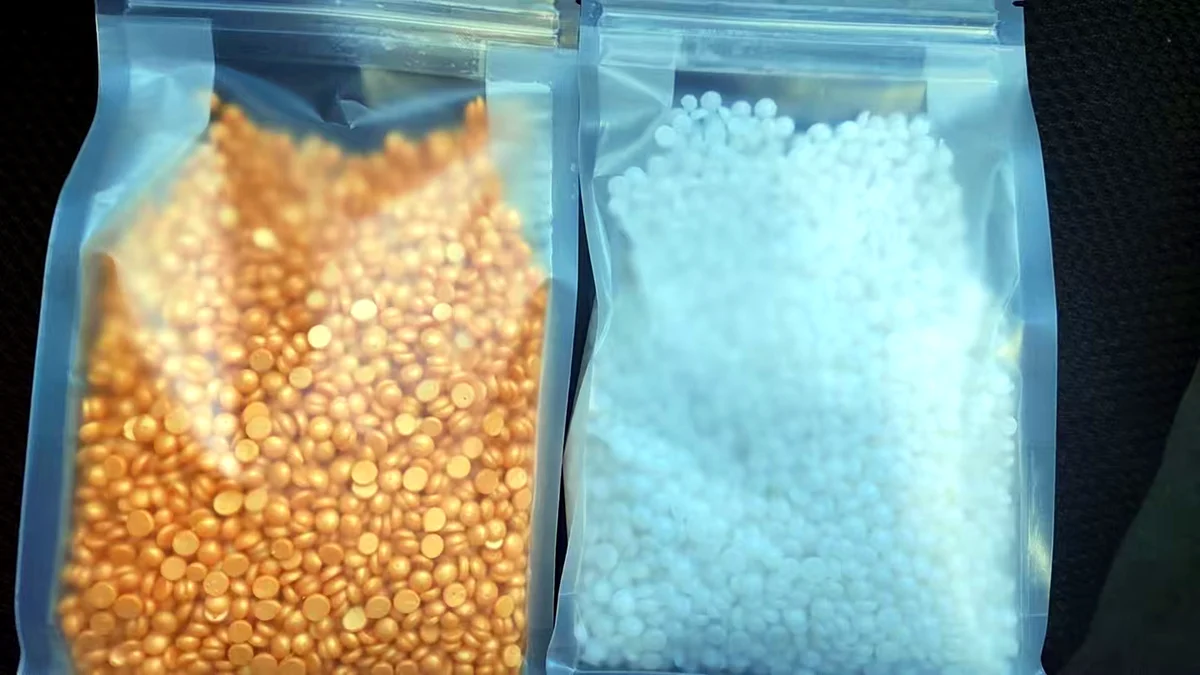
The bag arrives blank on purpose: the label that satisfies six authorities is printed where the registration is held, not where the wax is poured.
One standard, six doors
The common baseline is GSO 1943, the Gulf technical regulation for cosmetics and personal care, together with the labeling standard GSO ISO 22715 and the claims regulation GSO 2528. Compliance with those is necessary and nowhere near sufficient. Each state runs its own authority, its own listing procedure and its own document set on top of the baseline:
United Arab Emirates — product registration through the emirate municipality route (Montaji in Dubai for cosmetic products), with the federal health authority involved depending on the channel; the applicant must be a UAE-licensed entity. Saudi Arabia — notification to SFDA through the unified Ghad system, with consignment-level conformity documentation before the goods reach the port of entry. Qatar — Ministry of Public Health, Arabic and English artwork required. Kuwait — Kuwait Food and Drug Authority, with the strictest labeling review of the four smaller markets. Bahrain — NHRA, with Bahrain-specific labeling requirements. Oman — Ministry of Health through the pharmaceutical affairs directorate, with commercial registration from the trade ministry as a precondition.
Published processing windows from GCC regulatory consultancies in 2025–2026 run roughly 30–40 working days for Bahrain, 40–50 for Qatar, 45–60 for Kuwait and 35–45 for Oman, with additional laboratory testing adding weeks where a novel ingredient or a claim attracts a question. Registration validity is commonly up to five years and varies by country. Treat those as planning ranges and confirm the current figure per SKU — the numbers move, and a distributor quoting a launch date off an old table is the reason files get re-opened.
Only a local entity can file
Every one of these procedures requires an in-country agent or importer, and in most of them a foreign manufacturer cannot register directly at all. That single rule redefines the commercial relationship: the distributor is not a customer, they are the certificate holder. The file is opened in their name, in their account, and it does not travel with the goods. Change distributor in a market and the listing has to be rebuilt from the beginning — which, in Saudi Arabia, means a new product listing under the new importer’s SFDA account, not a transfer.
Two practical consequences. First, the letter of authorization should name the SKUs, the markets and the term, and should be issued per market rather than as one global document that says “all products, all territories”. Second, exclusivity and registration cost are the same negotiation: if the distributor pays for six files, they will expect protection, and a brand that grants territory without agreeing who owns the file is negotiating the same question twice.
The dossier you will be asked for six times
Build one master file and six cover sheets, not six dossiers from scratch. The recurring set is: full formulation with INCI names and percentages; a product information file; a GMP or ISO 22716 certificate for the manufacturing site; a safety assessment signed by a qualified assessor; a certificate of free sale from the country of manufacture; a certificate of analysis per batch; artwork in Arabic and English including the label layout; and a letter of authorization naming the local entity. Some authorities add laboratory reports, and some will ask for stability data where the storage claim is unusual — which, for a wax, it usually is.
This is also where a supplier’s own housekeeping shows. A factory that can produce a formulation sheet with percentages, a batch record and a stability summary on request is a different proposition from one that sends an SDS and calls it a safety file. The materials are not exotic; the discipline is.
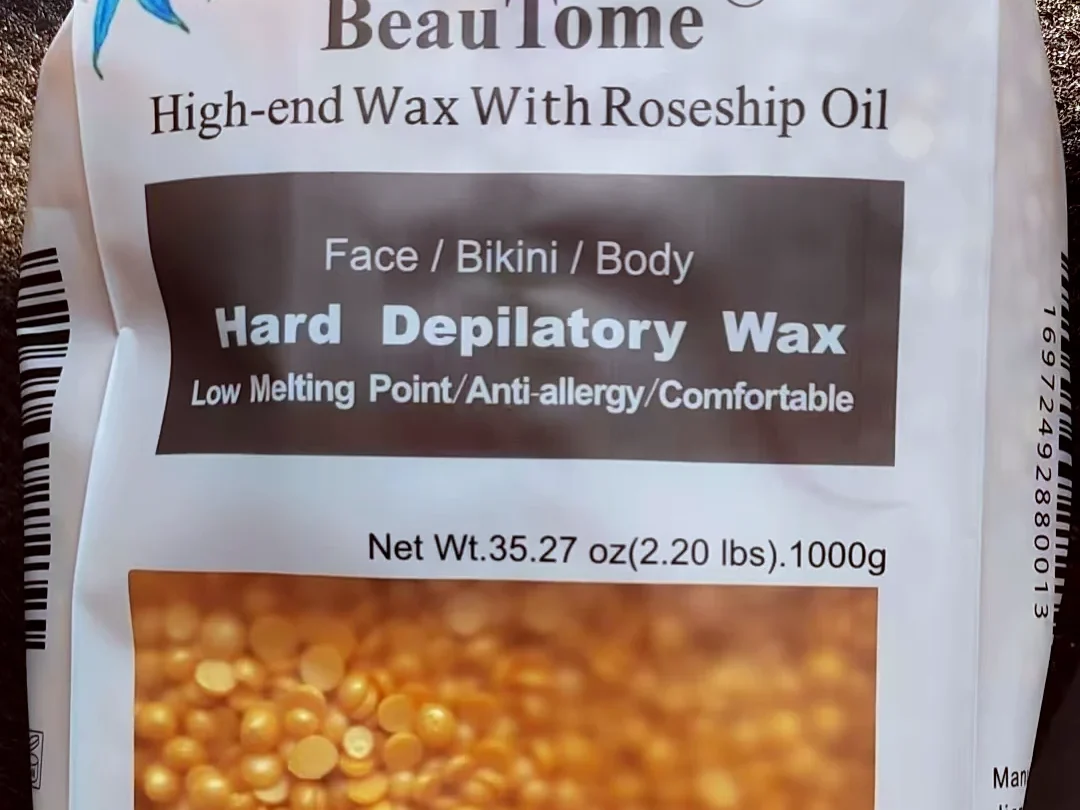
Formula A1, rosin-free, melting range 45–50 °C — the reference SKU most Gulf files are opened against.
The label is the review
Regulatory reviewers in this region read the pack before they read the file, and applications come back for label non-conformity far more often than for formulation. The recurring checklist: product name matching the filing exactly; manufacturer name, country and address; the local importer’s name and address; full INCI list in descending order with fragrance allergens declared; batch number; expiry date or period after opening; net content in metric units; Arabic mandatory with English alongside; storage instructions; and no therapeutic claim anywhere — “treats”, “heals” and “anti-inflammatory” move a cosmetic into a different category altogether.
For a depilatory wax there are three additions worth making standard: a professional-use statement, because the same formula sold to a salon and to a retail shelf is not the same product; the storage range, which for these formulas is 15–24 °C, dry and out of direct light; and the melting point written as a range rather than a single figure. Formula A1 is specified at 45–50 °C; a single-value melting point on the pack invites a complaint the first time a Gulf summer pushes a stockroom past 40 °C and the beads start to slump in the bag.
What this means for a clear bag
An unlabeled transparent bag has nothing to submit. The registration requires artwork, the artwork requires a decision on the label’s owner, and that decision belongs to the entity holding the file — so the sequence is fixed: master artwork in Arabic and English, then the six filings, then labels printed near the point of registration, then the bag shipped blank with only the lot and production date on the seam. Distributors like this model because it removes the printing cycle from the lead time and lets them hold one SKU across several brands. It only works if the sequence is respected.
Three failure points to design out. A bag that carries a lot number while the applied label omits it breaks traceability at the first recall question — put the lot field on both. Label adhesive on a polyethylene film is not the same as on a carton: test the actual combination at 40 °C for a week before committing to a print run. And the 300 g bag is the hardest layout in the range; the expiry line is the first thing to be squeezed out, so lay it out before the 500 g and 1,000 g versions rather than after.
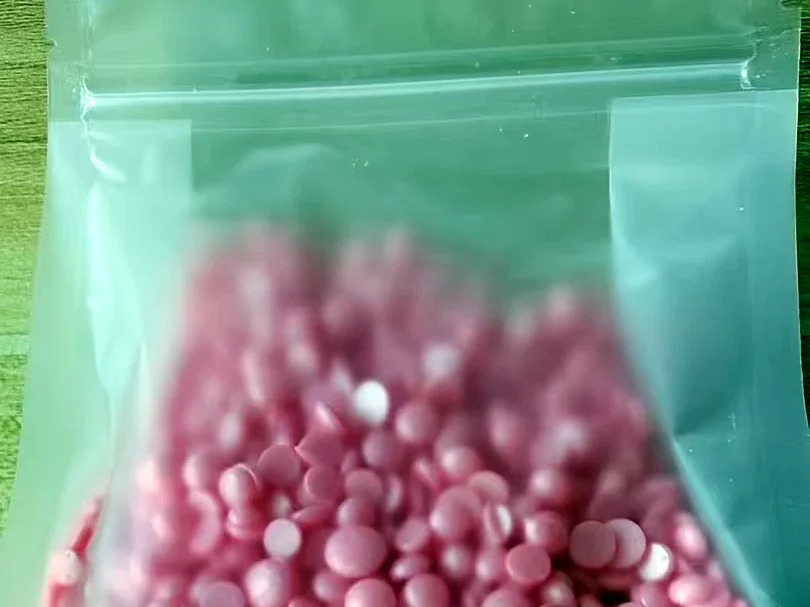
Pink in a clear bag — the label, the lot field and the Arabic block are added where the registration is held.
Four SKUs, three bag sizes, one storage rule
The range that covers most Gulf files is four products, documented in full on the wax formulas page. Formula A1, rosin-free, melting range 45–50 °C, in Gold and Pink as standard colors with White made to order — the sensitive-skin and first-client product. Formula A2, a premium rosin cream white bead with high elasticity, for short coarse hair. Consumer-Grade Hard Wax, a 55–60 °C film wax, for volume and for the retail shelf. All-Purpose Soft Wax in 450 g tins, for the strip line that a barber or a full-leg service still needs.
Bag sizes follow the room, not the price list: 300 g for a satellite counter or a mobile technician, 500 g as the standard store unit, and 1,000 g only for a distribution center or a genuinely high-volume back bar — a 450 ml pot holds about 400 g, so a kilo bag left open at the counter oxidizes long before it is finished. Private label runs on low MOQ with no printing cycle to wait for, which is the reason a new brand can test a market before it commits to six registrations; the branding ladder and artwork options are set out under OEM and ODM.
Timeline arithmetic
Six files run in parallel, and the slowest one sets the date: Kuwait at 45–60 working days plus any testing, then the label review, then the first consignment. Working backwards from a trade-show launch or a chain rollout, artwork has to be approved roughly four months earlier, and the authorization letters signed before that. Goods that arrive ahead of the file do not wait in a salon stockroom; they wait in a bonded warehouse or on demurrage, and either one costs more than the label print run that was deferred to save a week.
Context for the planning: the Saudi hair-removal wax market was around USD 0.21 billion in 2025, projected at 0.31 billion by 2034 at roughly 4.6% a year, with hard wax the fastest-growing product type (Deep Market Insights, 2026); the GCC wax market as a whole was put at USD 129 million in 2025, rising to 266 million by 2035 (Market Research Intellect, 2026). Growth of that order rewards the distributor who files first in a category, not the one who files cheapest. This guide covers the six GCC states only; European notifications are a separate file and are not addressed here.
Quick FAQ
Can a brand register its own hard wax with a Gulf authority?
Is one GSO-compliant label enough for all six markets?
How long should a first Gulf filing be planned for?
Next step
Send the markets you intend to file in, the SKUs and bag sizes for the first pallet, and whether the label will be applied at the distributor or at the store. We will return a quotation with the formulation and safety documents you will need for the dossier, the artwork fields laid out per country, and the bag sizes matched to your pot capacity. For a quotation, contact Miro Wu, Dedicated Account Manager — email miro.wu@beautome.com or WhatsApp +86 188 1393 3019.