AI Smart Nail Lamp for Israeli Salons: The SII File, 230 V and a Type H Plug
Israeli buyers are unhurried until they reach the paperwork, and then they are the most demanding buyers in the eastern Mediterranean. Equipment imported into the country clears through the Standards Institution of Israel, the grid is 230 V at 50 Hz on a plug geometry almost nothing else uses, and the labels must carry Hebrew warnings. None of that is difficult — but every item is a document, and documents take weeks. This is the file to assemble before the purchase order, not after it.
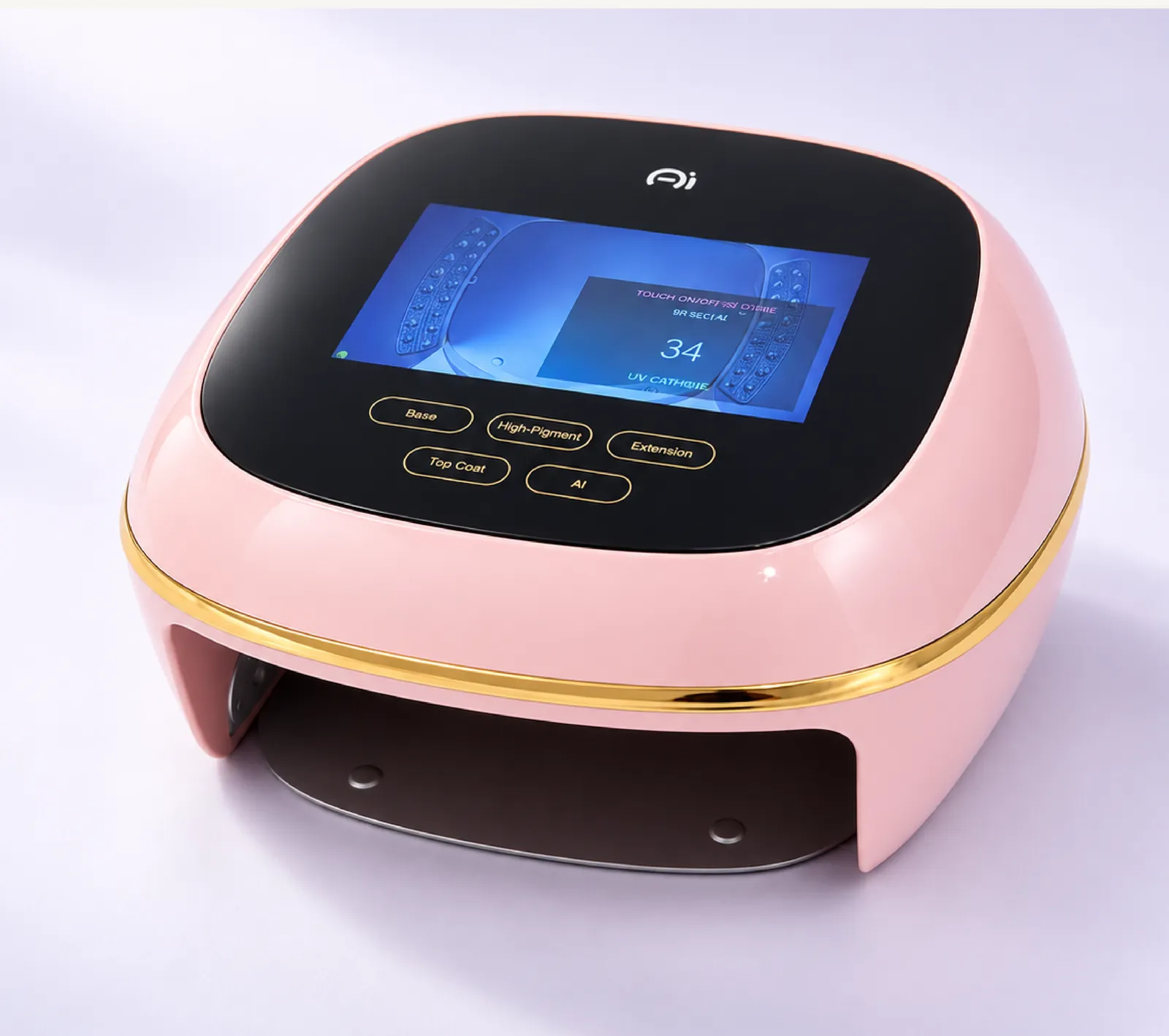
The AI Smart Nail Lamp — a 2MP camera, on-board vision processing and 136 dual-band LEDs that light the nails, not the whole hand.
A compact market that runs on express service
Israel is a small market with an urban rhythm that rewards fast, predictable chair time. Transpire Insight sized the nail salon segment at USD 47.5 million in 2025, reaching USD 76.85 million by 2033 at a 6.20% CAGR, with express manicure formats and appointment-driven booking replacing walk-in traffic in Tel Aviv, Jerusalem and Haifa. The same outlook notes that hygiene regulation and worker-safety expectations are tightening, which pushes small unregulated studios toward standardized, documented equipment.
For a distributor or a chain, that shape of demand favors one thing: a model that can be specified once and repeated across every branch, with the certification file attached to the model rather than to the shipment. Which is exactly where the SII conversation begins.
USD 47.5M
Israel nail salon market in 2025, growing at 6.20% CAGR to 2033 (Transpire Insight, 2025)
230 V / 50 Hz
Single-phase supply, with the Israeli three round-pin plug per SI 32 (type H)
3 years
Typical first validity of an SII certificate, with annual supervision (certification-body summaries, 2025–2026)
The SII file: one institution, one list, one certificate
The Standards Institution of Israel is the statutory body behind the country’s Standards Law of 1953, and products that appear on the official mandatory standards list must hold an SII certificate or exemption letter before they can be imported and sold. Two features of the system matter for a first-time importer:
- CB reports travel well. Israel is a member of the IECEE scheme, so a valid CB test certificate for the lamp’s appliance family can be transferred, with Israel’s national differences added as supplementary testing. That usually means fewer duplicated test items than a from-scratch program.
- The national differences are concrete. They include the 230 V ±10% / 50 Hz supply assumption, the plug geometry per SI 32, and labeling that carries Hebrew safety warnings. An IEC report alone does not produce an SII certificate; the differences test program does.
One more recent development is worth a question to your certification route. Israel has been migrating its household-appliance standards from the older SI 900 series to the IEC-aligned SI 60335 series — for washing machines, the new SI 60335-2-7 was published in the official gazette on 30 November 2025 with a one-year parallel period to 30 November 2026 (WTO/TBT alert, March 2026). The practical lesson: ask, in writing, which edition and which series your model will be assessed against, because the answer changes the test program and the marking.
A curing lamp also raises the same scope question that follows the product into most markets: it is a light source, and it is also a bench appliance with a timer and a controller. The appliance safety family (SI 60335 series) and the luminaire family (SI 60598 series) imply different test programs. Settle the classification with the certification route before samples are booked, and keep the answer in the technical file.
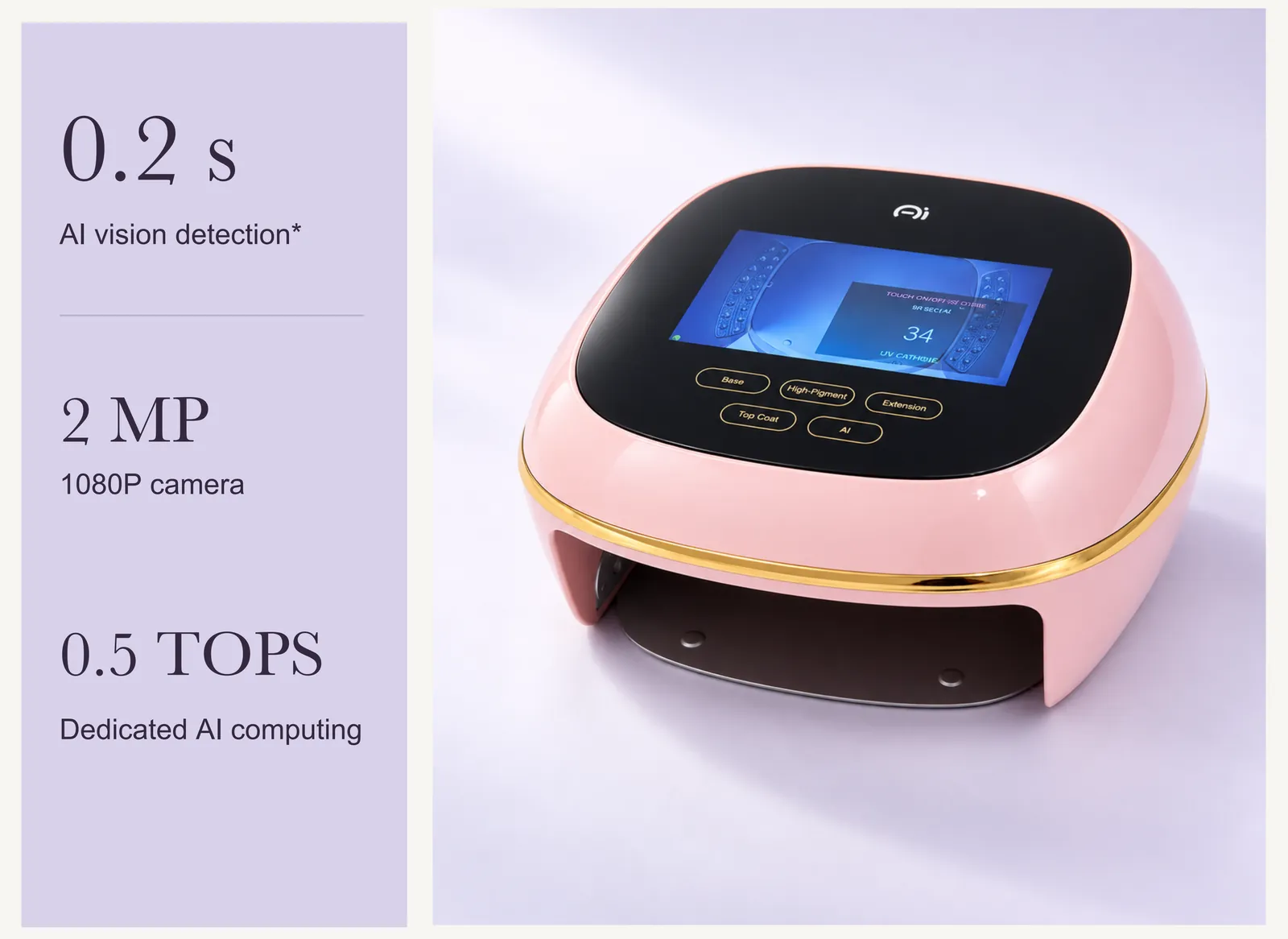
Vision detection maps the nail positions, and the array follows them — light goes where it is needed.
230 V, type H, and a cord set that ships on the order
Voltage itself is the easy part: 230 V at 50 Hz is the European assumption most factories already build for. The plug is not. Israel uses its own three round-pin geometry under SI 32 (the type H plug, in its modern form compatible with European two-pin plugs), and most factories’ standard cord sets are Schuko or UK mouldings. Specify the cord set as a line item on the purchase order. A moulded plug cannot be swapped at the port without re-testing the assembly, and an adapter hanging off a salon cable is the first thing a fit-out inspection or a mall operator notices.
Labeling is the second half of the same conversation. Israeli requirements call for Hebrew safety warnings on the product and its documentation. That affects the manual, the rating plate layout and the retail box — all of which are far cheaper to plan at the artwork stage than to correct after a container arrives.
What the hardware gives an Israeli chain
The curing chemistry is the same as any LED curing lamp — LEDs emitting UVA in the 365–400 nm range. What differs is delivery. A 2MP camera paired with 0.5 TOPS of on-board processing locates the nails in about 0.2 seconds, and the 136 dual-band LEDs (365–370 nm and 395–400 nm) then emit in zones rather than across the whole hand. Light follows the nails, which reduces unnecessary light exposure to the surrounding skin — the practical, demonstrable answer to the “dark hands” concern that clients raise, and a reason the chair-side conversation gets easier.
The rest of the spec reads the way a multi-branch operator needs it to: a 5.5-inch touchscreen with 29 language packs (confirm the Hebrew interface on a live unit before ordering — right-to-left rendering is exactly the detail to verify in person), thermal monitoring with a light-decay warning that flags output loss before a client complains, and a compact 24×24×11.5 cm body that fits a dense urban workstation. If you are comparing curing technologies before you buy, the UV and AI lamp comparison sets out the same-principle, different-control story in one page.
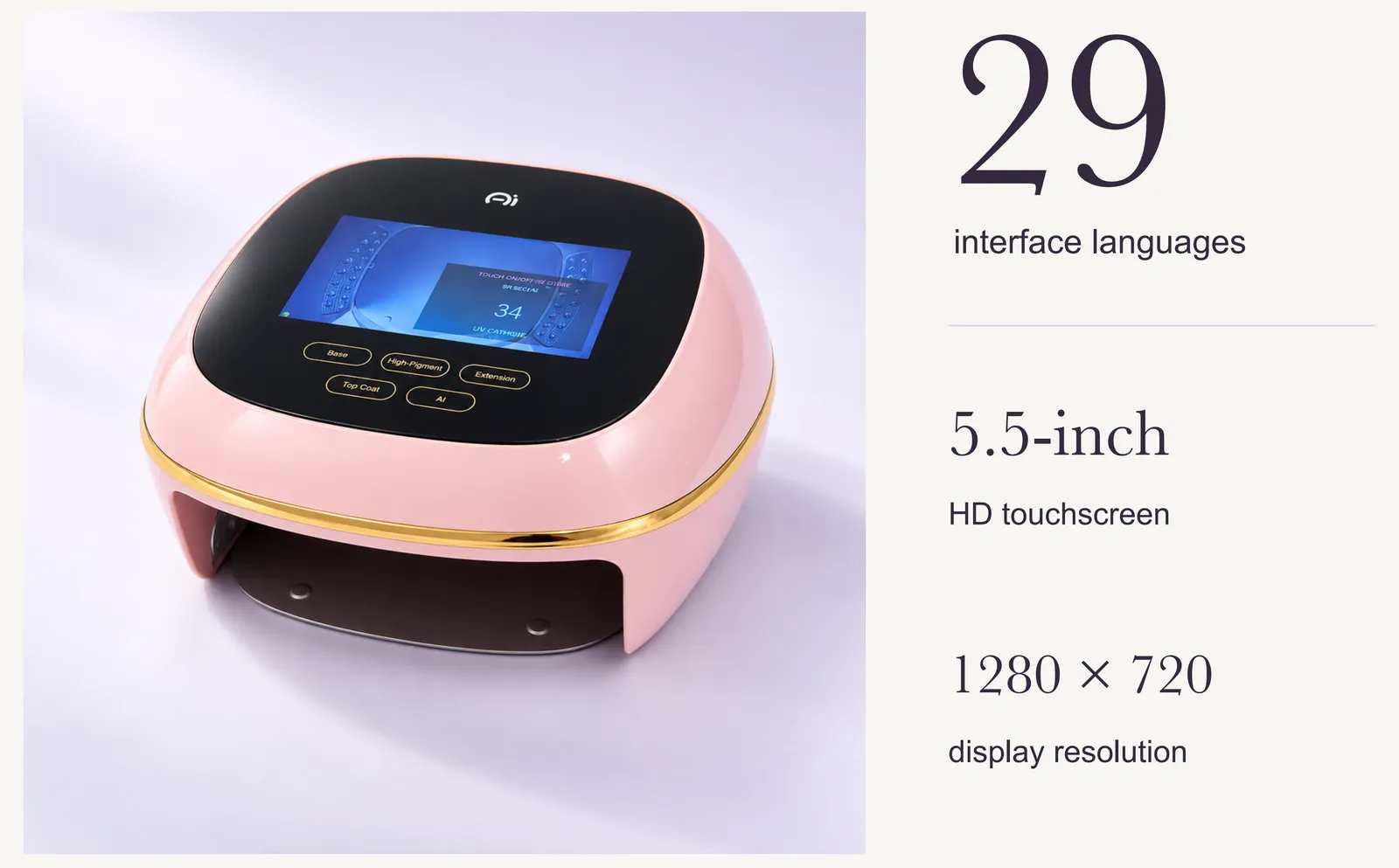
The 29-language console — confirm the Hebrew pack on a live unit, on the desk where it will actually be used.
Commercial terms, stated plainly
For an evaluation, white-label or neutral units start at 3–5 pieces, and a single sample can be shipped so you can test the Hebrew interface, the cord set and the curing speed on your own gel line. Custom branding — logo, colorway, retail packaging — starts at 300–500 units. Standard units ship AC powered, with no battery; a 6000 mAh lithium version is available on request for mobile technicians. The AI Smart Nail Lamp product page carries the full specification, and if your showroom also serves waxing rooms, the wax heater range runs from 20 ml to 800 ml on the same 230 V supply.
Quick FAQ
Do we need an SII certificate, and who applies for it?
Can the lamp ship with a European plug and an adapter?
Is the Hebrew interface available, and is the battery included?
Next step
Send us the branch count, the cord set you need and whether any site requires battery operation, and we will return the build configuration, the document pack your SII applicant will need, and a sample plan — single units for evaluation, 300–500 for a branded line. The BeauTome blog carries the market-by-market equipment notes. For a quotation, contact Miro Wu, Dedicated Account Manager — email miro.wu@beautome.com or WhatsApp +86 188 1393 3019.