





AI Smart Nail Lamp for UK and Irish Salons: Controlled Light, Client Comfort and Chain Consistency
UK and Irish clients have become very good at asking questions. They know a gel manicure uses a lamp, they know that lamp emits ultraviolet light, and a growing share of them arrive at the desk already worried about how their hands look after twelve months of fortnightly appointments. That shift has moved the buying conversation on from “how many watts?” to something more useful: how much of that light actually needs to reach the skin. Here is what a vision-guided curing lamp changes for a British or Irish salon or chain — and how to specify one without paying for features your team will never open.
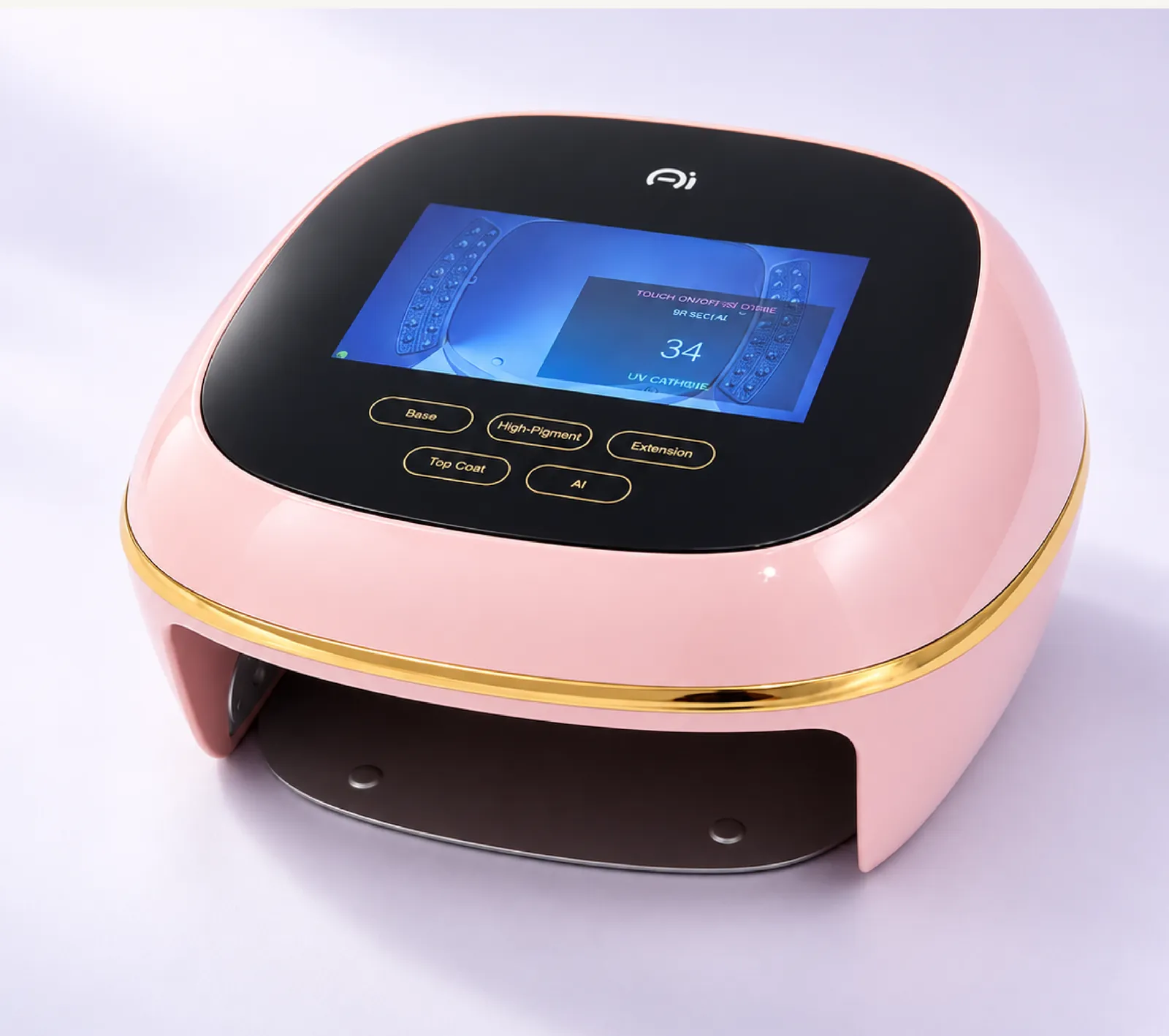
The AI Smart Nail Lamp: a 136-LED dual-wavelength array with camera-guided zoning, standard AC powered, battery optional.
The question your clients are already asking
Treat the light-exposure conversation as a commercial asset rather than a compliance chore. In the UK and Ireland the same three points come up at the desk almost every week:
“Will this make my hands go brown?” — a question about how much ultraviolet light lands on the skin around the nail, not about gel chemistry. “Does it hurt under the lamp?” — a question about heat control and hot spots. And “is this the same lamp every chair uses?” — which is a question about whether a chain has a standard, or whether each branch does its own thing.
All three are decided by the lamp specification, not by the brand of gel. A lamp with a timer and a fixed array can only answer them with a brochure. A lamp that can see the hand can answer them at the chair, in front of the client, which is worth more than any leaflet on the reception desk.
Same curing chemistry — the difference is where the light goes
It is worth being precise about this, because sloppy wording in a salon is how myths spread. Professional gel nails cure because photoinitiators in the gel absorb long-wave ultraviolet light — UVA — and start the polymerisation that hardens the coating. Both lamps commonly called “UV lamps” and lamps called “LED lamps” work this way: an LED chip emits a defined band of UVA, and the gel cures underneath it. The chemistry has not changed, and we do not claim that it has.
What has changed is control. A conventional lamp floods a fixed area for a fixed time: nail, fingertip, knuckle and a little of the surrounding skin all receive the same dose. Zoning the light so that only the nails are illuminated is a way to reduce unnecessary light exposure of the surrounding skin — the practical, honest answer to the darkening question, and the strongest thing your front desk can say to a client who has read one too many articles about hands ageing.
What 0.2-second vision detection actually does
The AI Smart Nail Lamp carries a 2 MP camera and an on-device neural engine rated at 0.5 TOPS. When a hand is placed under the head, the camera captures the hand, the model locates each nail in roughly 0.2 seconds, and the array lights only the segments that matter. No timers to set, no repositioning, no “did it get the little finger?” conversation.
For a busy UK high street salon the operational effect matters more than the specification. Curing becomes hands-free and repeatable: the technician can start preparing the next step while the current one finishes, and every chair produces the same result whatever the client’s hand shape or the depth of the nail bed.
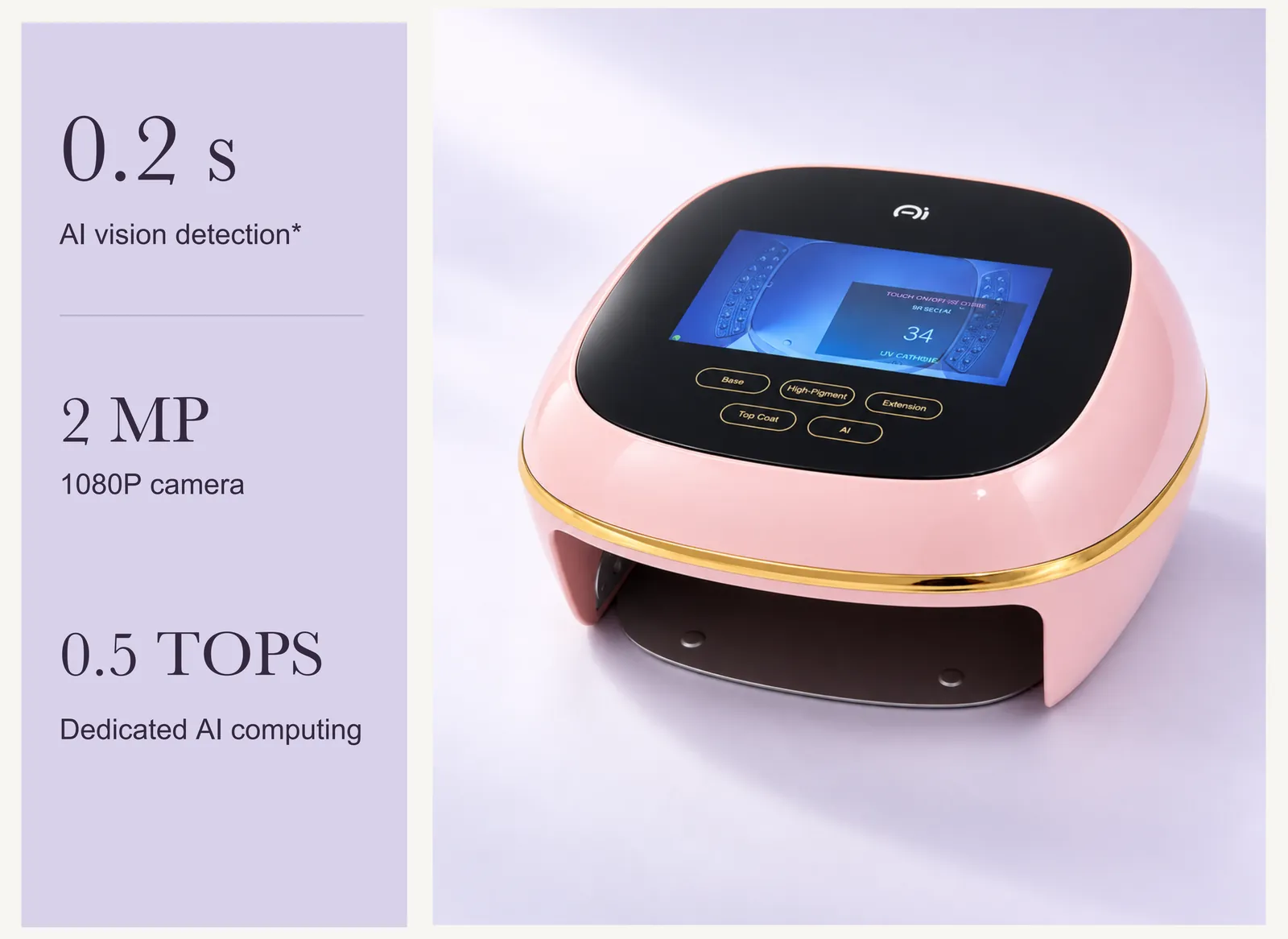
The camera locates each nail in about 0.2 seconds; the array then illuminates only the segments that matter.
136 LEDs across two wavelengths
The array holds 136 LEDs across two bands: 365–370 nm and 395–400 nm. Different gel systems are built around different photoinitiators, and covering two bands means one lamp cures the modern product families on the market without the technician keeping a second unit on the trolley — a real saving in a small treatment room.
For context when comparing quotations: the first wave of vision-assisted lamps in this category published specifications around 109 LEDs covering 365 nm and 405 nm from a single front-facing array. A 136-LED platform with front and side arrays spreads the output more evenly across the hand, which is why it can cure four nails plus a thumb consistently rather than relying on the client to rotate the hand perfectly.
Heat control and light-decay warnings
Two failures cause almost every complaint in a gel service: the heat spike while the coating exotherms, and a lamp that has quietly lost output after a year of daily use, leaving the client’s set soft at the free edge.
The lamp tracks both. Thermal management keeps the head inside a stable working window instead of rushing a cure and driving heat into the nail plate, and an LED light-decay warning tells the salon that the array is falling out of specification — before the redo appointments start arriving. For a chain, that turns a slow quality decline into a maintenance ticket.
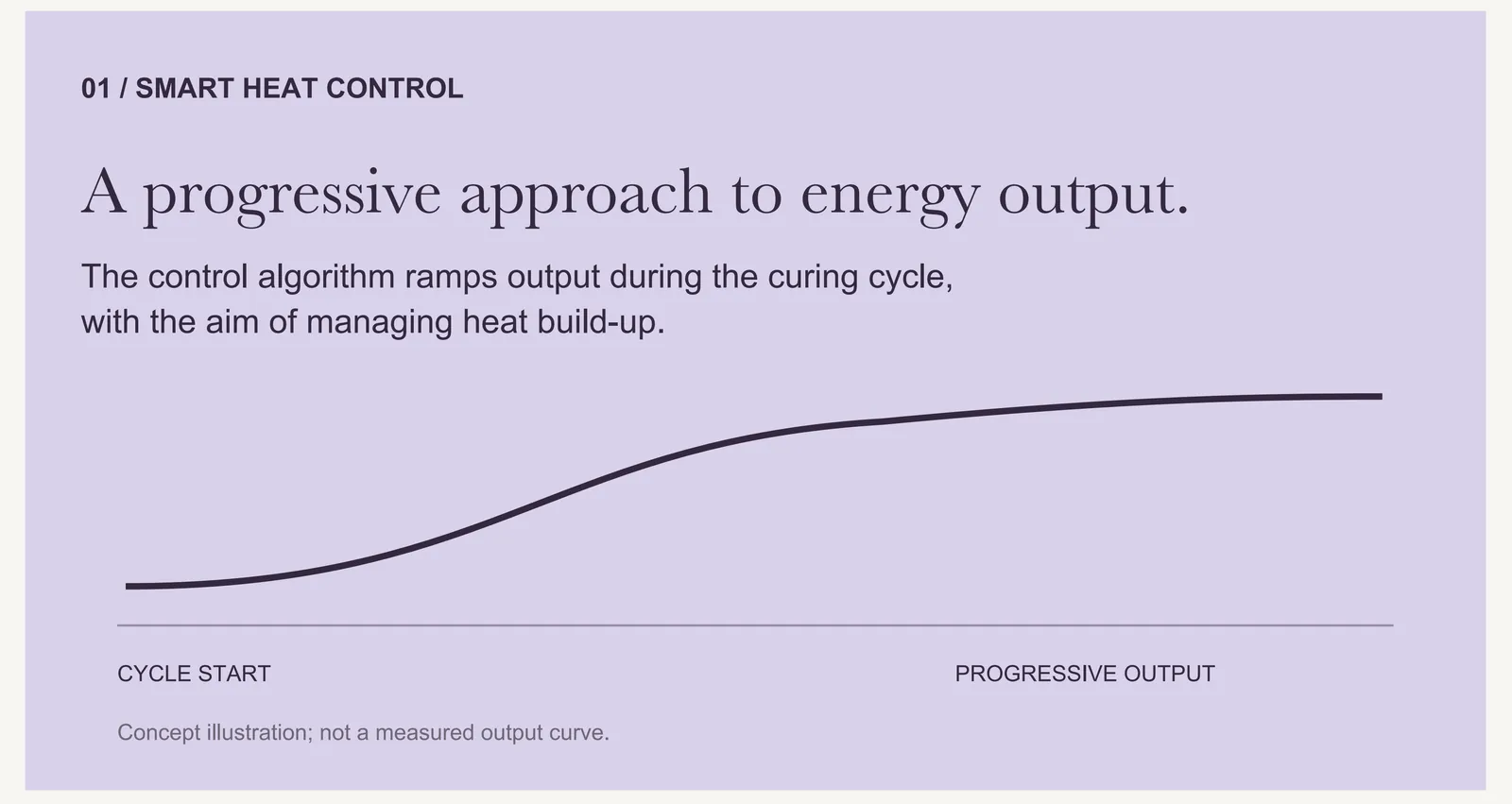
Smart heat control and a light-decay alert: consistent cures across a long service day, plus an early warning when the array needs attention.
A 5.5-inch screen in 29 languages
The 5.5-inch touchscreen runs 29 interface languages. In London, Birmingham, Manchester and Dublin that is not a marketing line — it is a staffing advantage. A salon that recruits across several language groups can put a new technician on the equipment in a single shift, and the screen becomes the training document. Tempered glass rather than membrane buttons also survives daily disinfection, which is the part of a lamp specification nobody advertises and every salon manager notices in year two.
Standardising across a chain — and the branding ladder
Where a group operates several sites, the sensible sequence is: sample unit first, then a standard configuration for the estate, then brand it. Our terms are built around that order.
White-label units start at 3–5 pieces, with a single sample unit available to evaluate. Standard configuration is AC powered without a battery; the 6000 mAh battery version is optional for mobile and event work. Custom branding runs from 300 units for a silk-screen logo on the standard colourway — matte white shell with purple chrome trim — with custom shell colours and chrome trim from 500 units and printed retail boxes at roughly 500 pieces. Early orders can ship in the standard box with multi-language manuals while your packaging artwork is being approved, so branding never delays a launch.
A lamp that answers the question at the chair
Full specifications and the complete accessory list are on the AI Smart Nail Lamp product page. If your committee is still comparing lamp types, the explainer on curing principle and light control is written to be shared with buyers who are not engineers; other regional sourcing guides sit in the market insights hub.
For a sample unit, a chain-wide quotation or a private-label plan for the UK and Irish market, contact Miro Wu, Dedicated Account Manager — email miro.wu@beautome.com or WhatsApp +86 188 1393 3019.