







AI Smart Nail Lamp for South African Salons: The Capex Window After Load Shedding
For three years, South African salon owners bought equipment around the grid rather than for the treatment room: an inverter here, a timer there, a generator for the busy Saturday. That period has paused. Eskom reported 497 consecutive days without load shedding in September 2026, and the equipment conversation in Johannesburg, Cape Town and Durban has shifted from backup power to throughput. Which makes this the moment a chain or distributor fixes its specification — before the first order is placed, not after.
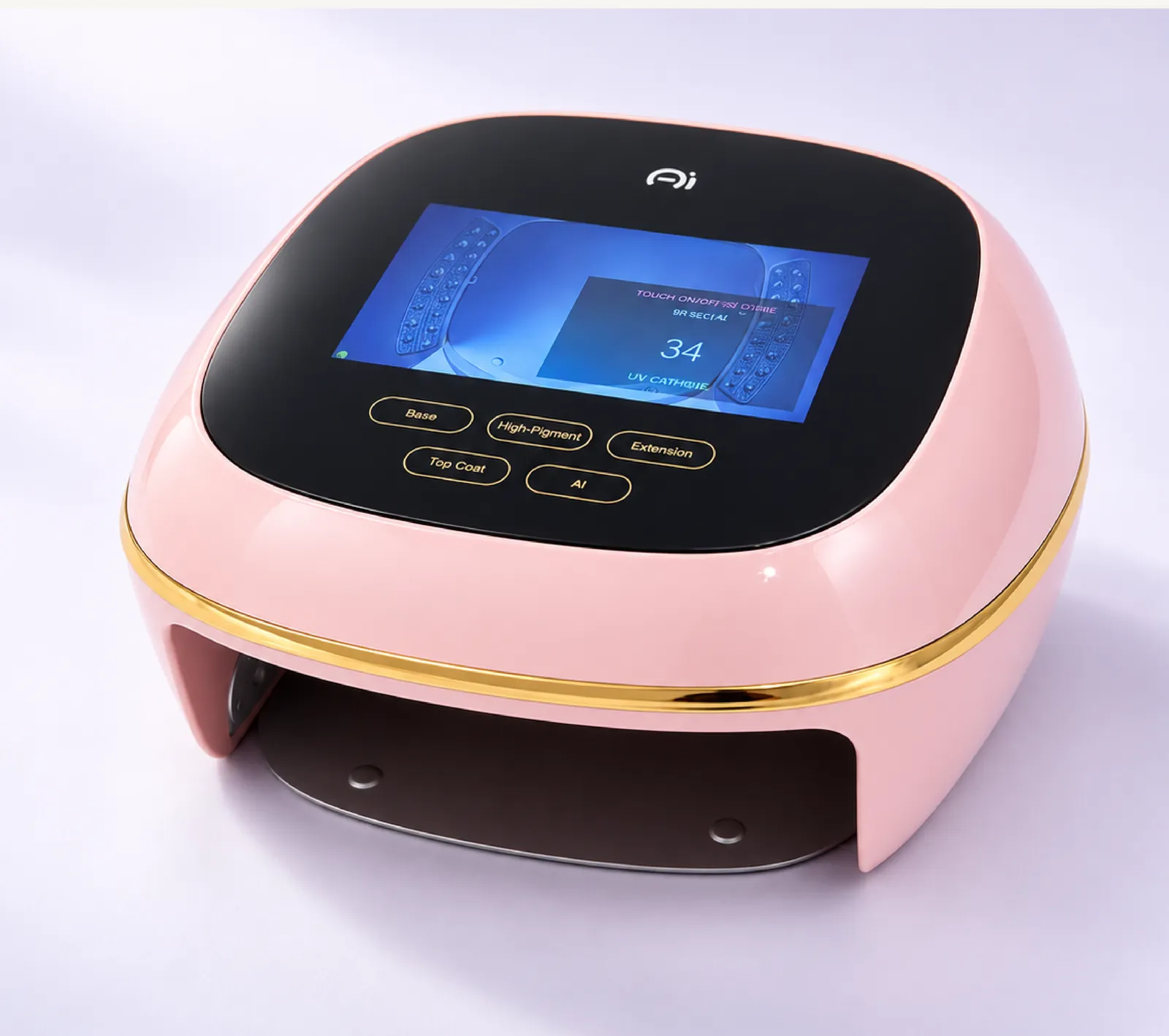
The AI Smart Nail Lamp — 136 dual-band LEDs, a 2MP camera and zoned emission that follows the nails instead of flooding the whole hand.
A market that stopped planning around outages
The numbers are unusual for this market and worth quoting to a buying committee. In its September 2026 system update, Eskom put the year-to-date Energy Availability Factor at 68.06%, the highest in six years, and confirmed 497 consecutive days without load shedding since 16 May 2025. Load reduction — the targeted, feeder-level intervention that is not load shedding — has been lifted for roughly 1.4 million customers, with about 247,600 still affected, concentrated in Gauteng and KwaZulu-Natal, and an eradication target of March 2027.
Two commercial consequences follow. First, equipment that was deferred in 2023 and 2024 is being bought now, and it is being bought on treatment-room logic: sets per chair per day, redo rate, staff training time. Second, the remaining interruptions are narrow and local — the parliamentary record describes load reduction windows of roughly 05:00–09:00 and 17:00–21:00 in high-risk zones, which for a salon are precisely the prep hours before the first client and the after-work rush.
497 days
Without load shedding as of September 2026, per Eskom’s system update
230 V
50 Hz single phase with a ±10% tolerance band, on a SANS 164-1 three-pin plug
136
Dual-band LEDs at 365–370 nm and 395–400 nm, in a 24×24×11.5 cm body
The file that decides whether the container lands
Electrical apparatus sold to ordinary users in South Africa falls under the compulsory specification VC 8055 (Government Notice R.89, Gazette 31844, 6 February 2009), which covers mains-powered equipment rated up to 500 V for household, light-industrial and office use. Compliance is evidenced by a Letter of Authority (LOA) issued by the NRCS, and the details in the specification are the ones that trip up first shipments:
- The test certificate must be less than 36 months old when submitted. A report that satisfied a European buyer in 2021 does not open this file.
- The applicant must be an established legal entity in South Africa — the manufacturer or the importer. A Chinese factory cannot hold the LOA itself, so agree in writing who applies, who holds it and who maintains it.
- Approval is per type and model, and design or component changes that affect a requirement must be reported to the NRCS. A silent LED-supplier change between orders puts the certificate out of step with the goods.
- Proof of approval within two working days on request, and proof of conformity of production within five. That is a document-retention obligation, not a formality.
- Rated 230 V, 50 Hz single phase, or a range including it, and safe within ±10%.
Then there is the scope question, which is worth settling before tooling rather than after. VC 8055’s own category list refers household appliances to SANS 60335 and luminaires to SANS 60598. A curing lamp sits awkwardly between the two: it is a light source, and it is also a bench appliance with a timer and a controller. Ask your certification route to state, in writing, which standard the model will be assessed against — because the test program, the marking and the manual content all follow from that answer.
One related instrument is worth a line in the file because buyers ask about it: the amended energy-efficiency specification VC 9008 was published on 28 August 2026 (Gazette 55257), with standby limits and a reinstated A–G label scale phasing in from August 2027. Its schedule lists regulated appliance categories — air conditioners, refrigeration, ovens, laundry. A nail lamp is not among them, but confirm that against the current schedule rather than assuming it from a supplier’s email.
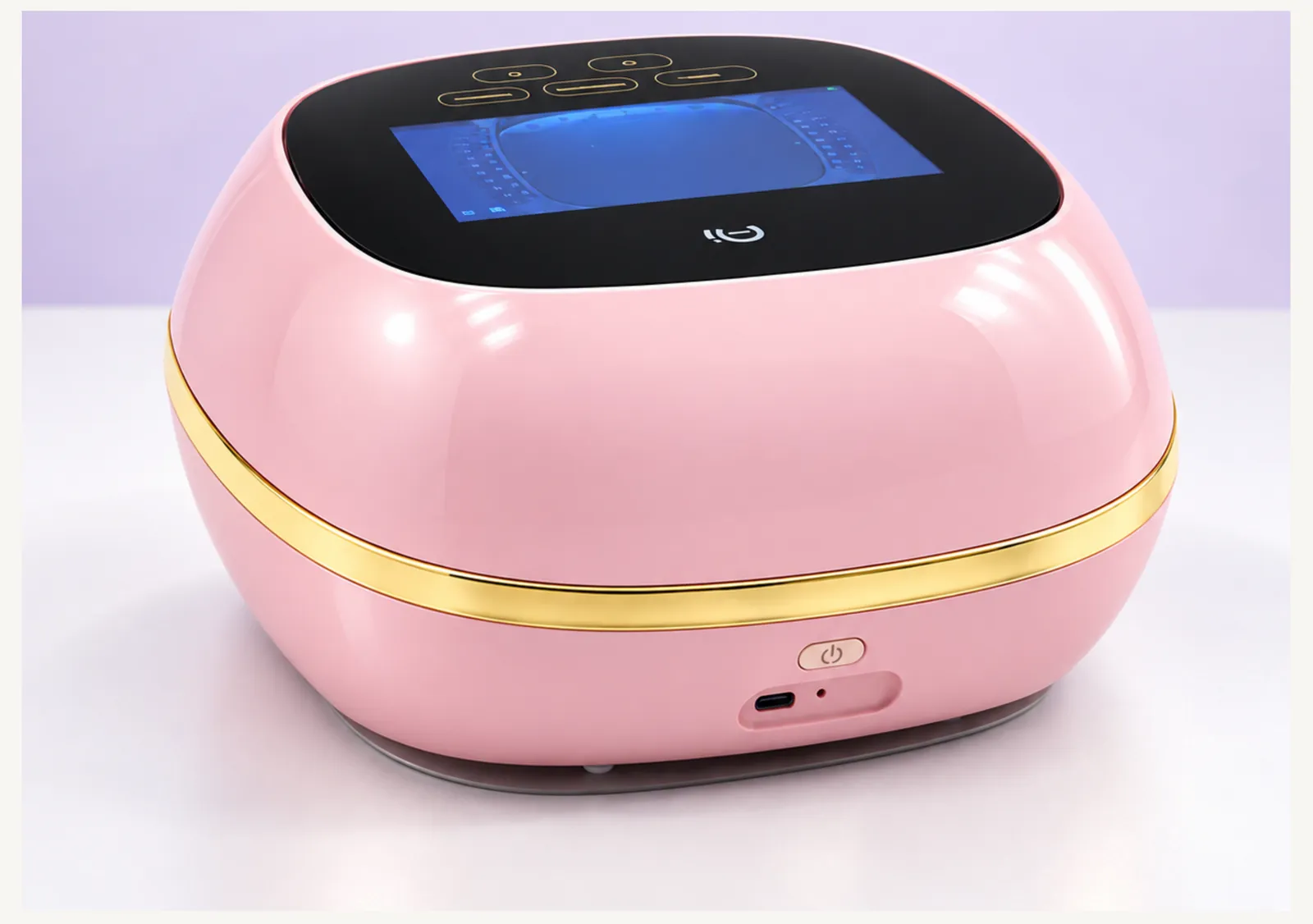
Rear power entry and USB-C detail. Voltage and frequency are fixed at the order stage; the battery is an option, not standard.
230 V, the plug, and the ±10% band
South Africa runs 230 V at 50 Hz with the large three-round-pin SANS 164-1 plug — not the European Schuko, not the UK rectangular pin. Specify the plug as a line item on the purchase order, because a moulded plug cannot be swapped at the port without re-testing the cord set, and a local adapter on a 1.8 m cable is the kind of detail a health-and-safety inspection notices.
The ±10% band means 207 V to 253 V. In buildings with heavy air-conditioning load and old distribution boards, the low end is where a curing lamp misbehaves: the controller browns out mid-cycle, the timer resets, and the technician re-runs a set she has already finished. Ask for the input range on the nameplate and for the behavior at the bottom of the band — not just the nominal 230 V.
What the lamp does for a chain that is expanding again
The commercial argument is consistency, and consistency is what a franchise sells. A 2MP camera with 0.5 TOPS of on-board processing locates the nails in about 0.2 seconds, and the 136-LED array then emits in zones rather than across the whole hand. The curing chemistry is the same as any LED curing lamp — LEDs emitting UVA in the 365–400 nm range — but the delivery is targeted: light goes where the nails are, which reduces unnecessary light exposure to the surrounding skin and the uneven cure that comes from a client holding her hand slightly off-center.
For a multi-site operator the operational wins stack up quietly: fewer redos on a set that cured unevenly, a 5.5-inch touchscreen with 29 language packs so a new hire reads the menu in the language she works in, and thermal monitoring that warns before output drops instead of after a client complains. South Africa recognises eleven spoken official languages; the console covers 29, so pick the two or three your training manual actually uses and confirm those builds on the order rather than assuming the default set. The body is compact at 24×24×11.5 cm, which matters in rooms where the lamp shares a narrow table with a drill and a dust extractor.
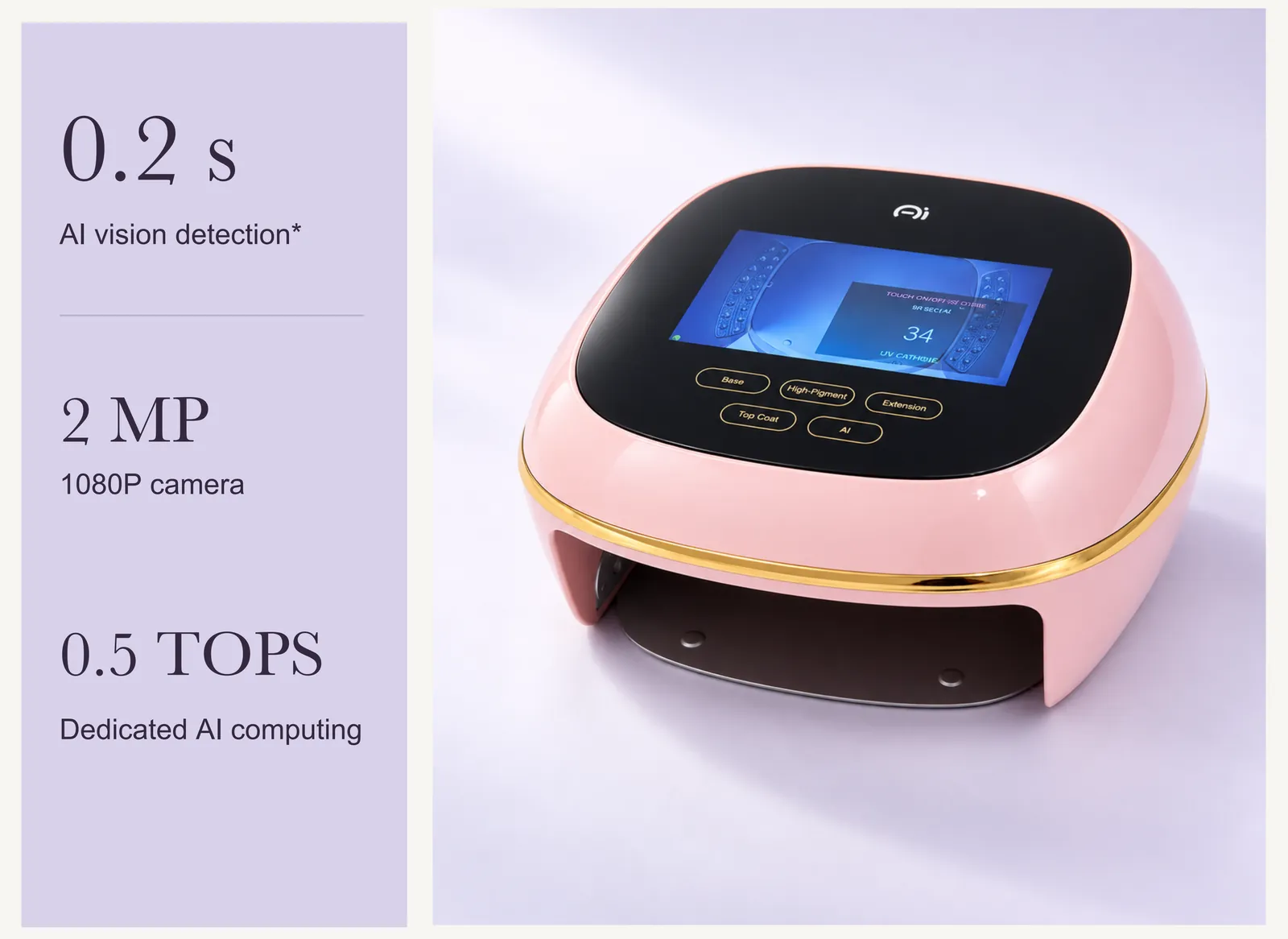
Vision detection mapped to nail position — the array lights the nails, not the whole hand.
The battery is an option, not a default
The standard configuration is AC powered, with no battery. A 6000 mAh lithium version is available on request, and for this market it has a specific, narrow justification: mobile technicians, and the roughly 3.4% of Eskom customers still on load reduction whose windows land on salon prep hours. It doubles as a differentiator for a distributor selling into areas where the feeder schedule is unpredictable.
What it does not do is substitute for a specification. A battery changes the electrical file, the shipping classification and the price, so decide it at the order stage. Chains that standardise on one SKU and then add batteries later end up with two configurations on the same invoice.
Commercial terms, stated plainly
For an evaluation, white-label or neutral units start at 3–5 pieces, and a single sample can be shipped for testing on your own gel line, at your own room temperature, on your own staff’s hands. Custom branding — logo, colorway, retail packaging — starts at 300–500 units. The AI Smart Nail Lamp product page carries the full specification, and the OEM and ODM page sets out the branding route. If you also run waxing rooms, the South African wax heater guide covers the NRCS file from the equipment side.
Quick FAQ
Does a CE or IEC report replace the NRCS Letter of Authority?
Is one SKU enough for the whole country?
Is the 6000 mAh battery included?
Next step
Send us your site list with the province, the outlet type and whether any location is still on a load reduction schedule. We will come back with the build configuration, the document pack your LOA applicant will need, and a sample plan — single units for evaluation, 300–500 for a branded line. The BeauTome blog carries the market-by-market equipment notes. For a quotation, contact Miro Wu, Dedicated Account Manager — email miro.wu@beautome.com or WhatsApp +86 188 1393 3019.