







AI Smart Nail Lamp for Colombian Salons: Two Grids, 60 Hz and the RETIE File
Colombia is not one electrical market. A Bogotá studio and a Cartagena hotel salon can sit on different voltages, and a franchise that standardizes on one SKU discovers this at the second location, not at the first. Add a conformity file that has to be opened before the container ships, and the specification conversation starts to look very different from the one a buyer has with a local distributor.
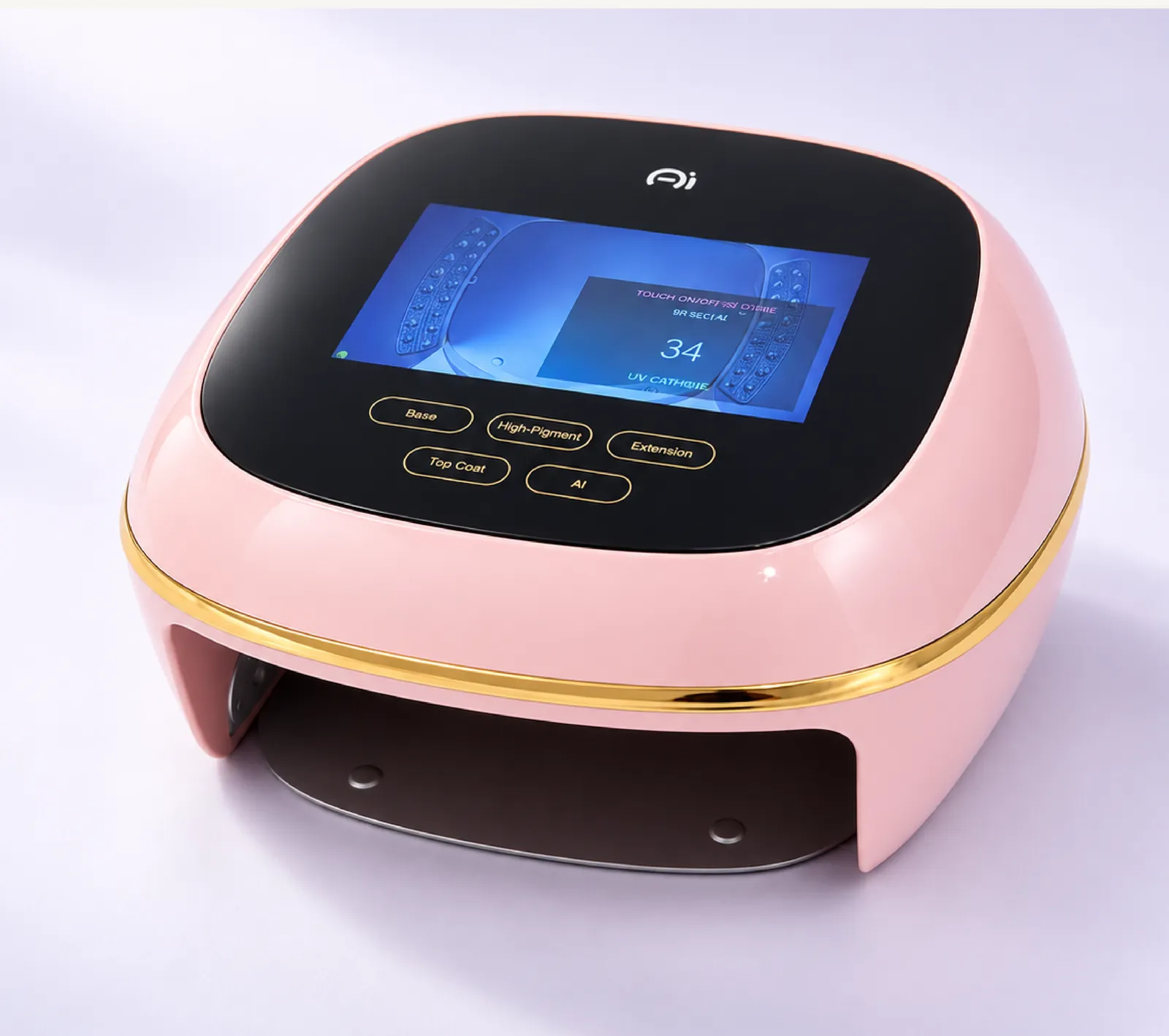
The AI Smart Nail Lamp — 136 dual-band LEDs, a 2MP camera and zoned emission that follows the nails rather than the whole hand.
A franchise market that buys equipment centrally
Colombia’s nail business has moved from independent studios toward formats. Research published in 2025 put the country’s nail salon market above USD 100 million, growing at roughly 5% a year, with franchise models doing the heavy lifting — one domestic nail spa chain operates 37 locations, 28 of them franchised, and reports more than a million services a year (Actual Market Research, 2025). Beauty and personal care overall reached about USD 4.28 billion in 2025, with per-capita spend of roughly COP 530,000, up 4.8%.
That matters for a lamp supplier because central purchasing changes the questions. An independent studio asks what a lamp costs. A franchise asks whether the same unit can be installed in fourteen rooms across five cities, whether staff can operate it without a two-week training program, and whether the paperwork exists to clear customs without a delay that costs a month of opening schedule.
110–120 V
Standard single-phase supply at 60 Hz; 208 V three-phase is common in commercial buildings, with 220 V pockets
136
Dual-band LEDs, 365–370 nm and 395–400 nm, in a 24×24×11.5 cm body
0.2 s
Vision detection that maps nail position before the LEDs switch on, zone by zone
What the grid actually looks like
Most of Colombia runs 110–120 V at 60 Hz, single phase, with type A and B outlets dominating. Commercial buildings frequently bring in 208 V three-phase, and there are 220 V pockets that a national chain will eventually hit. The practical consequence is arithmetic, not opinion: a unit built for 220 V and plugged into 120 V will switch on, light up and never deliver its rated output, because power falls with the square of the voltage ratio.
So specify voltage as a build parameter on the purchase order, not as an accessory. And specify current as well: for the same wattage, a 120 V unit draws roughly twice the current of a 220 V unit, which changes cord gauge, breaker selection and the plug on the end of the cable. In a salon where four lamps and four wax pots share a circuit that was sized for hairdryers, that difference shows up as a tripped breaker during a full appointment book — the kind of failure that gets blamed on the lamp.
60 Hz is a separate question from voltage
Frequency is where a specification quietly drifts. A curing lamp is a thermal system as much as an optical one: the LEDs generate heat, a fan moves it, and the controller decides when to warn the technician that output has decayed. A fan and an airflow path validated at 50 Hz will not behave identically at 60 Hz, and the difference lands in noise, in surface temperature and in how quickly the head recovers between clients.
Ask for test data recorded at 60 Hz, 120 V — not a converted 50 Hz report with a note. Our answer to that request is simple: the unit is built to the voltage and frequency on the order, and the cooling and thermal-warning behavior is documented for that configuration, including the light-decay warning that tells the technician the head needs attention before a set fails to cure.
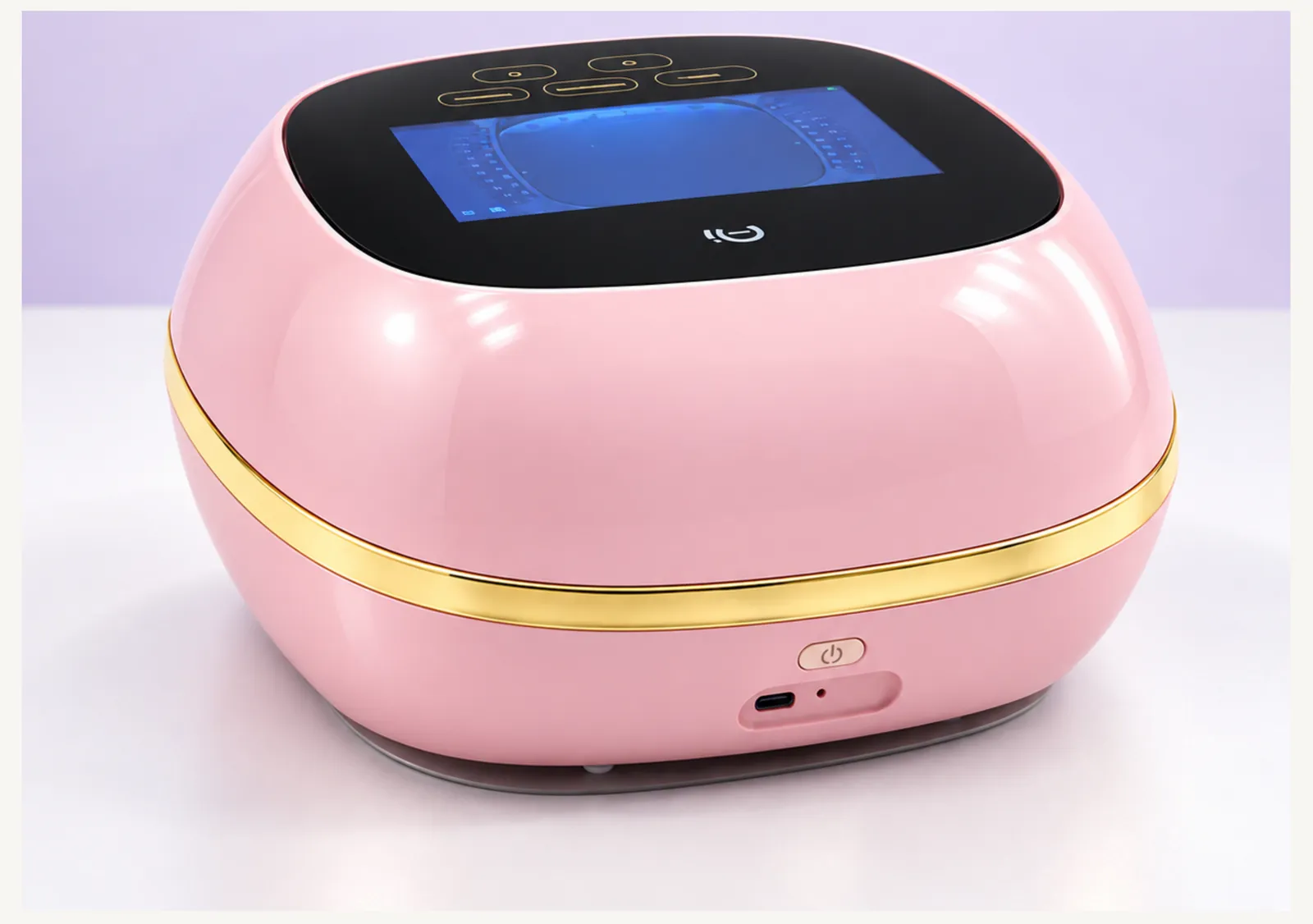
Rear power entry and USB-C detail. Voltage and frequency are fixed at the order stage; the 6000 mAh battery is an option, not standard.
RETIE is the file that stops the container
Electrical products entering Colombia fall under RETIE, the technical regulation for electrical installations, administered by the Ministry of Mines and Energy. In practice a conformity certificate has to be issued through a certification body accredited by ONAC, and a test report from an overseas laboratory, a CE declaration or a UL listing is not a substitute for it. Certification bodies have been working to Resolution 40117 of 2024, the re-issued RETIE text that took effect on 1 January 2026 — confirm the applicable resolution and the accepted assessment route with your certification body or customs broker before you build, because the text does move.
Three points that decide whether a first shipment is smooth:
- Scope first, line by line. Not every item in a salon fit-out is a RETIE product, and the assessment is made per product family rather than per shipment. Settle scope at enquiry stage, not at the port.
- The certificate runs through a Colombian entity. Foreign manufacturers do not hold it directly; the importer, distributor or local representative does. Agree in writing who applies, who holds it and who maintains it after the first year.
- Batch versus multi-year. A batch certificate covers a single import and suits a trial order; a multi-year certificate suits a chain that will reorder. The two routes cost differently and neither is right for every buyer.
Spanish is not optional either. Manuals, warnings and nameplate data belong in Spanish, and the unit should be comfortable in the tropical high-humidity conditions that certification testing assumes for this market. Related regulations sit alongside RETIE and are often confused with it: RETILAP governs lighting products and RETIQ governs energy labeling for defined appliance categories. Whether a curing lamp is treated as an appliance, a luminaire or neither is exactly the scope question above — get it answered in writing.
The lamp is not a cosmetic
One confusion is worth clearing early, because it wastes weeks. Gel polish, semi-permanent enamel and related products are cosmetics in Colombia and fall under the Andean framework administered by INVIMA, with mandatory health notification before they are marketed. The lamp is not a cosmetic. It is an electrical device, and its file is RETIE plus labeling, not a cosmetic notification. A distributor who assumes the lamp travels on the polish registration will find the container held.
The other regulatory touchpoint is the salon itself: municipal health authorities inspect premises for disinfection, waste segregation and instrument handling — Medellín alone ran 210 such inspections in the 2025–2026 cycle. Equipment that is easy to wipe down and has no exposed fasteners where debris collects is a small but real advantage in that inspection.
What the lamp does inside a franchise format
The commercial argument for vision-guided curing is consistency, and consistency is what a franchise sells. A 2MP camera with 0.5 TOPS of on-board processing locates the nails in about 0.2 seconds and the LED array then emits in zones rather than flooding the whole hand. The curing chemistry is the same as any LED curing lamp — LEDs emitting UVA in the 365–400 nm range — but the delivery is targeted: light goes where the nails are, which reduces unnecessary light exposure to the surrounding skin and the uneven curing that comes from a client holding her hand slightly off-center.
For a chain, the operational wins stack up: fewer redoes on a set that cured unevenly, a 5.5-inch touchscreen with 29 languages so a new hire reads the menu in the language she actually works in (confirm the Spanish and Portuguese builds on the order), and thermal monitoring that warns before output drops instead of after a client complains. The body is compact at 24×24×11.5 cm, which matters in rooms where the lamp shares a narrow table with a drill and a dust extractor.
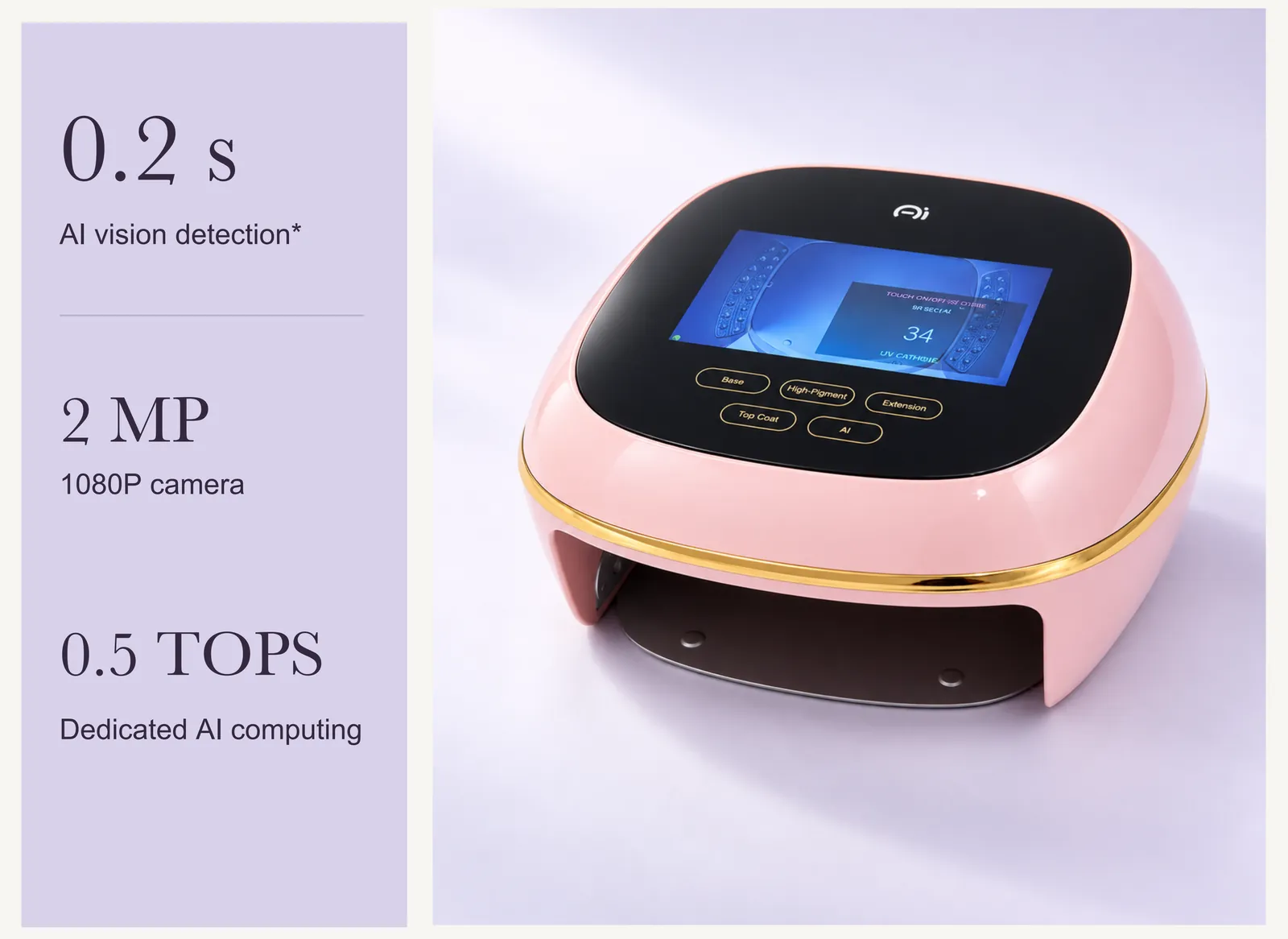
Vision detection mapped to nail position — the array lights the nails, not the whole hand.
Commercial terms, stated plainly
The standard configuration is AC powered, no battery. A 6000 mAh lithium battery version is available on request — useful for mobile technicians and for rooms with unreliable circuits, but it is an option and it changes the certification and shipping paperwork, so decide it before the order, not after.
For a first evaluation, white-label or neutral units start at 3–5 pieces and a single sample can be shipped for testing on your own clients and your own polish line. Custom branding — logo, colorway, retail packaging — starts at 300–500 units. If you are evaluating the category before committing to a chain rollout, the sample route is the one that answers the only question that matters: does it cure your gel, at your room temperature, on your staff’s hands. The AI Smart Nail Lamp product page lists the full specification, and the Brazil guide covers the dual-voltage ordering logic for the region.
Quick FAQ
Can one SKU serve all of Colombia?
Does a CE or UL report cover the RETIE requirement?
Is the battery included?
Next step
Send us your site list with the voltage at each location, the outlet type, and whether you are buying for one studio or a franchise rollout. We will come back with the correct build configuration, the Spanish-language document pack, and a sample plan — single units for evaluation, 300–500 for a branded line. The OEM and ODM page covers the branding route; for a quotation, contact Miro Wu, Dedicated Account Manager — email miro.wu@beautome.com or WhatsApp +86 188 1393 3019.