




AI Smart Nail Lamp for Canadian Salons: Bilingual Menus, Provincial Marks and the 120 V Spec
Canada is a small revenue line next to the United States and a disproportionate amount of paperwork for its size. Both facts are why it rewards a supplier who has actually read the rules: a console that speaks French, a safety mark that a provincial electrical authority recognises, a manual and label in two languages, and a 120 V specification that does not need an adapter. Here is what a Canadian salon chain, franchise or distributor should put in the purchase brief.
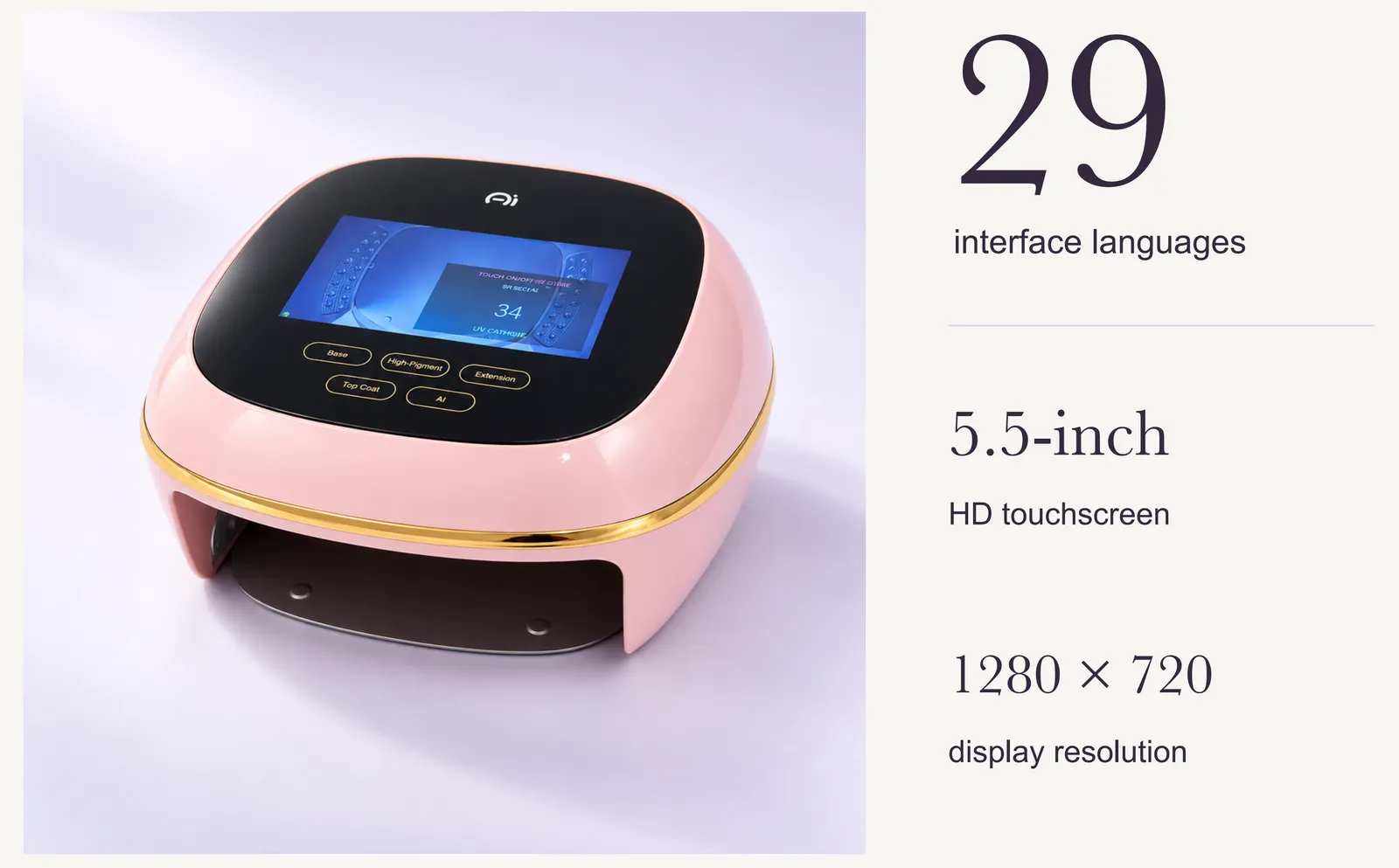
A 5.5-inch console carrying 29 interface languages — the specification that decides whether one menu set can serve Ontario and Quebec.
A market that is not a scaled-down copy of the US
Canada is the second-largest nail market in North America and one of the smallest by count of large operators. Industry research puts the North American nail salon market at USD 16.2 billion in 2025, growing to USD 34.2 billion by 2035 at a 7.8% compound rate, with the United States taking USD 14.3 billion of that and Canada contributing USD 1.9 billion — about 11.7% of regional revenue, projected to reach USD 3.9 billion by 2035. The same research notes that growth is concentrating in extensions, nail art, premium environments and multi-service formats rather than in classic walk-in volume, and that Canadian expansion is a franchise-and-boutique story rather than a single-store story.
USD 1.9 B
Canadian nail salon revenue, 2025 — on a path to USD 3.9 B by 2035 (Global Market Insights, 2025)
~41,000
Hair and nail salon businesses in Canada, employing roughly 67,700 people (IBISWorld, 2025)
59%
Share of Canadian personal-care establishments with fewer than five employees — a small-operator market (Statistics Canada, 2025)
That structure changes what you sell. In Canada the decision-maker is usually an owner-operator with four to eight stations, a franchisee who has to reproduce someone else’s standard, or a distributor whose territory crosses a provincial border. All three care about consistency, documentation and language — and none of them want to become an electrical-compliance specialist to buy a lamp.
Two official languages, one console
Quebec is where this stops being a nicety. The province’s Charter of the French Language was substantially amended by Bill 96, and the remaining provisions came into force on 1 June 2025: text on a product, its container, its packaging or any document supplied with it must be in French, and any other language present may not be given greater prominence. Public signage and commercial advertising must be markedly predominant in French, and the exemption that once let unregistered non-French trademarks sit on packaging without translation no longer applies — the mark now has to be registered to qualify. There is transitional relief: non-compliant goods manufactured before 1 June 2025 may continue to be sold in Quebec until 1 June 2027, which is a shelf life, not a licence. Federal rules point the same way for goods in general: most prepackaged consumer products sold in Canada carry both English and French information.
Two practical consequences for equipment. First, if the lamp is sold to a Quebec salon or through Quebec retail, plan bilingual labeling and a bilingual manual from the artwork stage — retro-fitting that after the first container is the expensive version. Second, the interface itself is part of the buying decision. Our lamp carries a 5.5-inch touchscreen with 29 interface languages, and French is one of the set a group can standardise on; confirm the exact language list you need at order stage, because firmware is fixed during production, not after arrival. For a franchise whose technicians rotate between provinces, one console language set removes a training task per new hire instead of adding one.
What the lamp has to do at the chair
Gel services at volume expose the same three weaknesses in Canada as anywhere else: hands that are not placed where the lamp expects them, light delivered across the whole hand rather than the nails, and output that decays without anyone noticing.
- Locating the hand. A 2 MP camera with 0.5 TOPS of on-device compute finds the nails in roughly 0.2 seconds before the emitters come up, so the technician is not fighting a fixed position box on a busy Saturday.
- Driving the light in zones. 136 dual-band LEDs at 365–370 nm and 395–400 nm are segmented rather than driven as one flat panel. Only the segments over the nails are lit, which is what makes the next point possible.
- Reducing what reaches the skin. Because the light path is targeted, exposure of the surrounding hand is reduced — the practical result technicians describe as avoiding a tanned hand after months of gel work. This is a statement about how the light is delivered, not about a different chemistry: like every professional curing lamp, ours uses LED chips that emit long-wave ultraviolet light in the UVA range, and gel is formulated to cure under it. The difference is targeting and duration.
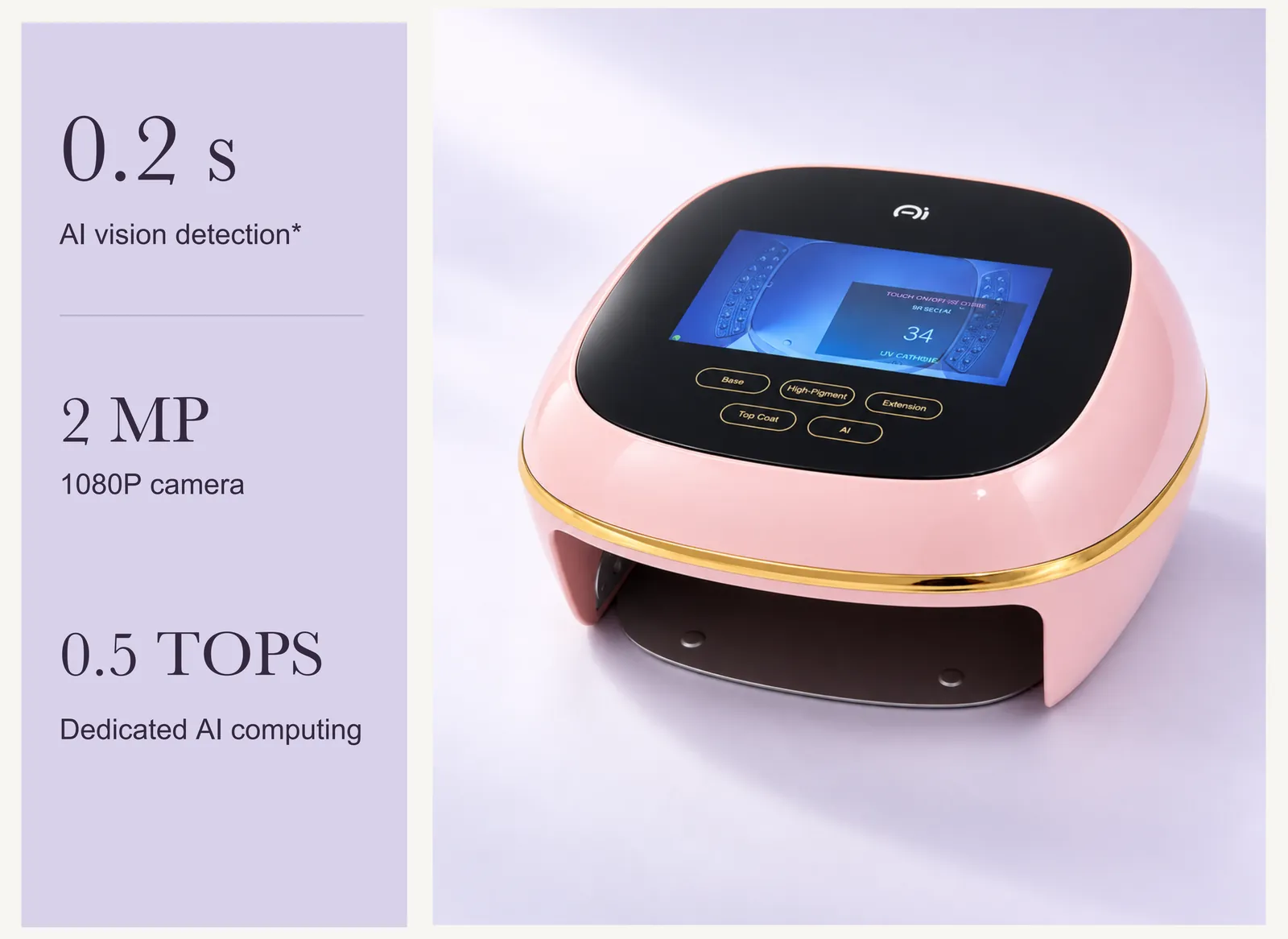
Detection at 0.2 s with a 2 MP camera and 0.5 TOPS on the device — the step between the client’s hand going in and the LEDs coming up.
Two further specifications matter to a group rather than a single chair. Smart heat control with a light-decay warning reports a fall in output instead of quietly curing more slowly, which is how a chain keeps results comparable across units of different ages. And a compact 24 × 24 × 11.5 cm body with a rear power inlet and USB-C suits the narrow stations and shared benches typical of Canadian urban studios.
Why a CE mark gets you nowhere in Ontario
Canada has no single federal electrical safety mark. Each province, through its own authority — Ontario’s ESA, Quebec’s RBQ, Technical Safety BC, Alberta’s Safety Codes Council among them — requires products to carry certification from a body accredited by the Standards Council of Canada, and the CSA mark is the most widely recognised of them. The technical route is the CSA C22.2 series, with the household-appliance safety standard cited as CSA C22.2 No. 60335-1. Equivalent marks from other SCC-accredited certifiers, including cUL and cETL, are accepted by the same provincial authorities, so the source of the mark matters less than the accreditation behind it. Two details trip up importers: a US-only UL listing is not the Canadian equivalent — you need the “c” mark — and ISED type certification applies to equipment with a radio or telecom interface, which a curing lamp without a wireless module normally does not have, though the classification should be confirmed for the exact configuration you order.
Power is less exotic than Brazil’s dual grid but still worth specifying: 120 V, 60 Hz with a NEMA 5-15 plug. Our standard shipment is AC powered with no battery; a 6000 mAh lithium version is available on request for mobile and at-home technicians, and a salon station should run on mains. What we supply is the technical file your certifier works from — accredited-laboratory test reports, circuit and component documentation, bilingual manual source files and label artwork. The certification itself is held by the Canadian entity that imports or markets the product, which is also the party the provincial authorities expect to be accountable.
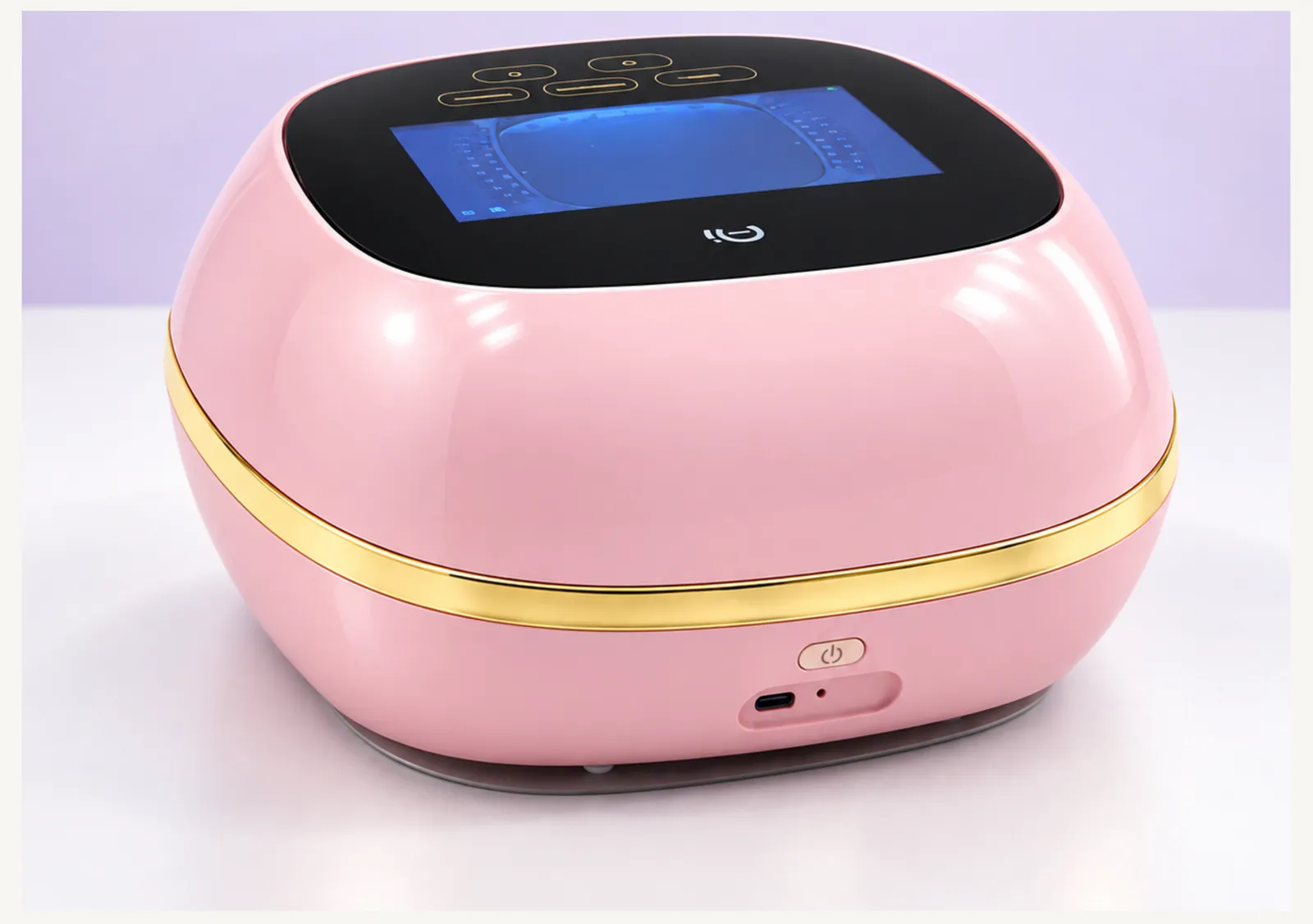
Standard configuration is AC with no battery; the 6000 mAh pack is quoted on request for mobile technicians.
Sample first, then the range
There is no reason to commit to a container before the lamp has been in front of Canadian technicians. A single unit can be shipped for evaluation, white-label or neutral (unlabeled) orders start at 3–5 units, and custom branding — logo, colorway and retail packaging — is quoted from 300–500 units, depending on how much of the shell and packaging changes. Full specifications are on the AI Smart Nail Lamp product page, the customization route is set out on the OEM & ODM page, and the parameter-by-parameter comparison against a first-generation AI lamp is in the spec comparison if your buying committee wants the numbers in one page.
Quick FAQ
Can the interface be delivered with French as well as English?
Which safety mark does a nail lamp need to be sold in Canada?
Is the lamp available in a cordless version for mobile technicians?
Next step
Send your target provinces, the voltage and plug type, and the language set your technicians need, and you will get a quotation with those items already specified. For a sample unit, a bilingual labeling plan or a private-label discussion for the Canadian market, contact Miro Wu, Dedicated Account Manager — email miro.wu@beautome.com or WhatsApp +86 188 1393 3019.