






AI Smart Nail Lamp for Qatari and Kuwaiti Distributors: Two Certificates, Two Clocks
The Gulf looks like one market from a container ship and behaves like six from a customs desk. A distributor in Doha and a distributor in Kuwait City can sell the same lamp to the same kind of three-chair studio, yet the two shipments do not travel on the same paperwork. One market asks for a product file that lasts years and a per-consignment certificate alongside it; the other asks for a technical inspection report tied to a single invoice. Get that rhythm wrong and the lamp is compliant and still stuck at the port.
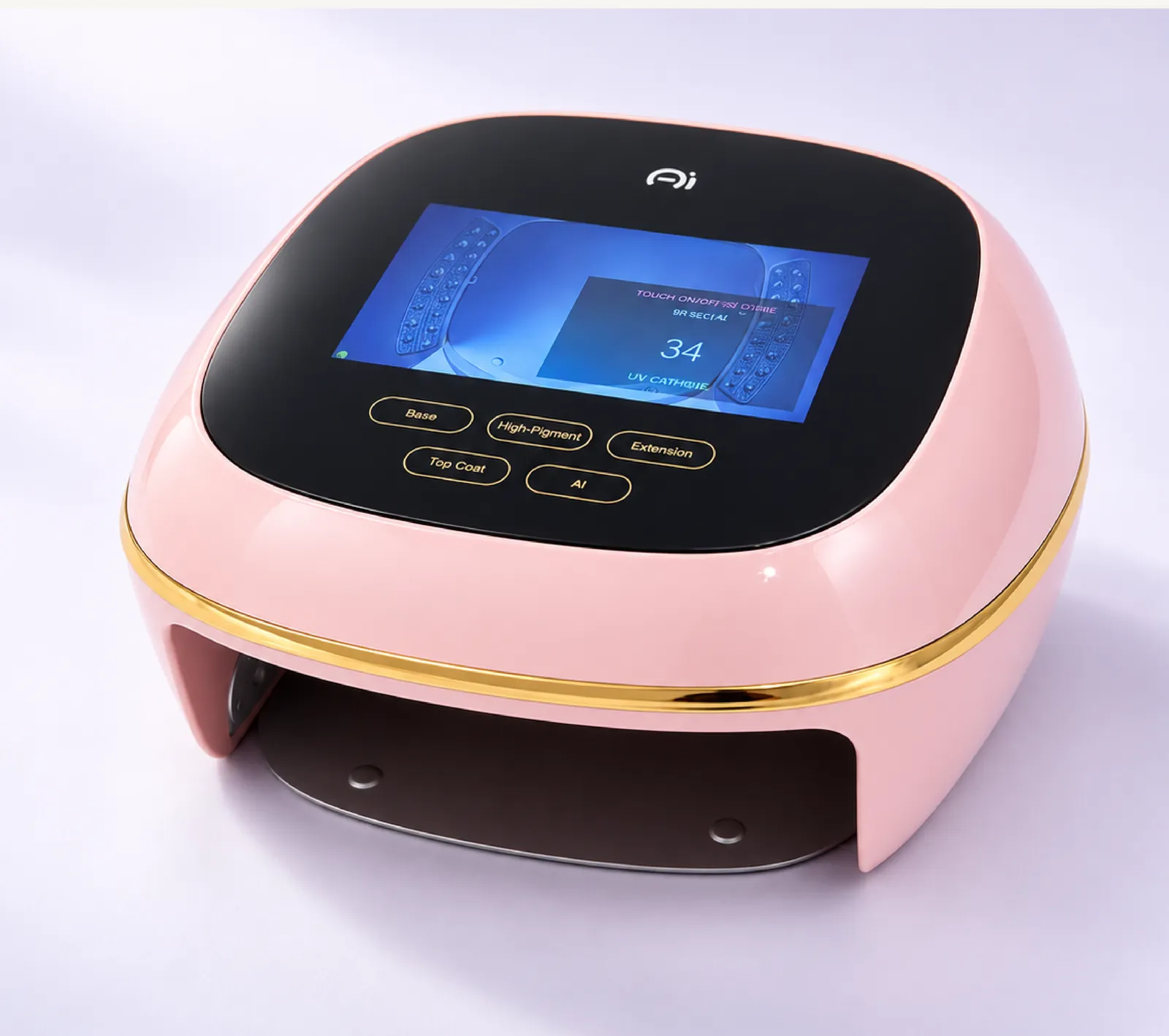
Same lamp body for both markets. The nameplate band, the cord set and the label language are what change.
One product file, one shipment file
Every GCC state sits inside the same regional framework and then adds its own front door. The regional layer is the GCC product certificate — the G-Mark — issued against the Gulf low-voltage technical regulation and typically quoted with a three-year validity and surveillance in between. The national layer is a consignment document: Qatar routes it through QGOSM-recognized conformity bodies as a certificate of conformity, Kuwait routes it through the KUCAS scheme as a Technical Inspection Report, issued against a specific invoice and a specific bill of lading.
Certification bodies publishing guidance through 2025 and 2026 describe the same division of labour in both countries: the product certificate proves the model is safe, the consignment document proves this shipment is that model. Kuwait adds a second layer that is easy to miss — a product-level technical evaluation report can exist with its own validity, and the per-shipment report is still requested on top of it. In practice that means a distributor with twelve deliveries a year is not buying one certificate, they are buying a cycle.
3 years
Typical validity quoted for a GCC product certificate, with surveillance in between — confirm the exact term with the appointed body
1 : 1
One consignment document per invoice and bill of lading in both Qatar and Kuwait — it cannot be carried forward to the next shipment
240 V
Kuwait’s supply, 50 Hz, on BS 1363 or BS 546 plugs — a 220 V-only rating is the one that gets questioned
The 240-volt nameplate problem
Qatar publishes 220–240 V at 50 Hz. Kuwait runs a nominally 240 V supply, and the certification guidance for KUCAS is unusually blunt about it: ratings such as 220–240 V, 230 V, 230–240 V and 240 V are accepted, while an appliance rated at 220 V alone is the case that gets refused. Nothing about the electronics changes. What changes is whether the label on the back of the lamp says a band that contains the number the inspector is looking for.
That is an order-level decision, not a stock decision. Ask for the destination before the rating plate is printed, and write the band into the purchase order as its own line: voltage band, frequency, and the plug. Both countries use BS 1363 type G on the wall, and Kuwait additionally recognizes BS 546; the plug is a moulded component with its own approvals, so a “GCC order” that mixes Doha and Kuwait City stock should still be split by cord set rather than quietly shipped on one.
The electrical reality behind the label matters too. A salon in Doha or Salmiya runs its treatment room on the same ring main as the dryer, the steriliser and the air conditioning, and the lamp draws a modest, steady load — which is exactly why a stable input is worth specifying rather than assuming. Ask us for the input range and the tested frequency coverage in writing; if a distributor intends to move stock between the two countries, say so early and the file is built once instead of twice.
Arabic is a layout decision, not a translation
Qatari requirements are explicit that labels and instruction manuals carry Arabic and English, and the inspection is done on the physical label, not on a PDF you can send later. A monolingual carton fails at the point of inspection regardless of how good the lamp is. Kuwaiti practice follows the same direction in the Gulf context. For a private-label buyer this reshapes the artwork brief: two languages on a carton that may only be 24 cm wide, plus the importer’s name and address, the model number exactly as it appears on the certificate, and the country of origin.
Software is the other half. An Arabic menu is not the same thing as an Arabic interface: right-to-left rendering changes where the numbers, the units and the warning icons land, and a layout that reads perfectly in English can put a timer value in the wrong corner. We test the Arabic pack on the actual 5.5-inch console before shipping, with the language locked at the factory to the set the buyer needs — Arabic plus English for a Doha chain, Arabic, English and Hindi for a mixed team in Kuwait, where a large expatriate technician pool is the norm. Print the quick-start card in the same set; a technician who can read the heat and light-decay warnings in her own language uses them.
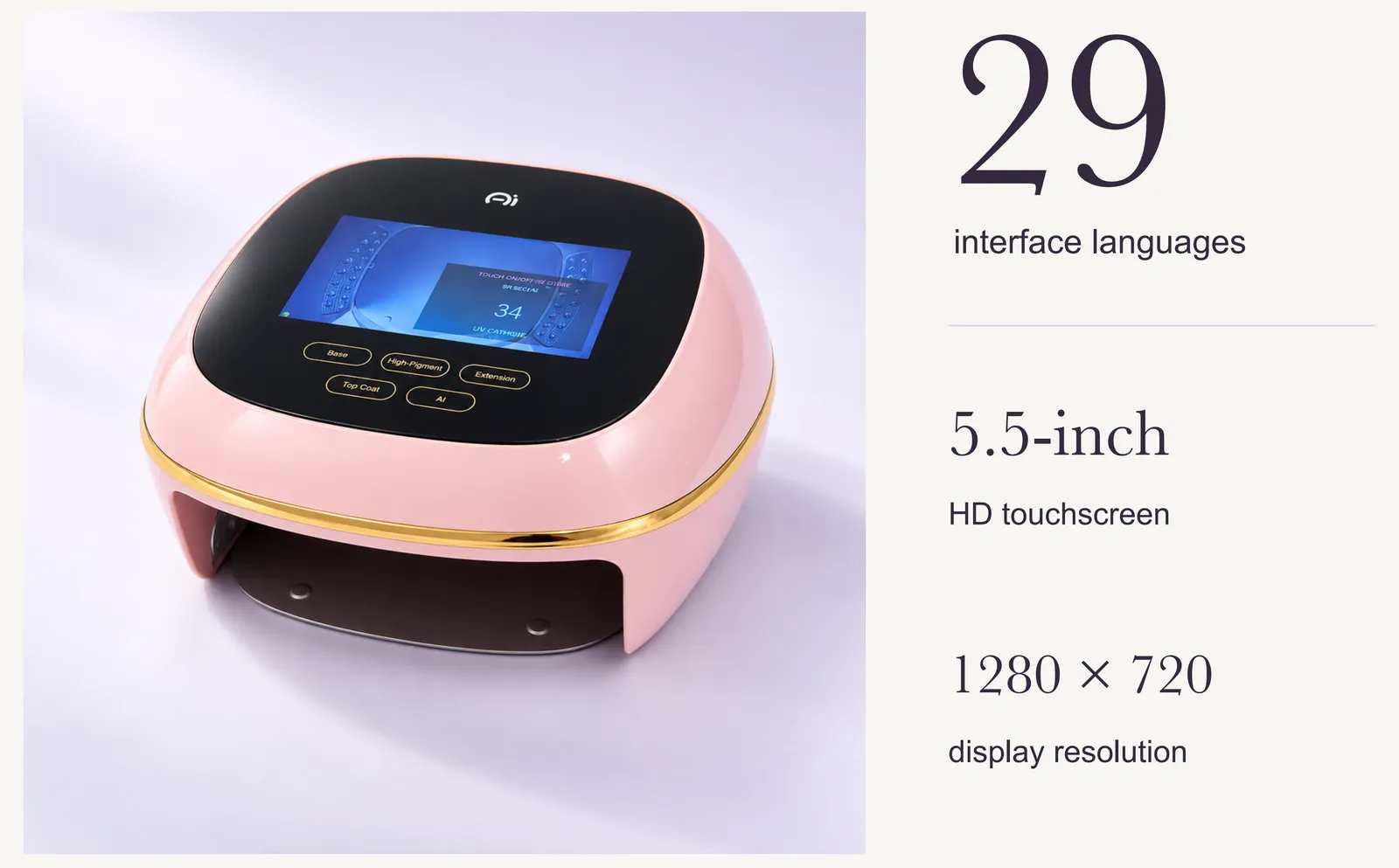
Twenty-nine languages on the console; the useful number for a Gulf buyer is the two or three that get locked in.
What the light does in a three-chair studio
Curing speed is not the argument in this region. Every professional lamp cures gel. The argument is the twenty minutes a client’s hand spends under a head that also lights the skin around it, in a market where hand care is discussed openly and where a bride’s appointment cannot be rebooked into next week. The AI Smart Nail Lamp carries 136 dual-band emitters at 365–370 nm and 395–400 nm and cures on the same UVA principle as every other professional LED lamp in the category — that part is not a differentiator and we do not pretend it is.
What differs is control. A 2-megapixel camera with 0.5 TOPS of on-device compute locates the nails in about 0.2 seconds and drives only the zones above them, so the surrounding skin receives less unnecessary light exposure over a working week. For a client who is worried about her hands darkening, being able to point at the zones on the console is a better answer than a larger irradiance figure. Smart heat control closes the loop: the head reports temperature and flags light decay before a set under-cures, which in a three-chair room is the difference between a booked slot and a redo.
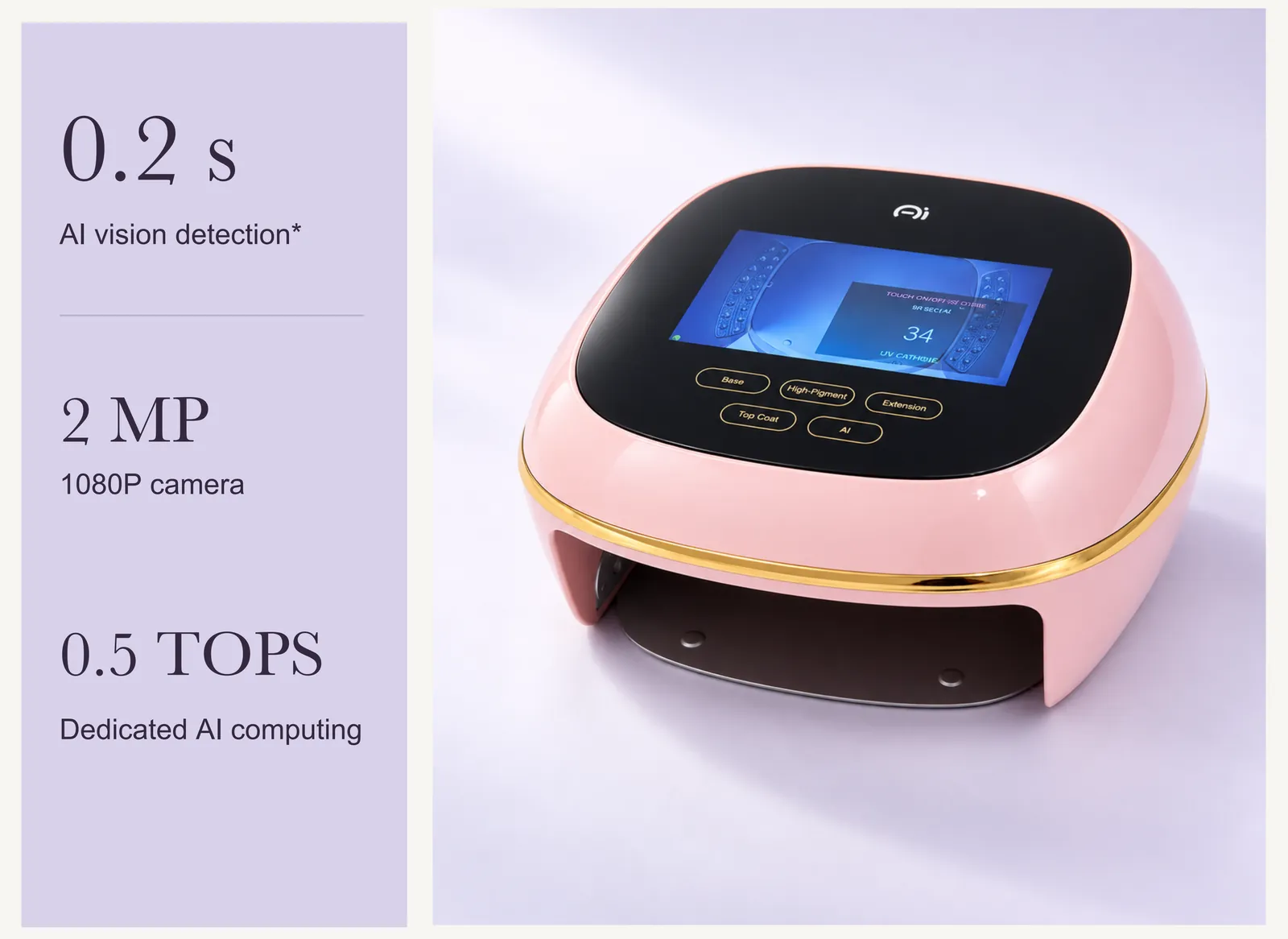
Zoned output is the demo a Gulf distributor should rehearse: darken the room, place a hand, watch which zones light.
What goes on a Doha or Kuwait City order
Six lines settle most of it: the model number exactly as certified; the voltage band and frequency as they will read on the rating plate; the cord set, split by destination if the order covers both countries; the label languages plus the importer’s block; the console language pack and the matching quick-start card; and who holds which certificate and for how long, written down rather than assumed. Standard units are AC-powered with no battery; the 6,000 mAh pack is an option on request for mobile technicians and home-service calls, and it changes nothing about the safety file but a good deal about the label.
Commercial terms travel the same way. White-label and neutral units start at three to five pieces, and a single unit can ship as a paid sample — which is how a distributor in Doha tests a market before committing shelf space. Full custom branding, from logo and colorway to retail packaging, starts at 300–500 units.
The full parameter set is on the AI Smart Nail Lamp product page, the branding ladder sits under OEM and ODM, and the curing-principle comparison with ordinary LED lamps is in this technical note. Distributors consolidating several Gulf markets usually start from the market notes on the blog.
Quick FAQ
Can one certificate cover both Qatar and Kuwait?
Is a 220 V rating acceptable in Kuwait?
Does the console need Arabic for a Kuwaiti salon?
Next step
Send us the two markets you are covering, the distributor’s name in each, and whether the first order is a sample or a shelf. We will come back with the rating-plate wording, the cord set split, the label artwork with the importer’s block, and a demo unit set to your language pack. For a quotation, contact Miro Wu, Dedicated Account Manager — email miro.wu@beautome.com or WhatsApp +86 188 1393 3019.