





AI Smart Nail Lamp for Australian and New Zealand Salons: Labor Cost, Consistency and the RCM File
Australian and New Zealand salons pay some of the highest technician wages in the world and still cannot fill their chairs. Once a set of nails costs more in labor than it used to, a salon group stops comparing lamps on purchase price and starts asking how many sets a technician can finish without a redo. This article covers what vision-assisted curing changes in that arithmetic, and the electrical file an Australian or New Zealand importer has to hold before the first unit is sold.
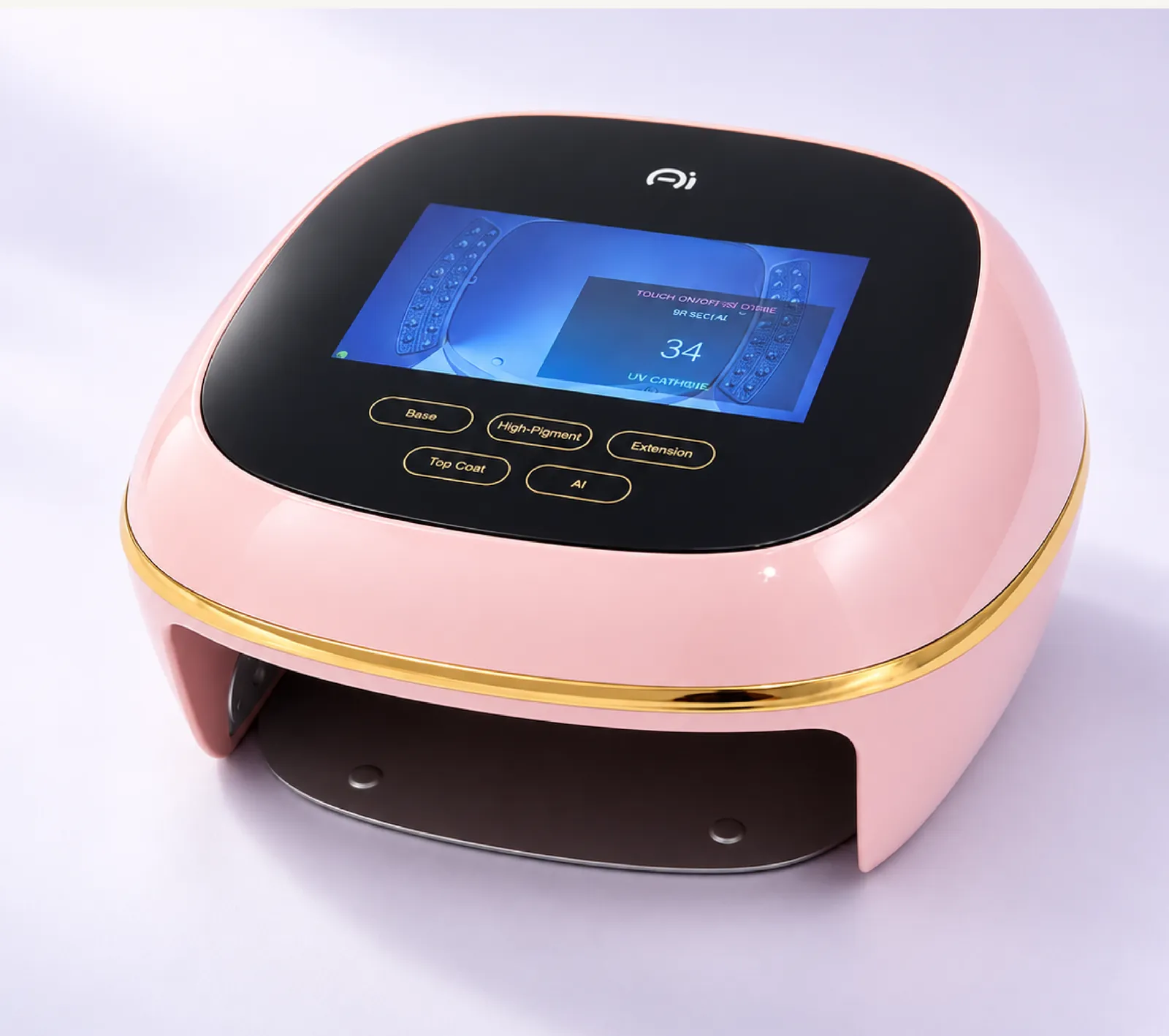
The AI Smart Nail Lamp: a 2 MP camera and on-device vision behind 136 dual-band LEDs, driven from a 5.5-inch touchscreen.
A high-wage market that cannot hire fast enough
Australia and New Zealand are small by population and expensive by wage. IBISWorld sizes the Australian personal waxing and nail salon industry at A$1.9 billion for 2025–26, expanding at roughly 2.4% a year across the five years to 2025–26, and the industry is fragmented enough that no operator holds more than 5% of it. That fragmentation matters to a supplier: there is no single chain to win, only a long tail of owners who each make their own equipment decision on their own timeline.
A$1.9 bn
Australian personal waxing and nail salon industry revenue, 2025–26 (IBISWorld, November 2025)
39,264 → 43,410
Beauty therapist workforce, 2025 to a projected 2035 — and still on the national shortage list for 2025 (Jobs and Skills Australia, 2025)
USD 1.05 bn
Australian nail salon market, 2025 (Global Market Insights, 2025)
The binding constraint is labor. Jobs and Skills Australia counted about 39,264 beauty therapists in 2025 and projects roughly 43,410 by 2035, a 10.6% increase that still leaves the occupation carrying a national shortage rating for 2025 — meaning employers reported genuine difficulty finding qualified people. Add booth and suite rents in the major cities and the conclusion is unavoidable: the expensive resource in an Australian salon is the person holding the brush, not the appliance on the table. Anything that shortens a set or prevents a redo pays back faster here than in almost any other market we ship to.
What a vision-assisted lamp actually changes
The AI Smart Nail Lamp places a 2 MP camera and 0.5 TOPS of on-device compute behind 136 dual-band LEDs. In use, the camera locates the nails in 0.2 seconds and the light is split into zones that follow those positions, rather than flooding the whole hand for a fixed cycle. Three consequences matter to a salon owner, and none of them is cosmetic.
Fewer redos. Under-cured gel is the expensive failure mode: the set comes back, the following appointment runs late, and the client remembers which nail lifted. Automatic detection means curing no longer depends on the technician remembering to reposition the hand.
Less light on skin. Zoned output concentrates the cure on the nail bed and reduces unnecessary light exposure of the skin around the nail — the practical answer to the darkening complaint clients raise after months of gel wear.
Consistency across a roster. In a market where technicians move between locations, a lamp that measures and reacts gives a junior the same starting point as a senior. Multi-site operators value that far more than another watt of output.
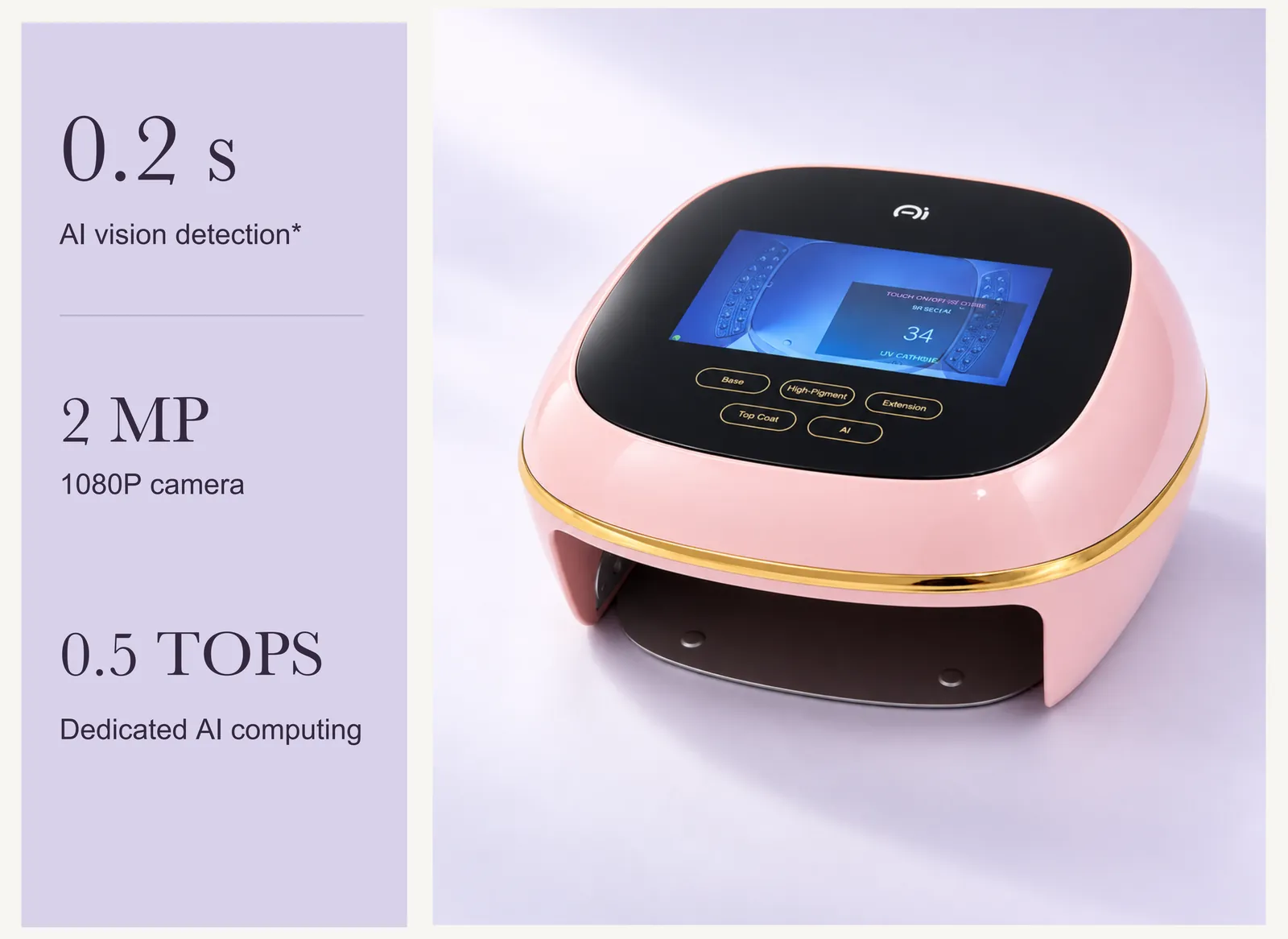
The camera locates each nail before the LED zones fire, so curing follows the hand instead of a fixed timer.
The curing principle is the familiar one
It is worth being precise, because the trade language is loose. Gel polish cures under long-wave ultraviolet light, and in both the lamps the industry calls “UV” and the lamps it calls “LED”, that light is emitted by LED chips — the two names describe the emitter and the band, not two different chemical processes. Our lamp runs two bands, 365–370 nm and 395–400 nm, across 136 LEDs. A widely published first-generation AI lamp in this category lists 109 LEDs at 365 nm and 405 nm. Same chemistry, different control: what separates the machines is where the light lands and how the device decides when to send it. That is the sentence to use with a salon owner who has read a scare article about UV, and it is why the specification comparison is written to be forwarded to a buying committee rather than filed — see the side-by-side principle comparison.
RCM and the EESS file: what an importer must hold
Australia and New Zealand operate one electrical safety scheme, the Electrical Equipment Safety System (EESS), and a mains-powered salon appliance sits inside it. In-scope equipment means low-voltage equipment rated above 50 V AC and below 1000 V AC that is designed or marketed for household or personal use — and, as the Queensland Government’s guidance states, that definition holds even if the supplier markets the product as commercial. The model’s risk level decides how much evidence is required, from a compliance folder for medium-risk equipment up to a Certificate of Conformity issued by a recognized certifier for the high-risk level. Registration on the EESS national database and the Regulatory Compliance Mark are required either way.
Two practical points decide whether the first shipment clears without drama. First, the Registered Responsible Supplier must be the Australian or New Zealand manufacturer or importer; an overseas factory cannot register on your behalf, so the registration is made in your importing entity’s name. Second, the technical file has to exist before you register: circuit documentation, component and BOM lists, and safety and EMC test reports from a recognized laboratory. That file is the manufacturer’s part and we supply it; the registration and the marking are yours. Confirm the standard set that applies to your exact model with your certifier, because the risk classification drives the evidence package.
Twenty-nine languages on one console
Australian and New Zealand salons employ technicians from across Asia, Europe and the Pacific, and a group with sites in Sydney, Melbourne and Auckland cannot standardize on a device that speaks one language. The 5.5-inch console carries 29 interface languages, which removes the training friction that turns every new hire into a three-week cost. For a group placing a ten-unit order, the screen language is not a feature; it is the reason one purchase order can cover every location without a site-by-site exception.
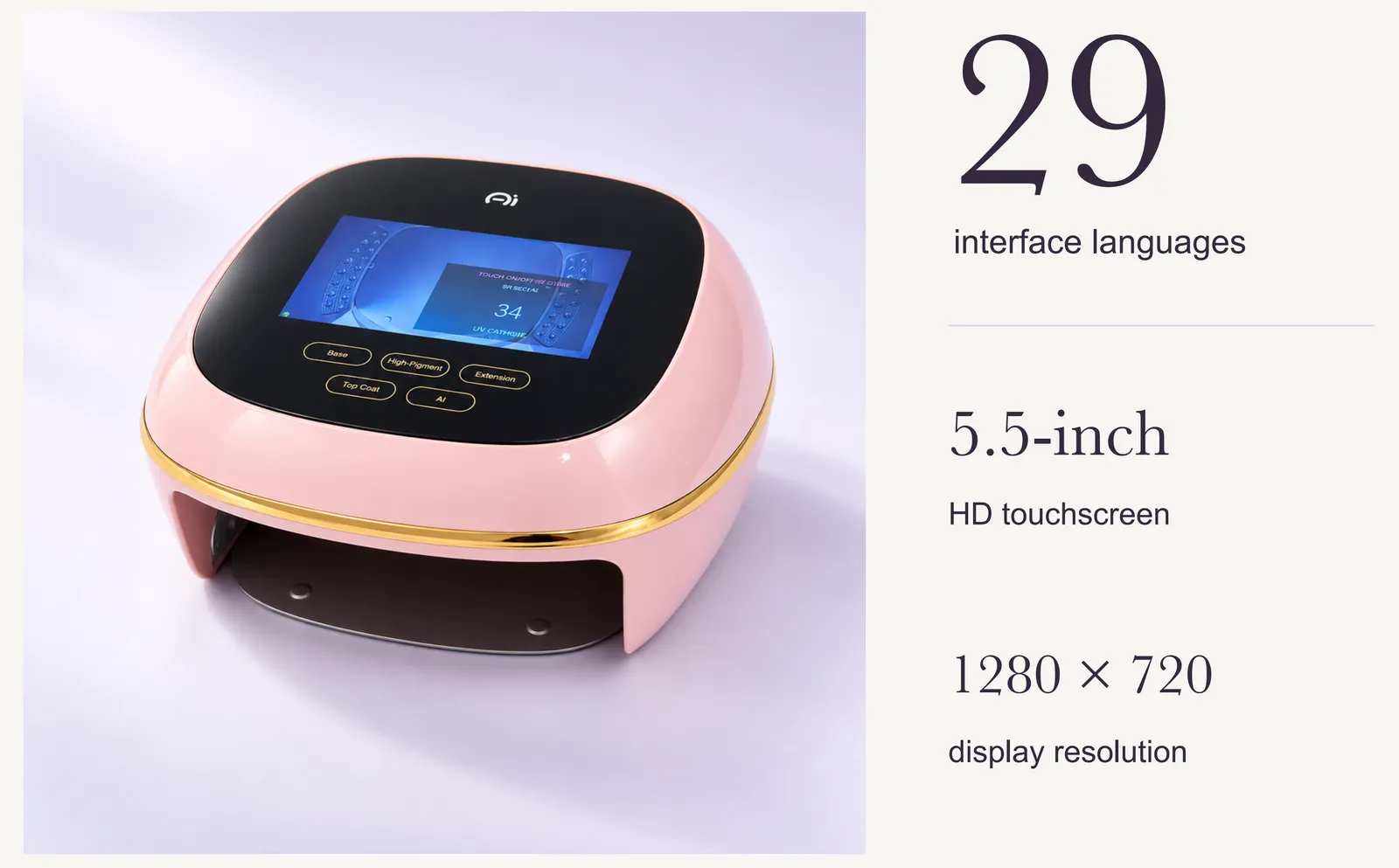
A multilingual console lets one model serve a multi-site roster without retraining per location.
Sample first, brand later
The commercial route is deliberately stepped. Neutral, unbranded units start at 3–5 pieces, and a single unit can be shipped as an evaluation sample — the normal way an Australian distributor validates a lamp against salons it already supplies. Custom branding, meaning logo screening plus a standard shell color, starts at 300 pieces and rises to 500 when the housing color or the chrome trim changes; retail packaging runs at roughly the same volume. Standard shipments are AC powered with no battery, and a 6000 mAh battery version is available on request for salons with limited table sockets. The configuration matrix sits on the OEM & private label page.
Next step
Specifications, the visual gallery and the accessory list are on the AI Smart Nail Lamp product page. For a sample unit, an RCM documentation discussion or a quotation for a multi-site Australian or New Zealand group, contact Miro Wu, Dedicated Account Manager — email miro.wu@beautome.com or WhatsApp +86 188 1393 3019.