





AI Smart Nail Lamp for Japanese and Korean Salons: What Premium Studios Test Before They Buy
Japan and South Korea are the two most specification-literate nail markets in Asia. Salons there do not buy a curing lamp because it is new; they buy it because it measurably helps a technician working a full book of meticulous gel services. For a distributor or franchise buyer in Tokyo, Osaka, Seoul or Busan, that makes the evaluation unusually concrete — and it puts the import file in the same conversation as the light output. Here are the six things those buyers test.
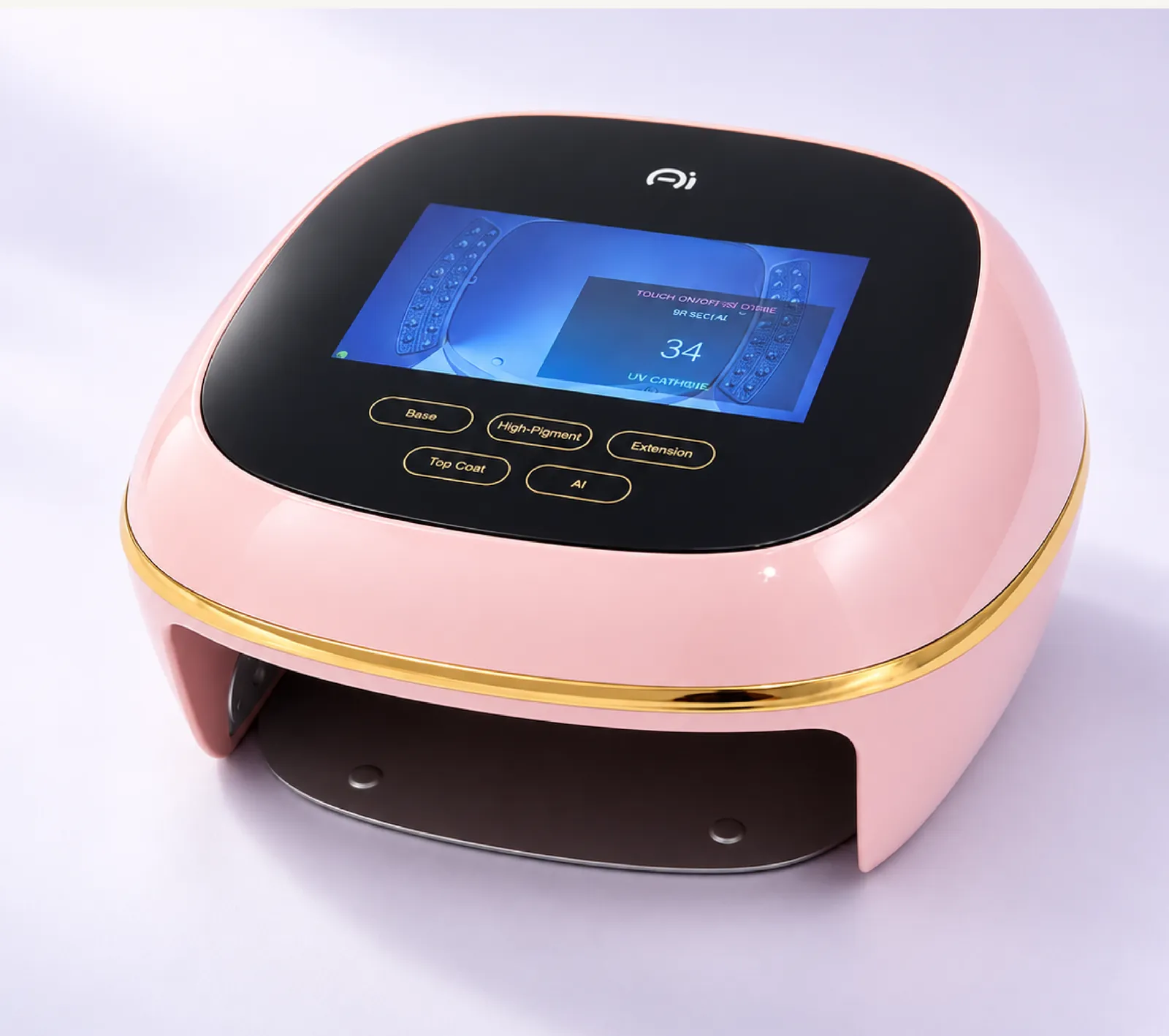
The AI Smart Nail Lamp: camera-guided curing head, 136 dual-band LEDs, 5.5-inch multilingual touchscreen.
Two markets that read the specification sheet first
Both countries run nail services at a frequency the rest of the region is still catching up with, and both sit inside the fastest-growing nail region in the world: Asia Pacific is forecast to move from roughly USD 8.9 billion in nail salon revenue in 2025 to USD 24.1 billion by 2035, a compound rate near 10.5% (Global Market Insights, 2025).
USD 1.73 B
Japan nail salon market, 2025 — Global Market Insights, 2025
USD 1.41 B
South Korea nail salon market, 2025 — Global Market Insights, 2025
28,492
Nail salons operating in Japan, August 2025 — POI Data, 2025
Service revenue is the base; the ticket is the point. Independent analysis puts Japan’s nail care services at about USD 1.3 billion in 2025 growing to USD 1.8 billion by 2033 and South Korea’s at USD 1.6 billion growing to USD 2.2 billion (Verified Market Reports, 2025) — slower headline growth than Southeast Asia, but at materially higher spend per service. Stable volume at a premium ticket rewards equipment that shortens a service rather than shaving its price.
What a studio in Tokyo or Seoul is actually paying for
Minutes per set. A technician with a full book loses an entire slot, not a minute, when a cure is missed on a sidewall and the set has to be redone. Gel-system diversity. Japanese and Korean studios stock many gel brands whose photoinitiators differ, so a lamp delivering light across more than one useful UVA band is more forgiving. Client comfort. Clients here read aftercare content closely, and uneven tone on the hands from unnecessary light exposure is a service-quality complaint, not a slogan. Hygiene. Alcohol-based disinfection between clients is routine, and the unit has to survive it for years.
The curing principle is shared; the control layer is the difference
Be precise here, because a technician in Osaka will correct you if you are not. Professional gel polish cures because photoinitiators in the gel absorb long-wave ultraviolet light — UVA — and begin to polymerise. That holds for every professional lamp: the units sold as “UV lamps” and the units sold as “LED lamps” both work through LED chips emitting defined UVA bands. We claim no different chemistry, and a buyer should be wary of any supplier who does.
What changes is where the light is delivered. A conventional lamp floods a fixed area for a fixed time, so the fingertip, the knuckle and the surrounding skin receive the same dose as the nail plate. A camera-guided lamp maps each nail first and lights only the parts that need it, which reduces unnecessary light exposure of the surrounding skin — the practical reason a client leaves with even-toned hands. The unit carries a 2 MP camera with an on-device neural engine rated at 0.5 TOPS, locating each nail in around 0.2 seconds, and the array holds 136 LEDs across two bands, 365–370 nm and 395–400 nm in front and side groupings so four fingers plus a thumb cure evenly. For context, the first wave of vision-assisted lamps published around 109 LEDs covering 365 nm and 405 nm from a single front array — emitter count, band coverage and delivery geometry are the three parameters worth putting in front of a buying committee.
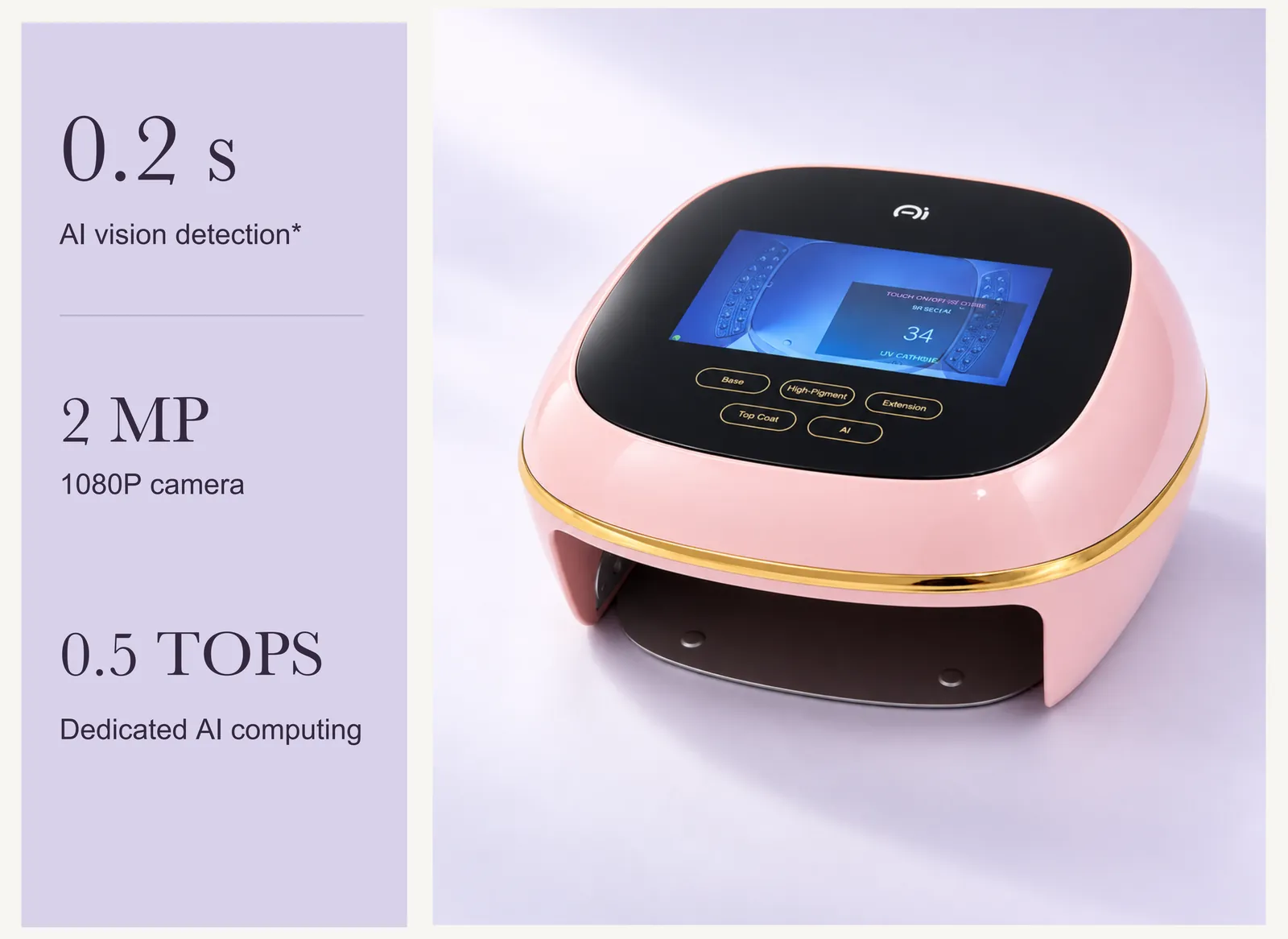
Nail detection in about 0.2 seconds — the camera decides where the light goes, not a fixed timer.
The parameter sheet your buying committee will ask for
| Parameter | AI Smart Nail Lamp | Why it matters here |
|---|---|---|
| Light source | 136 LEDs, dual band 365–370 nm + 395–400 nm, front and side arrays | Broader photoinitiator coverage across the gel brands a studio stocks |
| Vision system | 2 MP camera, 0.5 TOPS on-device engine, ~0.2 s detection | Zoned curing without a timer; fewer missed sidewalls and redos |
| Interface | 5.5-inch 1280×720 touchscreen, 29 interface languages | Japanese and Korean on screen — no printed manual to maintain |
| Footprint | Approx. 24×24×11.5 cm | Fits a compact workstation and keeps freight and shelf costs low |
| Power | AC powered as standard, no battery; 6000 mAh battery optional | Fixed sites take the lower-cost standard unit; mobile work adds the battery |
| Serviceability | Smart heat control with light-decay warning | Turns a vague “gels are not curing” complaint into a maintenance ticket |
Japanese and Korean on the screen: one SKU, two markets
The interface question is commercial, not cosmetic. A panel that only speaks English pushes training cost onto your clients, and in a market of tens of thousands of small salons that cost is the reason mid-range equipment stalls. The 5.5-inch touchscreen runs 29 interface languages, Japanese and Korean included, so a single SKU covers both markets and their export channels — the screen itself is the training document. Tempered glass also stands up to the disinfection routine, which is the detail a service department notices in year two rather than week one.
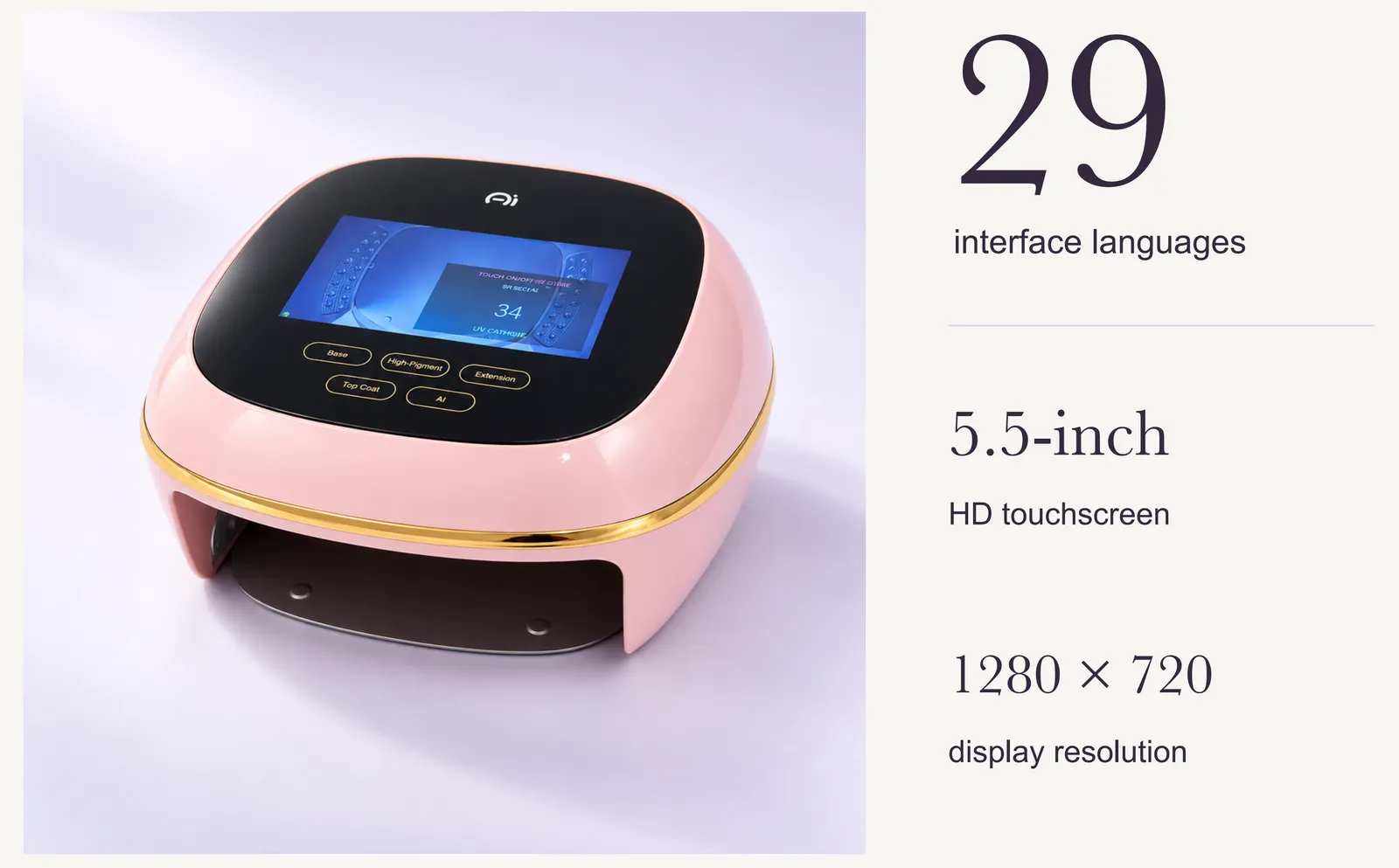
One SKU, 29 languages — Japanese and Korean included, so no separate panel build is needed.
PSE for Japan, KC for Korea: the files question
Japan regulates electrical products under the Electrical Appliance and Material Safety Act (DENAN). Products split into 特定電気用品 — specified products, 116 categories, requiring conformity inspection by a registered body and the diamond PSE mark — and everything else, which requires self-testing to the technical standard, retained records and the circle PSE mark. Low-voltage electronic lighting-type products generally sit in the self-declaration class, but classification follows rated voltage and construction, so confirm the category with your importer before committing a tooling plan. An importer must also file an electrical appliance import business notification, and an overseas seller selling direct to Japanese consumers must appoint a domestic manager in Japan (JETRO).
South Korea applies KC certification, which bundles electrical safety, electromagnetic compatibility and hazardous-substance limits into one mark. Testing runs at a Korea-recognised laboratory, the certificate holder is normally a Korean entity, and the certificate carries a validity period with periodic surveillance — commonly quoted at three to five years depending on the scheme, so confirm current terms with your agent rather than a forum post.
In practice the technical file travels with the order — circuit documentation, component lists, test reports and the CE, RoHS and FCC paperwork the factory already holds — while the local certificate is issued in the name of your importing entity or its appointed agent. Agree that split in writing at quotation stage; it is the most common cause of a confirmed order missing its first sailing.
From one sample unit to your own brand
The commercial ladder is short by design. Evaluate with a single sample unit. Start neutral-brand resale from 3–5 units. Move to your own branding from 300 units for a silk-screen logo on the standard colorway, with custom shell and trim colors from 500 units and printed retail boxes quoted from roughly 500 pieces. Orders placed before packaging is final can ship in the standard box with multilingual manuals, so branding never holds up a launch window. The framework behind those terms sits on the OEM & private label page.
Next step
Full specifications, packaging options and accessories are on the AI Smart Nail Lamp product page. If your team is still comparing lamp categories, the explainer on curing principle versus light control is written to be forwarded to resellers, and other regional sourcing guides sit in the market insights hub.
For a sample unit, a PSE or KC documentation discussion, or a private-label plan for Japan or South Korea, contact Miro Wu, Dedicated Account Manager — email miro.wu@beautome.com or WhatsApp +86 188 1393 3019.