






Hard Wax for Gulf Barbershops: Adding Waxing to a Gents’ Grooming Menu
In the Gulf, the barbershop is already a high-frequency channel: men come weekly, they trust the barber’s recommendation, and they buy product at the counter on the way out. Adding waxing to that menu is a service decision with a product decision attached — and the product decision is narrower than a full salon range. Four SKUs, correctly chosen, will cover almost every client who walks in. Eight will confuse the staff and tie up cash.
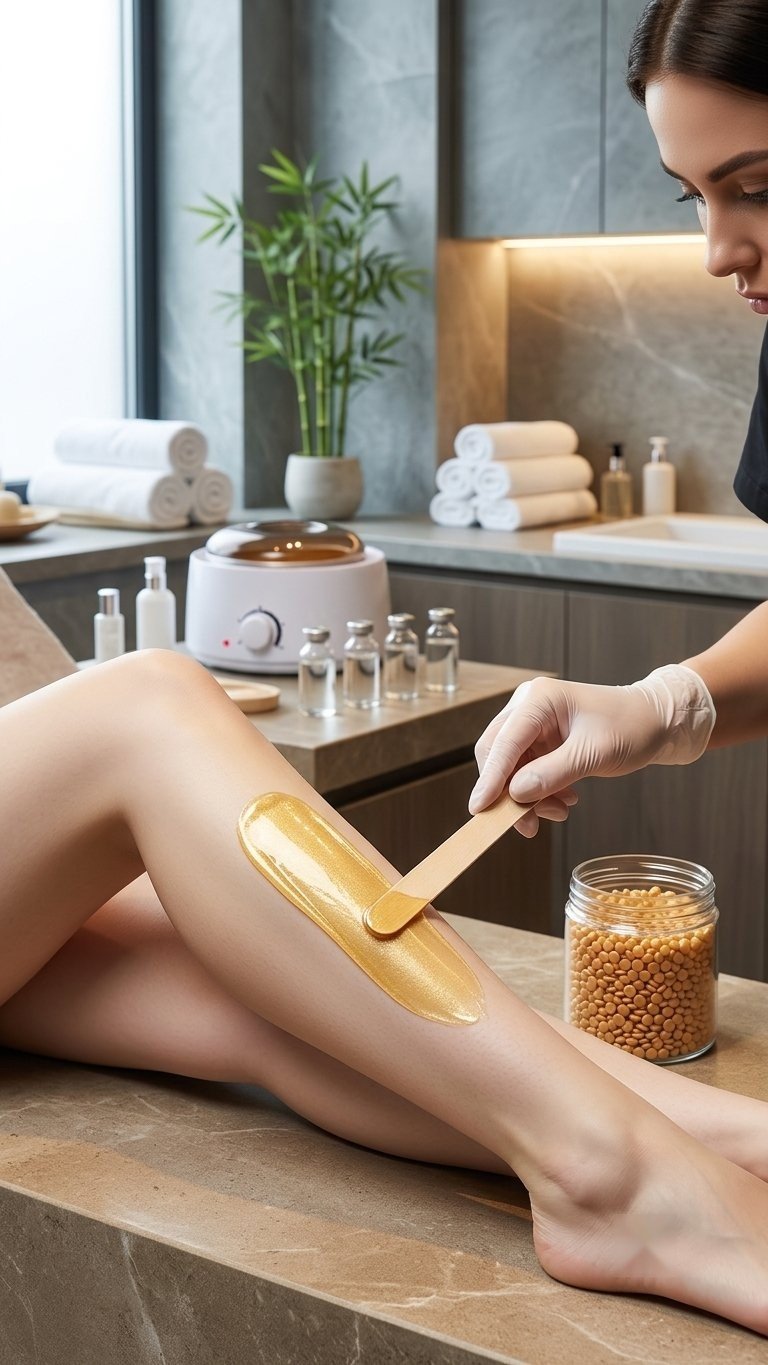
Film wax applied thin and worked in one pass — the technique a barbershop team has to learn before the menu goes live.
Why the barbershop is the right entry point
The numbers behind the channel are not subtle. The GCC male grooming market was valued at USD 4.79 billion in 2025 and is forecast to reach USD 8.04 billion by 2034, roughly a 5.75% annual growth rate (IMARC, cited 2026); the wider Middle East and Africa salon services market sits at USD 21.83 billion in 2025 (Fortune Business Insights). Within hair removal specifically, the Middle East and Africa accounted for about 6.6% of global men’s wax revenue in 2025, growing at roughly 7.2% a year through 2034, with the UAE, Saudi Arabia and Qatar described as premium consumption hubs (Dataintelo, 2025).
Two details in that research matter more than the headline. First, the premium tier — products priced 20% or more above the category average — reached about 28.5% of market value in 2025, up from 19.3% in 2021. Second, thermal-sensitive stripless hot wax is identified as the premium format of choice for back, chest and groin work. Both point the same way: this is not a market where the cheapest pot of wax wins the account. It is a market where the client notices the difference.
USD 4.79B
GCC male grooming market, 2025, heading to USD 8.04B by 2034 (IMARC)
28.5%
Share of category value held by premium-priced product in 2025, up from 19.3% in 2021
7.2%
Forecast annual growth for men’s hair removal wax in the Middle East and Africa to 2034
The four-SKU starter range
A gents’ salon does not need a wax library. It needs one wax that handles the hardest job on the menu, one that handles the most nervous client, one that handles volume, and one that covers the client who still wants strips. That is the whole range.
- Formula A2 — premium rosin, cream white beads. This is the back-and-chest wax. Rosin gives the film its tack; the cream white base makes it visible on the skin and easy to explain at the counter. The mechanical argument is elasticity: the film stretches instead of shattering, so it holds short, dense growth on the first pull rather than requiring a second pass over an already-sensitive area. On a back, a second pass is not a minor inconvenience — it is the reason a client does not rebook.
- Formula A1 — rosin-free, 45–50 °C working window. This is the wax for the first-time client, the client with sensitive skin, and the groin area where heat is felt most. Always quote the melt as a range, not a single number, because the wax behaves differently across a pot, a room and a therapist’s rhythm. A lower working temperature means more open time to place the strip and less risk of the film setting before the hand is positioned. Gold and Pink are standard colors and repeat exactly order to order; White is a custom color, the most demanding of the three to produce consistently, made to order. Pack sizes are 300 g, 500 g and 1000 g.
- Consumer-Grade Hard Wax — a 55–60 °C film wax. The volume tier. Higher working temperature, faster rhythm, lower cost per service. It is the right answer for a high-traffic chair doing legs and arms, and the wrong answer for a first-time back wax.
- All-Purpose Soft Wax — 450 g cans. Strip wax, for the client who asks for it and for large flat areas where speed beats sensitivity. Keeping one can on the shelf prevents the salon from sending a paying client to a competitor.
That is four formulas covering four different jobs. What it is not is four price points of the same product, which is how most starter ranges go wrong: the staff cannot tell them apart, so they use whichever pot is closest.
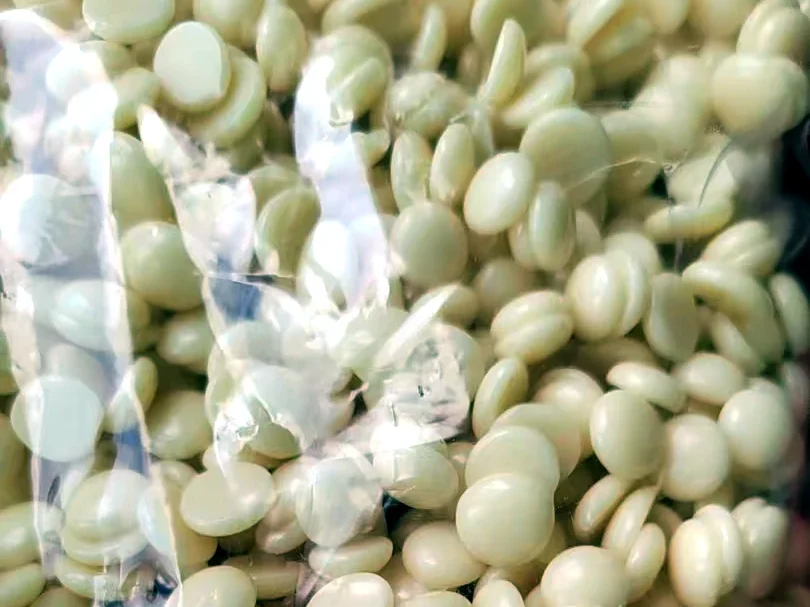
Formula A2 in cream white beads — the workhorse for back and chest, where elasticity matters more than price per gram.
Back and chest is a different service, not a bigger leg
Treating a back is a logistics problem before it is a waxing problem. The area is large, the hair runs in several directions, and the film has to stay workable long enough for the therapist to move across the shoulder blade and down to the waist without re-dipping constantly. Three things follow for the product and the room:
- Open time beats speed. A wax that sets in seconds is a wax that gets applied twice. A2’s elasticity buys the therapist time to lay a continuous strip.
- Pot capacity, not wattage. A 450 ml pot is right for one chair doing brows and lip; a back service pulls far more product per appointment, so a 500 ml or 800 ml pot keeps the column moving. Our heater range runs from a 20 ml graphite warmer to an 800 ml single and a 400/800 ml double-pot station for exactly this reason.
- Privacy and positioning. A gents’ salon converting a room needs a couch, a stool and a screen. That is a fit-out cost, and it belongs in the business case next to the wax.
Then there is aftercare, which is where Gulf conditions change the script. Air conditioning dries skin while the climate outside keeps clients sweating between appointments; a film that leaves residue will show up as irritation within a day. A clean-pulling film plus a fragrance-free post-wax oil is a simpler recommendation than a shelf of products the barber has to explain.
Packaging for a house brand, without a print run
Most barbershop groups that add waxing want their own name on the bag, and most of them do not want to fund a printing minimum to get it. The format that solves this is the unlabeled transparent bag: beads in a clear bag with no printing, at low MOQ, with no print lead time. The group applies its own label, in its own language, with its own batch and address. A new line can be on the shelf in the time it takes to print labels rather than the weeks it takes to print bags.
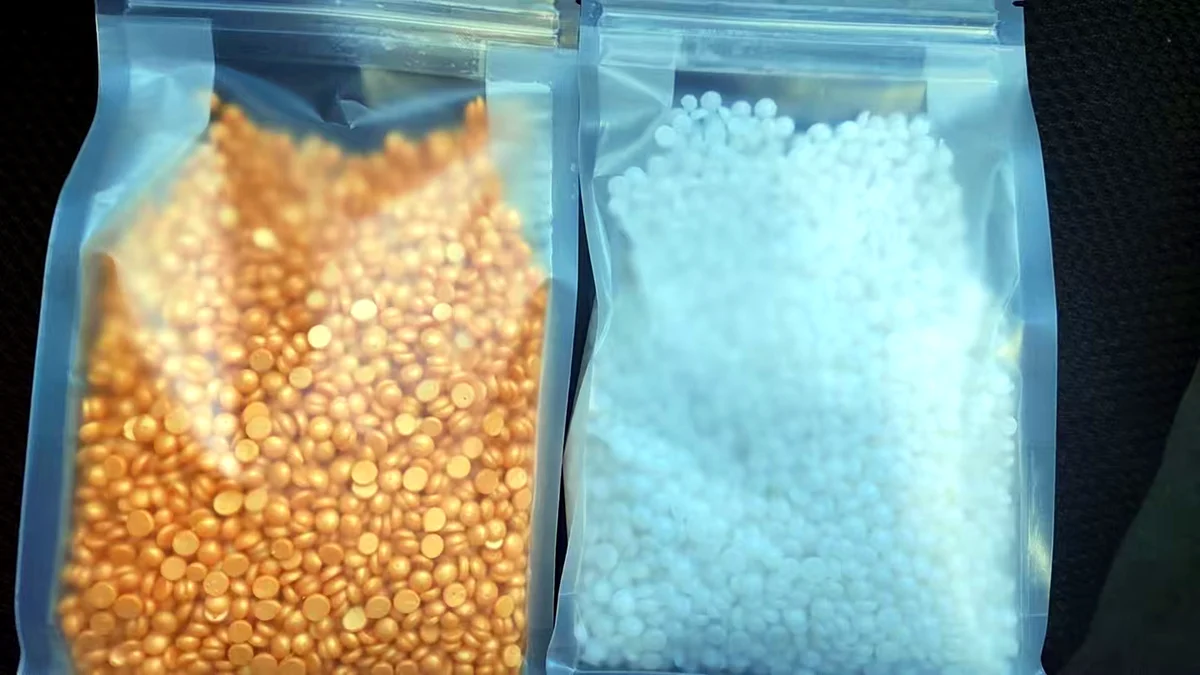
Unlabeled transparent bags in gold and pink — the private-label format with no print run and no artwork cycle.
That convenience carries an obligation, and it is worth stating plainly because it is where first shipments stall. Wax placed on the Gulf market is a cosmetic product. In the UAE the reference standard is GSO 1943/2016, which follows the EU cosmetics framework with regional adjustments; labeling has to carry Arabic (bilingual is acceptable), the INCI ingredient list, batch number, production and expiry dating, country of origin, and the responsible entity’s details. Registration runs through ECAS and, for Dubai, the Municipality’s cosmetic product registration, and it is submitted by a UAE-authorized representative — importer, distributor or appointed agent — not by the overseas factory. Saudi Arabia runs its own route through SFDA and SABER, with requirements that have been revised repeatedly, so confirm the current procedure with your agent before you print.
What we supply is the manufacturing side of that file: formula documentation, ingredient breakdown, batch records and artwork templates. What we do not do is stand in as your regulatory representative, or claim that a clear bag with no label is compliant — it is compliant when your label is on it and your registration covers it. The ingredient and provenance questions buyers ask most often, including the porcine question, are covered in our earlier Gulf ingredient guide.
What to test before the menu goes live
- Patch test on the forearm with both A2 and A1, on the same client, a week before the service. Rosin tolerance varies by individual, and A1 exists precisely so the salon has a second answer.
- One-pass pull on a two-week regrowth back. Count the passes. If it takes three, the wax is too brittle for this service or the film is too thin.
- Reheat behavior. Melt, cool, remelt. A wax that darkens or thickens on the second cycle will generate complaints at the back bar, not at your desk.
- Residue test. Pull a strip and press a white tissue to the skin. Oil transfer means a post-treatment product is now part of your service cost.
Quick FAQ
Which single wax should a barbershop start with?
Can we buy unlabeled bags and print our own labels?
Is White available as a standard color?
Next step
Tell us how many chairs you are adding waxing to, which services you plan to menu, and whether the bags ship labeled or unlabeled, and we will send the formula sheet with melt ranges, color options and the document pack your registration agent will ask for. The range is on the wax formulas product page, also available in Arabic; the private-label route is on OEM and ODM. Contact Miro Wu, Dedicated Account Manager — email miro.wu@beautome.com or WhatsApp +86 188 1393 3019.