






AI Smart Nail Lamp for Southeast Asian Salon Chains: Solving the Technician Shortage
Southeast Asia is compounding faster than any other nail market in the world, and its bottleneck is no longer demand — it is people. Chains across Indonesia, Vietnam, Thailand, the Philippines and Malaysia open units faster than they can train technicians, and a lamp that removes part of the skill requirement is worth more to them than a lamp that shaves a few seconds off a cure. That is the conversation this market actually has.
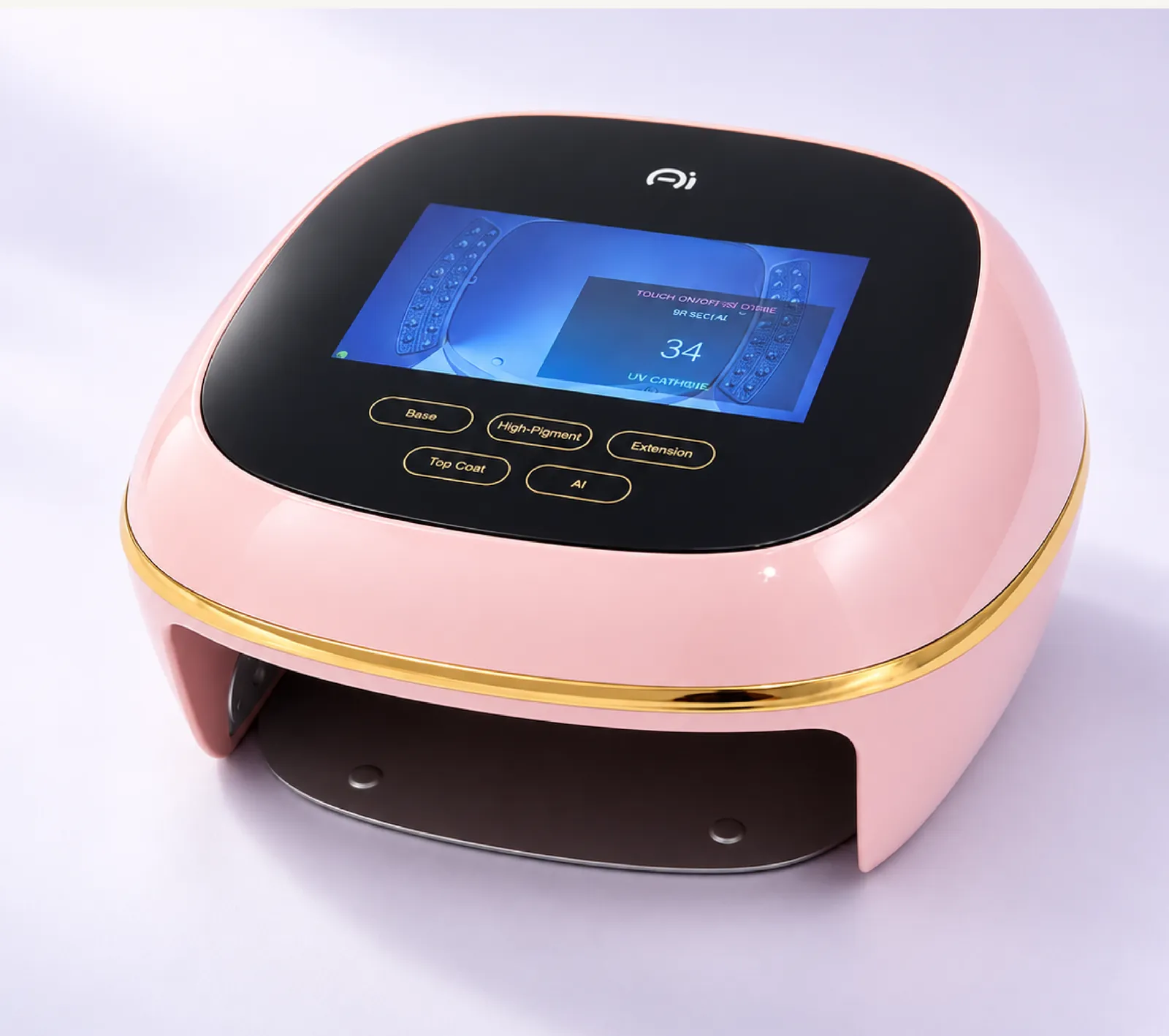
The AI Smart Nail Lamp: camera-guided curing head, 136 dual-band LEDs and a 5.5-inch touchscreen console.
A region growing faster than it can train technicians
Asia Pacific is now the largest nail salon region in the world, and its growth is being driven by exactly the countries a distributor would name first.
USD 9 B
Asia Pacific nail salon market, 2025 — forecast USD 20.4 B by 2035 (Global Market Insights, 2026)
8.5%
Compound annual growth projected for the region, 2026–2035 (Global Market Insights, 2026)
62%
Share of the Asia Pacific nail market held by independent salons in 2025 (Global Market Insights, 2026)
Two details in that forecast matter more than the headline. Indonesia is singled out as the fastest-growing national market in the current outlook, and skilled labor shortage is listed among the key challenges facing the sector, alongside hygiene standards. The same analyst notes that operators in the region are investing in staff training programs as a competitive strategy — another way of saying the market has already priced what it costs to keep a bench staffed and consistent.
What technician churn actually costs
A gel set runs roughly an hour. When a technician is new, the failure does not show up as a minute lost; it shows up as an uneven cure on a sidewall, a set that lifts within a week, and a redo that consumes a slot somebody else paid for. Where independent salons make up the majority of outlets and chains hire continuously, that cost lands on the schedule rather than the payroll — and hardest on the newest member of the team.
So the question a chain buyer asks is unusually practical: how much of this can the lamp do for a technician who has not learned it yet? That is a different brief from the one a European studio writes, which is why vision-assisted curing sells here on training economics rather than novelty.
Lowering the skill floor: the camera handles the positioning
In a conventional lamp the technician does the geometry: hand square on the base, fingers flat, nails under the emitters, then run a fixed timer and hope the alignment held. A camera-guided unit moves that job into the machine. A 2 MP camera with a 0.5 TOPS on-device engine locates each nail in around 0.2 seconds, and the 136 LEDs — two bands, 365–370 nm and 395–400 nm, arranged in front and side groupings — then light the segments that need light. A trainee whose hand sits slightly off still gets a complete cure, because the lamp compensates instead of the appointment.
The same mechanism answers the client question that circulates in every one of these markets: whether the hands will darken. Because the array emits only where nails are detected, the unit reduces unnecessary light exposure of the surrounding skin. That is a statement about where the light is delivered — and it is the honest one.
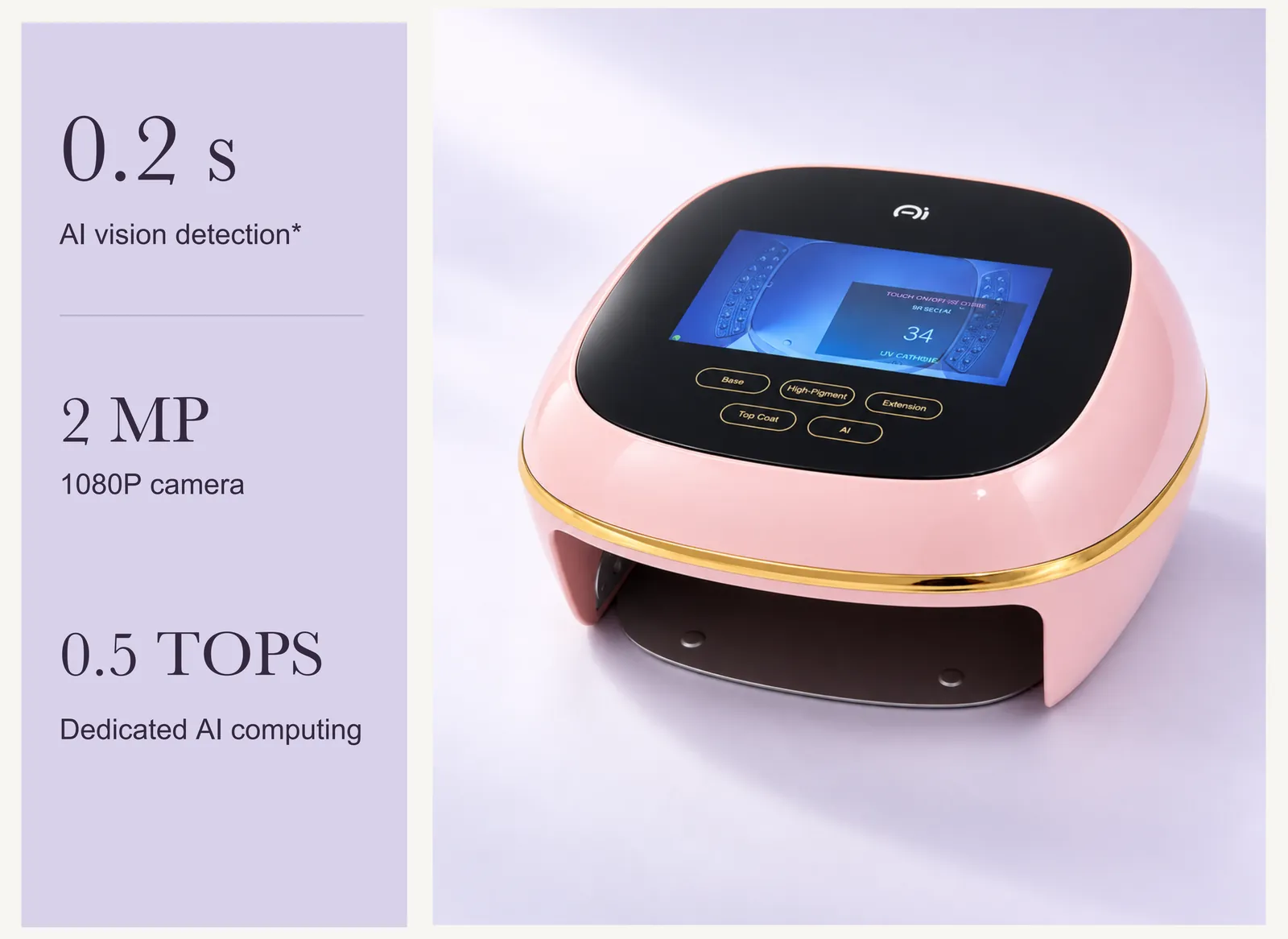
Nail detection in about 0.2 seconds — the lamp compensates for an imperfect hand position instead of the trainee having to.
The screen is the training document
A region this multilingual is expensive to support with paper. The lamp carries a 5.5-inch 1280×720 touchscreen running 29 interface languages, so a chain can deploy one SKU across several countries and let the on-screen flow do the onboarding, instead of commissioning a manual per market and reprinting it whenever a menu changes. Two things are worth confirming before you order: which languages are in the shipping firmware, and whether a language your market needs can be added within a private-label project. Both are legitimate questions at quotation stage, and both are cheaper to ask early.
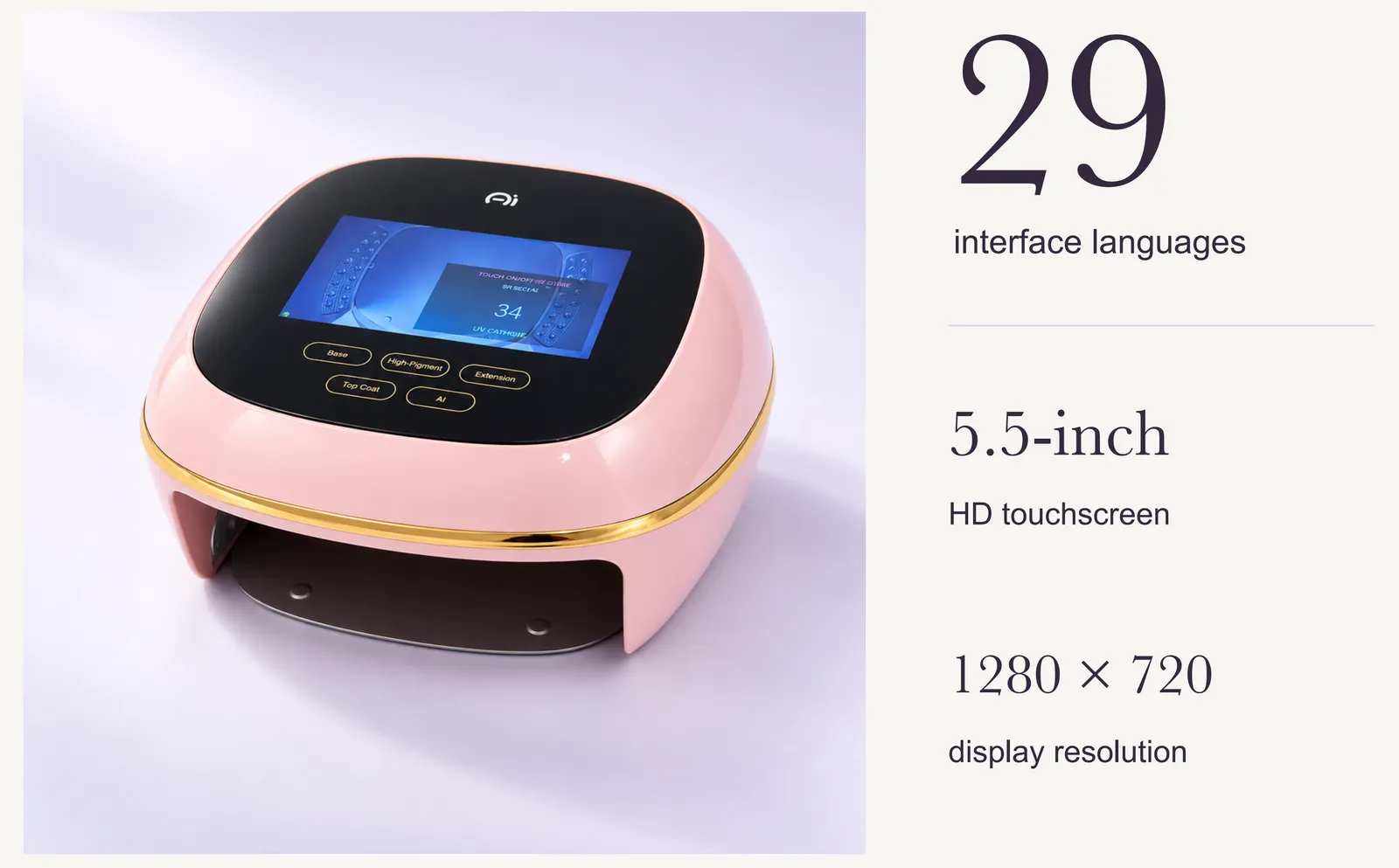
One console, 29 interface languages — one SKU can serve several countries in the region.
One curing principle, better-controlled delivery
Be precise with your resellers here. Professional gel cures because photoinitiators in the gel absorb long-wave ultraviolet light — UVA — and polymerize. Every professional lamp works that way: the units sold as “UV lamps” and the units sold as “LED lamps” are both LED chips emitting defined UVA bands. We claim no different chemistry. What differs is control — a 2 MP camera maps each nail first and the array lights only what needs it, so the skin around the nail receives less unnecessary exposure than under a flooded fixed-area lamp.
Certification before the container leaves
Mains-powered salon equipment is regulated market by market in this region, and the certificate is normally held by a local entity — which means the registration sits on your side of the transaction, not the factory’s. The shape of the requirement differs enough that a single regional plan will not survive contact with customs:
| Market | Compliance route | Practical note |
|---|---|---|
| Indonesia | SNI mark (BSN), mandatory for listed electrical goods | Application must come through an Indonesian entity; local laboratory testing, factory assessment, certificate with periodic surveillance |
| Thailand | TISI mark, household-appliance safety standards harmonized with IEC 60335 | Thai representative required; factory inspection is part of the process; Thai-language marking on the product |
| Vietnam | CR mark under the national technical regulation for electrical goods | Local company applies; factory audit depends on the certification mode selected |
| Malaysia | SIRIM certification for listed electrical equipment | Certificate must be held by a Malaysian entity |
| Philippines | PS or ICC mark for electrical products | Local testing, multi-year validity with annual factory audit |
Practitioner guidance published through 2025 and 2026 puts the realistic timetable at roughly two to four months per market, with Indonesian testing queues recently running longer; treat those figures as planning inputs and confirm current terms with your agent. The grid is the easy part: the region is 220–240 V / 50 Hz throughout, so specify the voltage build once and the plug type per market. The factory supplies the technical file — circuit and component documentation, test reports, and the CE, RoHS and FCC paperwork it already holds — while the local certificate is issued to your entity or its appointed agent. Agree that split in writing before tooling anything.
From one sample unit to your own brand
The commercial ladder is short on purpose. Evaluate with a single sample unit. Open neutral-brand resale from 3–5 units. Move to your own branding from 300 units for a silk-screen logo on the standard colorway, with custom shell and trim colors from 500 units and printed retail boxes quoted from roughly 500 pieces. Orders placed before packaging is final can ship in the standard box so a branding decision never holds up a launch; the framework is set out on the OEM & private label page.
Next step
Full specifications, packaging options and accessories are on the AI Smart Nail Lamp product page. If your team is still separating lamp categories, the explainer on curing principle versus light control is written to be forwarded to resellers, and the rest of the regional sourcing guides sit in the market insights hub.
For a sample unit, a certification discussion or a private-label plan for Indonesia, Vietnam, Thailand, the Philippines or Malaysia, contact Miro Wu, Dedicated Account Manager — email miro.wu@beautome.com or WhatsApp +86 188 1393 3019.