




AI Smart Nail Lamp for Nordic Salons: Exposure Files, Chair Time and a Multilingual Console
Sweden, Norway, Denmark and Finland share one characteristic that shapes every equipment decision: the most expensive technician minute in Europe, sold at the highest ticket price. A salon here cannot absorb redoes, and its staff spend all day working beside an ultraviolet light source. That is why the first question a Nordic buyer asks is not about watts — it is about what the lamp does to the people standing next to it.
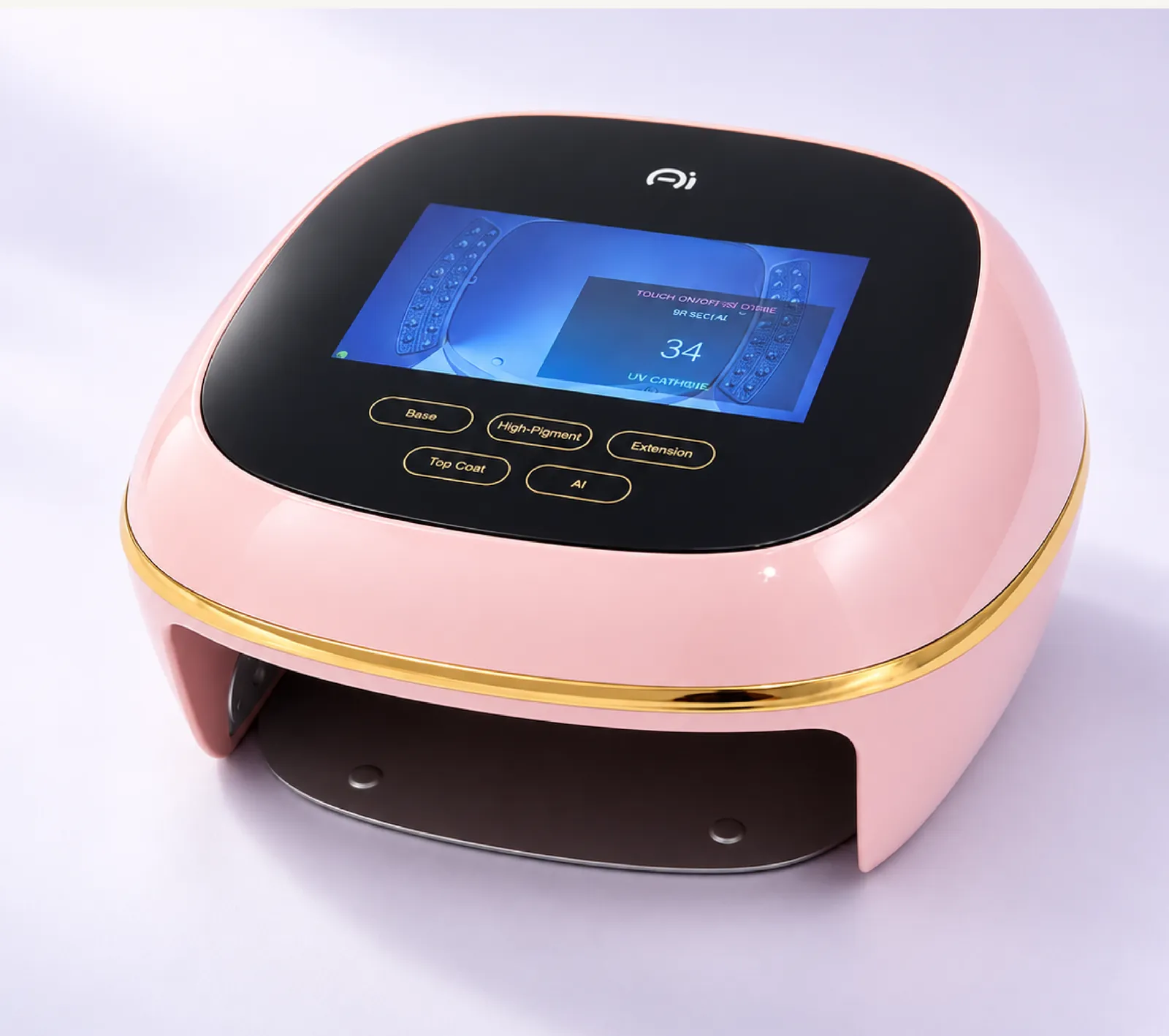
The AI Smart Nail Lamp — a 2 MP camera, on-device detection and 136 dual-band LEDs that light only where the nails are.
A premium market that pays for minutes, not for watts
The Nordic countries are a small slice of European volume with an outsized share of its premium revenue. Analysts put Sweden, Norway, Denmark and Finland together at 6–8% of European gel polish consumption, with premium pricing and a customer base that expects regulatory compliance as a baseline rather than a feature (IndexBox, 2025). Denmark illustrates the shape of the market: the personal grooming and beauty services sector there has grown close to 20% over the last five years, with more than 1,100 nail salons in the largest urban centres alone (Statistics Denmark, cited in 2025 Danish press), and a standard gel manicure commonly priced in the DKK 350–700 band (Danish market reporting, 2025).
6–8%
Share of European gel polish consumption held by Sweden, Norway, Denmark and Finland — premium pricing, high compliance expectations (IndexBox, 2025)
~20%
Growth in Denmark’s personal grooming and beauty services market over the last five years, with 1,100+ salons in the largest urban centres (Statistics Denmark, cited 2025)
DKK 350–700
Typical Danish gel manicure price band, reported in 2025 — roughly EUR 47–94 per appointment
Two consequences follow. First, chair time is the whole margin: at those prices, every extra minute under the lamp is revenue that cannot be booked again. Second, labor is scarce and mobile — industry research on the Norwegian and Finnish salon markets keeps returning to workforce turnover and rising operating costs as the sector’s binding constraints (6Wresearch, updated 2025). A lamp that shortens a set and that a new hire can operate on day one is worth more here than a lamp that is simply cheaper.
The question Nordic buyers ask first: what does the light do to the room?
The Nordic countries enforce occupational health rules closely, and there is European law directly on point. Directive 2006/25/EC covers worker exposure to artificial optical radiation. It requires an employer to assess and, where necessary, measure or calculate exposure levels, keeps exposure limit values aligned with ICNIRP guidance, and — this is the part a salon owner should read twice — names choosing technical equipment that emits less optical radiation as one of the measures in the prevention hierarchy (EUR-Lex / EU-OSHA summaries of Directive 2006/25/EC). For a salon with several stations running all day, that turns the lamp specification into an OHS document.
At the product level, the file that supports that assessment is photobiological safety testing to IEC/EN 62471, which grades a lamp from RG0 (exempt) through RG3, and the newer IEC 62471-6:2023 written specifically for UV-emitting products, nail lamps included. Testing laboratories working with this category report two things that buyers should know: lamps in the common 8–48 W range are frequently classified RG2, which is not banned but does require warning labels and stated safe use distances and durations, and larger buyers increasingly prefer RG0 or RG1 products because it lowers their own liability (certification-industry guidance, 2025).
One point of engineering honesty belongs here. Our lamp cures with LEDs that emit ultraviolet light in two bands, 365–370 nm and 395–400 nm — the same curing principle as the UV and LED lamps already in every salon. What differs is delivery. That is the only claim worth making, and it is the one we can demonstrate.
What zoned emission changes in the chair
The AI Smart Nail Lamp — our vision-assisted curing platform — carries a 2 MP camera with on-device compute (0.5 TOPS) that detects the nail positions in about 0.2 seconds, and 136 dual-band LEDs arranged in independently driven zones. Only the zones that sit over fingers are lit; the rest of the array stays dark. The practical effect is less unnecessary light exposure of the surrounding skin, which is also the honest explanation for the complaint clients bring to the desk most often — hands looking darker after regular gel appointments. A technician can show the mechanism on the screen instead of making a promise about it.
Two other details matter to a busy Nordic studio. The control loop watches heat and reports LED degradation, so a lamp whose output has drifted is flagged rather than quietly producing soft gel and a redo. And the housing is compact with a rear power inlet and USB-C, plus an optional 6000 mAh battery version for salons that cannot run cable to every station — on request, not standard.
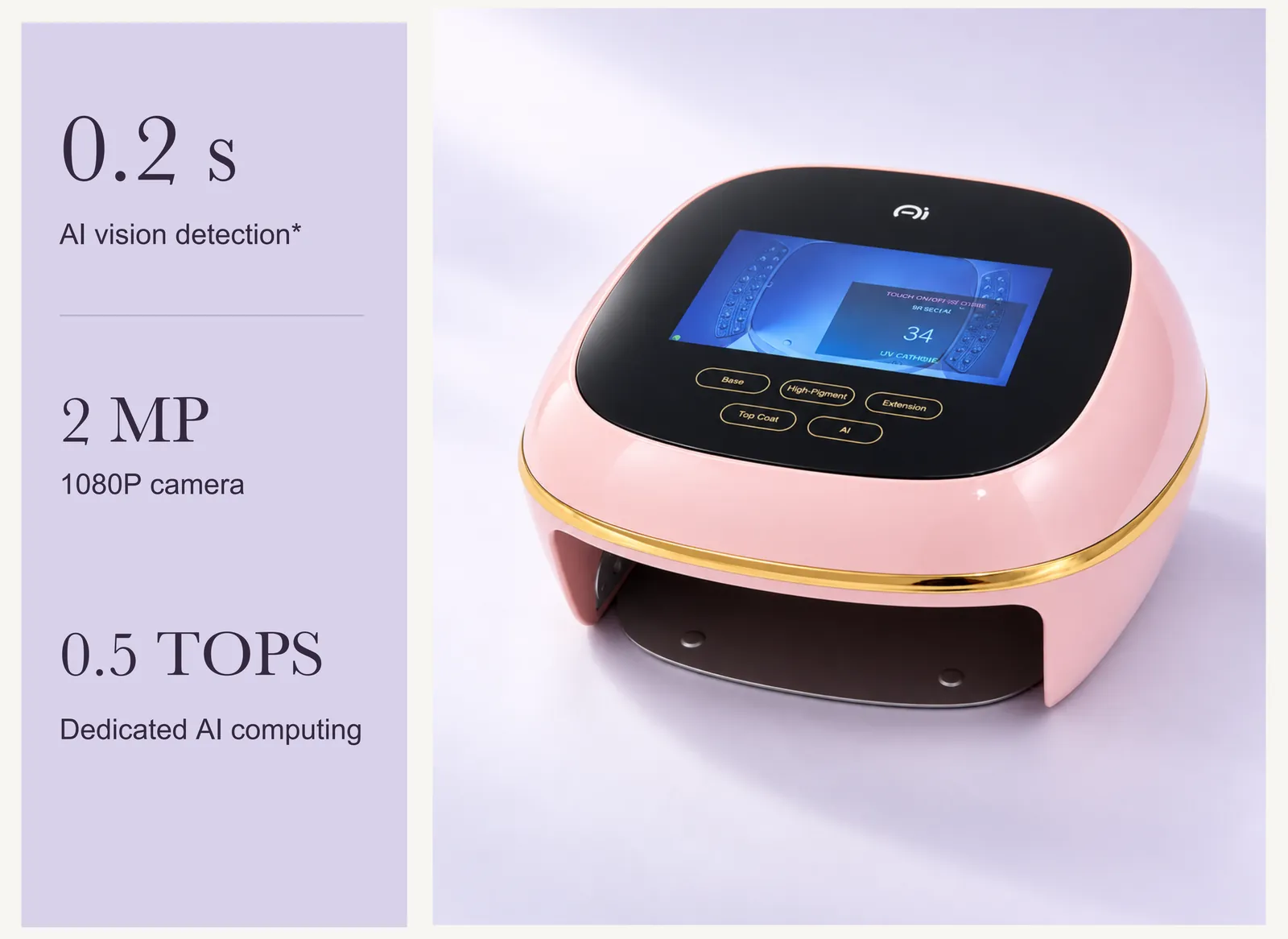
Detection in roughly 0.2 seconds: the camera locates the nails, and only the zones above them are driven.
One console, many languages: the staffing reality
Nordic salons staff across languages, and a technician trained in one branch may cover another. The 5.5-inch touchscreen runs 29 interface languages, and the language set is locked at order, so a chain can standardize on the ones it actually hires in. Treat the console as onboarding documentation: menus that state what the lamp is doing reduce the training conversation and make multi-site consistency a setting rather than a matter of seniority.
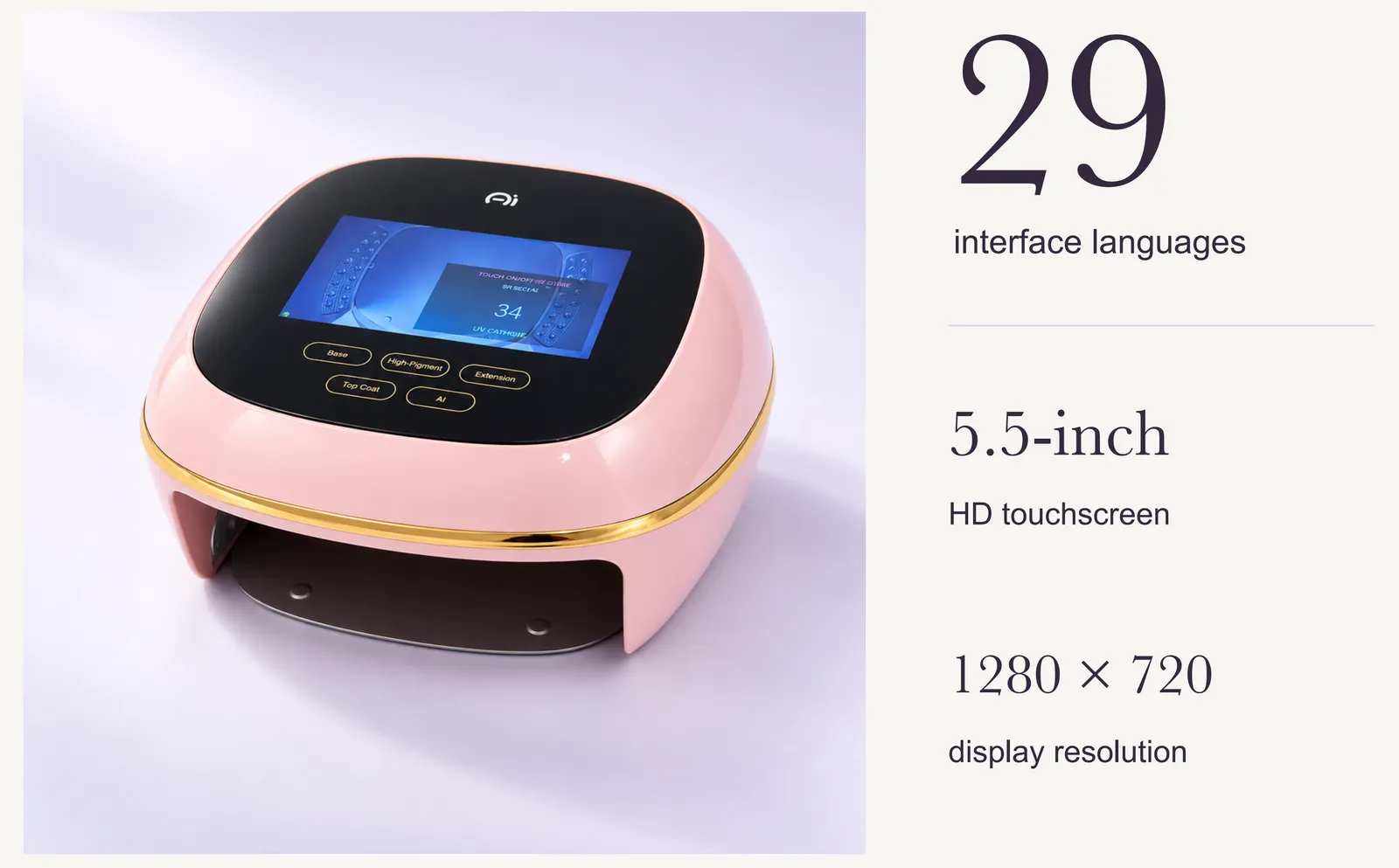
The 5.5-inch console, supplied with up to 29 interface languages locked to your order.
Commercial terms before you commit to a pallet
- Standard configuration: AC powered, no battery. The 6000 mAh lithium version is an option, quoted on request.
- White label or neutral: from 3–5 units, with a single sample unit available for evaluation before that.
- Custom branding — your logo, colorway and retail packaging: 300–500 units.
- Documentation: CE/LVD, EMC and RoHS paperwork travels with the sample, and we can supply the light-safety data your own exposure assessment needs. The technical file for the EU market should be assembled by the importer placing the product on the market.
The parameter-by-parameter breakdown, including the two-generation comparison your buying committee will ask for, sits on the AI lamp comparison page, and the full specification is on the AI Smart Nail Lamp product page.
Quick FAQ
Our lamp uses LEDs, not UV tubes. Do we still need a photobiological assessment?
Can we order a small first run for the Nordic market?
Is the battery version standard?
What evidence can we give our staff about exposure?
Next step
Tell us whether you are equipping a single studio or a chain, how many stations run at once, and which languages your staff work in, and we will send a sample plan with the configuration that fits. For a sample unit, a private-label quote or a chain rollout schedule, contact Miro Wu, Dedicated Account Manager — email miro.wu@beautome.com or WhatsApp +86 188 1393 3019.