






Hard Wax Private Label for Japan: The Label Artwork Sheet Behind a Legal Bag
In Japan the bag is not packaging with a logo on it. It is the document that makes the product legal to sell. Article 61 of the Pharmaceuticals and Medical Devices Act lists what has to appear on the direct container, and a 300 g bag of hard wax carries the same statutory fields as a 1 kg bag. For a private-label brand working from unlabeled transparent bags, that list is the real project plan — and it starts before the formula is finalized, not after the cartons are printed.
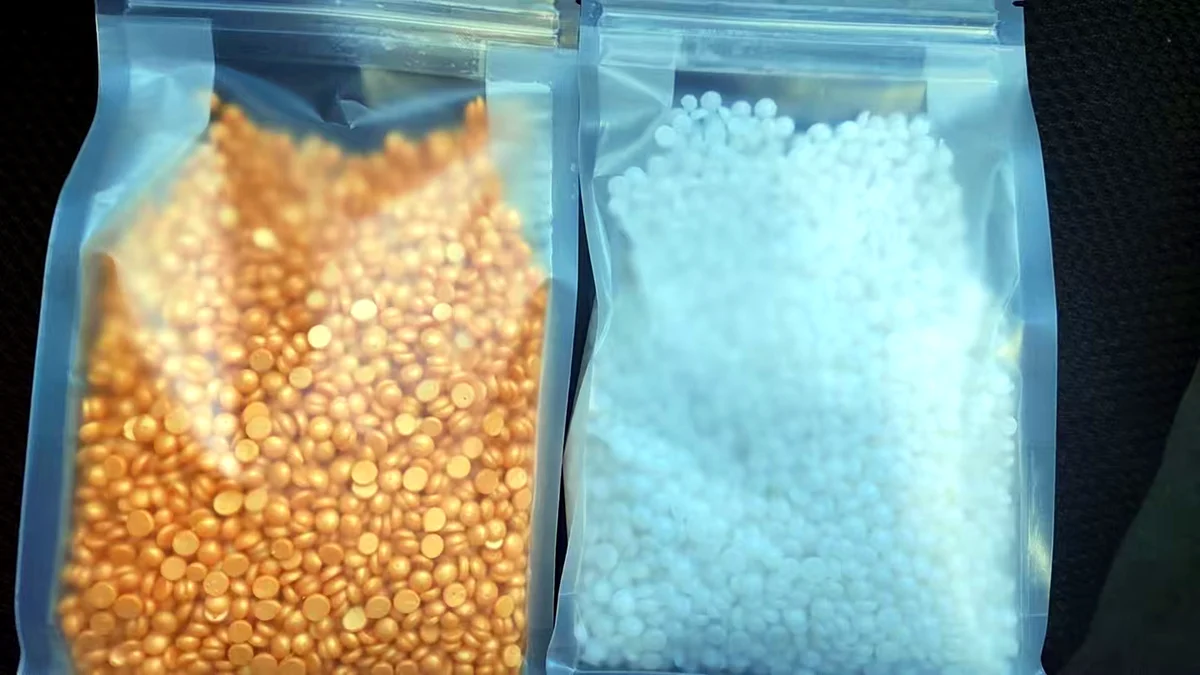
An unlabeled bag moves the printing to the brand — and with it every field the law requires on the direct container.
Why the artwork comes before the formula
Most private-label projects elsewhere start with a color and a scent, then hand the artwork to a designer two weeks before shipping. In Japan that order is backwards, for a simple reason: the label content depends on decisions the factory cannot make. Which legal entity is the marketing authorization holder. What the product is called in its notification. Whether the product is handled as a cosmetic or as a quasi-drug. Each answer changes a line on the bag, and a bag printed with the wrong line has to be destroyed — there is no sticker-over solution that a Japanese distributor will accept.
The practical fix is a single spreadsheet with four columns per label field: the field, where its content comes from, who signs it off, and where on the pack it is printed. Once that sheet exists, the artwork becomes a checklist rather than a design conversation, and the factory can print a compliant bag on the first pass.
What Article 61 puts on the direct container
The statutory list is short and unglamorous, and the Tokyo Metropolitan Government’s pharmaceutical affairs office sets it out item by item for cosmetics: the name and address of the marketing authorization holder (the address being that of the office where the general marketing director works), the product name as notified, the manufacturing number or manufacturing symbol, the names of the ingredients — in principle every ingredient in the formula — and the expiry date, which is required where the product’s properties or quality may change within three years under proper storage (Tokyo Metropolitan Government, Pharmaceutical Affairs guidance on cosmetic labeling, PMD Act Art. 61; ingredient names per Ministry of Health, Labour and Welfare Notification No. 332 of 2000; expiry per Notification No. 166 of 1980).
Two extensions matter for a wax. The first is that the list must appear on the direct container or direct wrapping — for a bag of beads, the bag itself. The second is the outer-box rule: if the bag is then packed in an opaque box, the same items have to be repeated on the outer packaging, because otherwise the statutory information is no longer visible. A brand that plans a retail carton for department stores is therefore printing the full set twice, on two different substrates, in one production run.
Art. 61
The PMD Act article that fixes the labeling items for the direct container, with the outer pack repeating them when opaque
3 years
The threshold that makes an expiry date mandatory: quality may change within three years under proper storage
45–50 °C
Working range of rosin-free Formula A1, stated as a range because the melt window is one
The ingredient line is a naming problem, not a translation problem
This is where most first drafts fail. Japanese cosmetic labeling does not accept a literal translation of an English INCI list; ingredient names are drawn from the Japanese ingredient labeling names maintained by the Japan Cosmetic Industry Association, and a name that is not on the list is not a valid declaration. A formula that reads cleanly in English can produce two or three ingredients with no obvious Japanese equivalent, and each one has to be resolved before the artwork is released.
Take the four formulas in the range and map them one by one. Formula A1 is the rosin-free line: synthetic resin, EVA, microcrystalline wax, paraffin and four vegetable oils, with the melt window stated as 45–50 °C and Gold and Pink as standard colors, White made to order. Formula A2 is the premium rosin line, a cream-white bead with high elasticity for short, coarse hair. Consumer-Grade Hard Wax is the 55–60 °C film wax, and All-Purpose Soft Wax is the 450 g can for strip work. Each has a different ingredient set, which means four artwork sheets, not one with a color swap.
Two sequencing notes save a printing cycle. First, the order of the ingredient list is not the regulatory problem here — the naming is — so do not spend review time arguing about sequence while an unresolved name sits in the middle of the line. Second, any colorant or fragrance has its own naming conventions, and a custom White run is the most likely place for a new ingredient to appear late. Lock the White formula’s ingredient names before accepting a custom order, or the artwork will be reprinted at the brand’s expense.
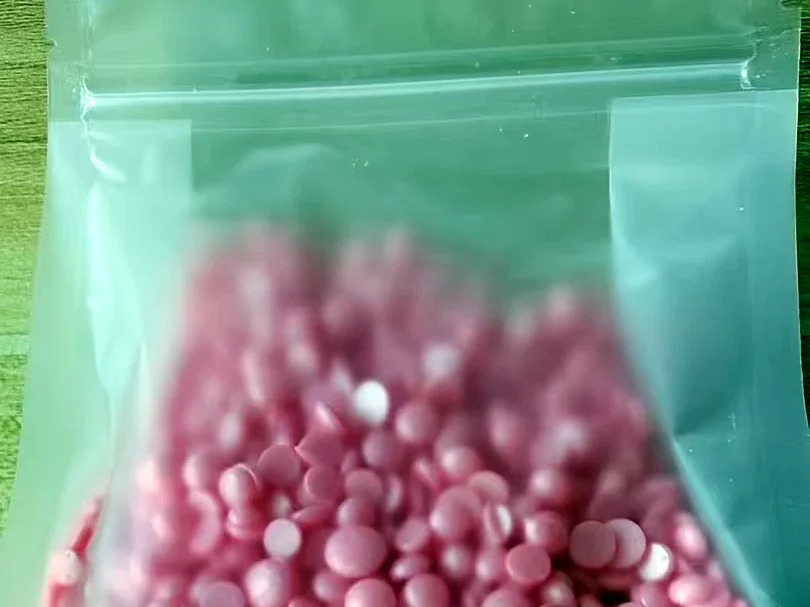
The transparent bag is the direct container. Every statutory field lands on the label the brand prints.
Classification first: cosmetic or quasi-drug
Before the artwork there is a question that decides how much of it exists. Under the PMD Act, hair removal appears in the definition of a quasi-drug — the purposes listed in Article 2 include the prevention of hair loss, hair growth and hair removal. A hard wax sold with a hair-removal claim therefore cannot simply be treated as an ordinary cosmetic by default; and a quasi-drug route brings its own approval step and a different label set, including approved efficacy and usage wording.
What this means in practice is that the claim on the pack drives the classification, not the product form. A wax positioned purely around cleansing and care sits on one side of the line; the same wax with an explicit removal claim sits on the other. Settle it with the marketing authorization holder and, where needed, a regulatory professional, before the artwork brief is written — a misclassification discovered after printing costs months, not days. The document chain behind the holder side — the manufacturing and marketing license, the foreign manufacturing site registration, the per-SKU notification — is set out in this earlier note on the Japanese file.
Three failure modes on a transparent bag
The lot code is missing. A manufacturing number or symbol is a statutory field, and on an unlabeled bag the only place it can live is the brand’s label or a factory-applied print on the bag seam. Decide which, in writing. If the factory prints the lot and the brand prints the rest, the two must be reconciled in one record, otherwise a recall cannot be scoped to a batch.
The label does not survive the pack. Polyethylene and laminate surfaces reject ordinary paper labels in a warm room; a bag that sits at 28 °C in a stockroom for a season will lift at the corners. Specify the adhesive and the substrate, and test a labeled bag at 40 °C for a week before approving the print run.
The size range is treated as one artwork. A 300 g, 500 g and 1,000 g bag carry the same fields but not the same layout. The statutory block does not shrink to fit a curved surface gracefully, and a 300 g bag is the one that usually loses the expiry line first. Lay out the smallest pack first; if it fits there, the larger ones follow.
The four-column artwork sheet
Column one is the field: holder name and address, notified product name, manufacturing number, ingredient names, expiry date, plus any standard-mandated caution wording. Column two is the source: the holder’s license record, the notification, the factory’s batch record, the formula’s ingredient mapping, and the stability data behind the shelf life. Column three is the sign-off: who within the brand accepts each line, by name rather than by department. Column four is the print location: bag front, bag back, seam print, or outer carton.
Fill it once and it becomes reusable: the next SKU inherits the layout and changes only the ingredient block, the product name and the color. That is the difference between a private-label program that can add a SKU in three weeks and one that reprints every time.
Pack, quantity and what we ship
Standard packs are 300 g, 500 g and 1,000 g. The 300 g bag suits trial and mobile work, the 500 g is the working back-bar size, and the 1,000 g belongs where weekly volume justifies it — a 450 ml pot holds roughly 400 g, so a 1 kg bag left open on a bench oxidizes before it is finished. Unlabeled transparent bags carry a low MOQ and no printing cycle on our side, which is precisely what makes a Japanese launch testable: the brand prints its own statutory block, in its own name, on its own schedule. Storage is 15–24 °C, dry and out of light; bring bags back to room temperature before opening in a humid month.
The full range is on the wax formulas page, brand and carton options are under OEM and ODM, and the earlier notes on this market are linked from the BeauTome blog.
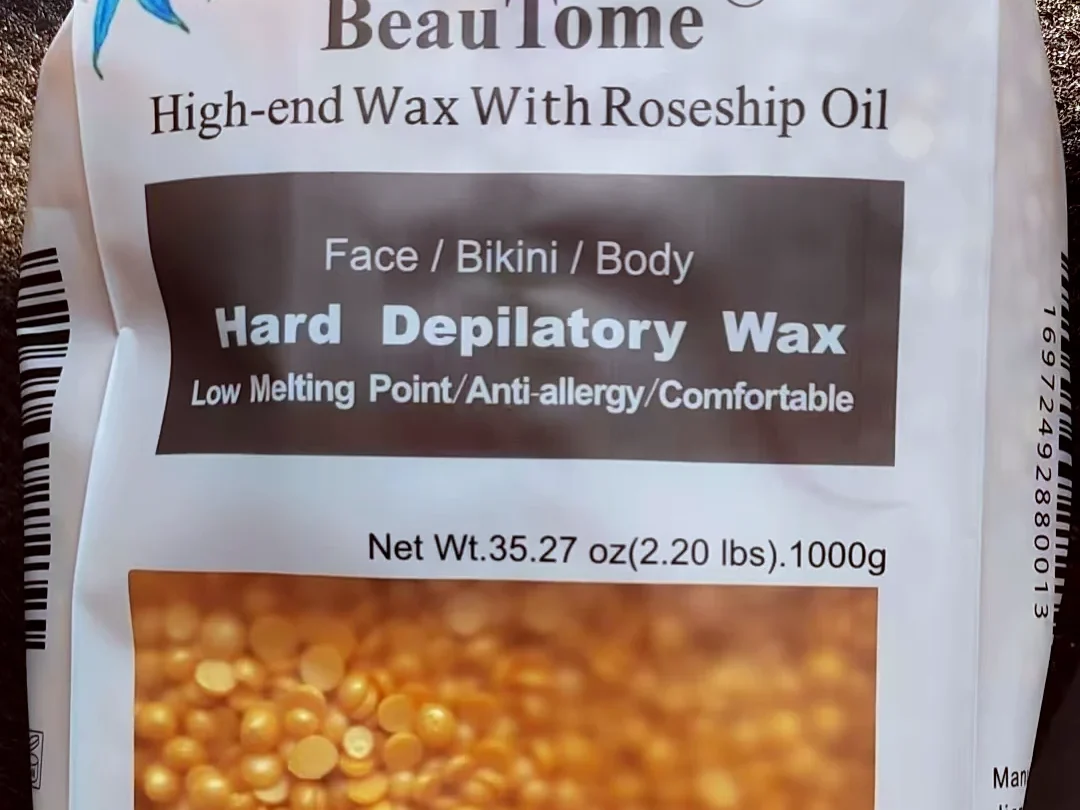
The same beads, printed twice: once as an unlabeled bag and once as a branded retail pack carrying the full statutory block.
Quick FAQ
We already have an English INCI list. Can the designer simply translate it?
Do we need an expiry date on every bag?
Can the bag stay unlabeled until it reaches Japan?
Next step
Send us the four formulas you intend to list, the pack sizes and the name of the marketing authorization holder, and we will return the ingredient breakdown per SKU in a form your regulatory contact can map, plus unlabeled samples in the pack sizes you plan to print. If the classification question is still open, say so in the first email — it changes what the artwork has to contain. For a quotation, contact Miro Wu, Dedicated Account Manager — email miro.wu@beautome.com or WhatsApp +86 188 1393 3019.