







Hard Wax for Russian Distributors: Replenishment Rhythm, Safety Stock and the Soft-Wax Test Line
Most Russian and CIS wax businesses do not lose money on the price of a bag. They lose it on the gap between how fast a salon burns through wax and how slowly a container arrives. A 500 g bag that sells at a fair margin is worthless if the salon runs out in the second week of the pre-summer rush. This piece is about the arithmetic in between — the reorder point, the season, and the one line worth testing rather than launching.
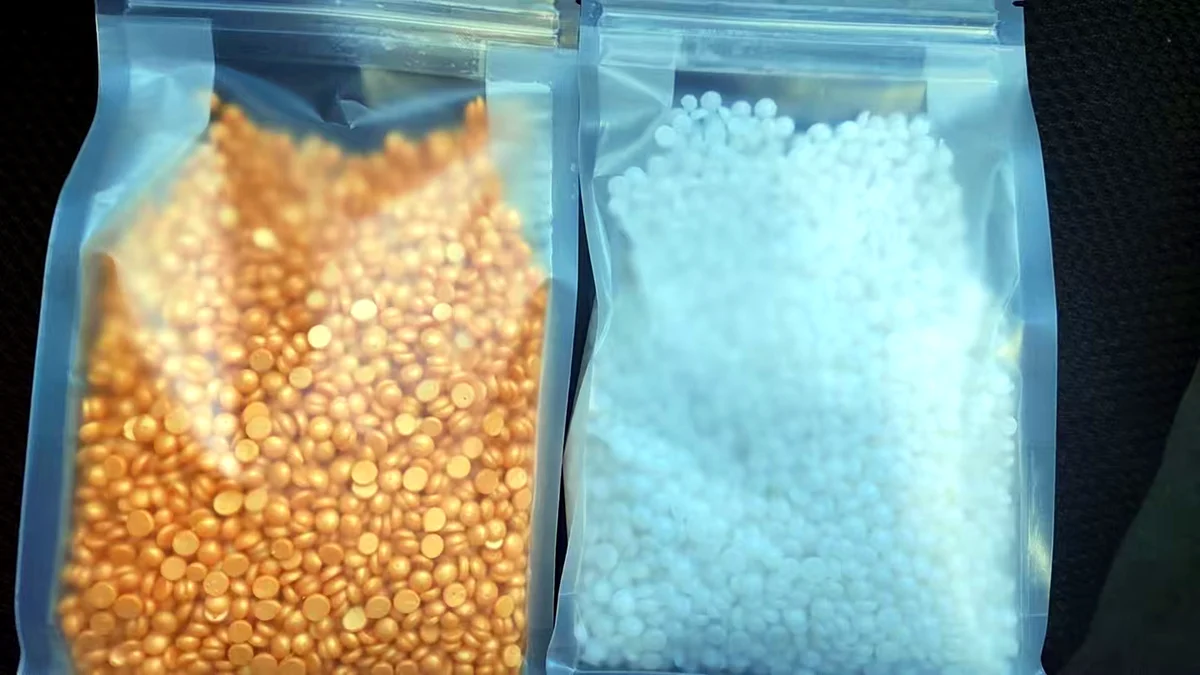
Unlabeled transparent bags — the private-label format that removes printing lead time from the replenishment cycle.
Two clocks: the salon’s week and the container’s month
The depilatory wax category is growing at a steady, unspectacular rate globally — USD 2.34 billion in 2026, reaching USD 3.53 billion by 2032 at 6.68% CAGR (Research and Markets, September 2026) — and inside that average, hard wax keeps taking share from strip wax because it needs no cloth and suits smaller treatment rooms. Steady growth is good news for a distributor, but it also means the wins come from operational discipline rather than from riding a wave.
That discipline starts with recognizing that two different clocks are running. A salon consumes wax weekly. A container arrives monthly or quarterly. Everything that goes wrong in this market — emergency air freight, a salon switching to a local brand for six weeks, a distressed sale at cost — happens in the space between those two clocks.
40–70 g
Hard wax used per VIO service — roughly 15–25 services per kilogram, which is the base unit for every stock calculation
18–30 days
Typical China–Moscow transit: rail 18–25 days, road 20–30 days, air 6–13 days (freight-forwarder guidance, 2026)
15–24 °C
Storage band for bead wax — above freezing, below the temperature at which beads soften and block in the bag
The arithmetic of a reorder point
Every distributor we work with ends up with the same formula, whether they write it down or not: reorder point = demand during lead time + safety stock. The only hard part is filling in honest numbers. Here is a worked example for one Russian distributor serving twelve salons, each with a single waxing room:
- Weekly demand. Twelve rooms at roughly twelve hard-wax services a week, at 50 g per service, is 7.2 kg per week across the customer base.
- Lead time. Ten working days of production, 25 days of road freight, three days of clearance and inbound handling — about 38 days, or 5.5 weeks.
- Demand during lead time. 7.2 kg × 5.5 = 39.6 kg in the pipeline, or already committed, before a single new order lands.
- Safety stock. Two weeks of cover for a missed sailing or a customs query: 14.4 kg.
- Reorder point. 39.6 + 14.4 = 54 kg. In 500 g bags, that is 108 bags — the level at which the next order goes in, not the level at which stock runs out.
Two things fall out of this. First, the order quantity should be a multiple that respects carton and pallet configuration, not a round number chosen for the invoice. Second, safety stock is a decision about service level, not about optimism: two weeks covers a normal delay, four weeks covers a season, and no amount covers a distributor who only reorders when the shelf looks empty.

Formula A1 in Gold — a 45–50 °C working range, with Pink as the second standard color and White made to order.
Why the order has to be placed before the season, not in it
Demand in this region is not flat. It steps up in the weeks before summer, when legs and underarms come back into the menu after a long winter, and it spikes around 8 March and the New Year period, when salons sell gift certificates and run promotional menus. Both are predictable, which is exactly why they are unforgiving: everyone orders at once, freight space tightens, and a container booked in April arrives after the peak has passed.
Work backwards from the peak. If the rush starts in the second half of April, and the pipeline is 38 days, the purchase order needs to be confirmed in the first half of March — which means the salon-level demand signal has to reach you in February. Distributors who get this right do one simple thing: they collect a forward estimate from their ten largest salons in January, convert it into kilograms, and treat it as a floor for the season order rather than a forecast to be argued with.
Where 300, 500 and 1,000 g fit in the calculation
Pack sizes are usually presented as a price ladder. Operationally they are something more useful: a way of matching stock to the customer’s consumption rate.
- 300 g is a trial and mobile unit — one technician, one or two rooms, or a specialist who travels. It is also the size that lets a new salon test a formula without committing a month of stock.
- 500 g is the working unit for a single room, and the size most of your reorder points should be expressed in.
- 1,000 g belongs at the back bar of a two-technician room or a chain’s central store, where it is decanted rather than sold.
If you are also supplying private label, the unlabeled transparent bag is what makes small runs practical: the customer applies their own label, so there is no printing cycle between the order and the shipment. Our private-label route is low MOQ by design for exactly this reason. The wax formulas page lists the full range and the pack options per SKU.
The soft wax question: test it, do not launch it
Hard wax dominates this region’s professional channel, and it should stay the core of the range. But there is a case for a strip-wax line at the entry end — legs, arms and back, where volume matters more than grip, and where a 450 g can is a lower-commitment purchase than a bag of beads. The mistake is launching it as a full line on the strength of one interested salon.
Run it as a test instead. Put a 450 g can into five to eight salons for eight weeks, and measure three things: whether the technicians actually use it after the novelty, whether the service time is shorter or longer than the hard-wax equivalent, and whether the client rebooks. Soft wax needs strips and a separate pot set point, so a positive result has an equipment consequence — which is also why a test is cheaper than a launch. Our wax heater range covers the second pot from 250 ml upward for precisely this scenario.
Currency, price validity and the distributor’s margin
Buying in dollars and selling in rubles means the margin you calculated at order time is not the margin you collect at delivery. The working fix is administrative rather than financial: publish a price list with a stated validity window of 30–45 days, separate the list price from the promotional price so a currency move does not force you to break the list, and price in whole cartons rather than per bag so small currency swings do not require repricing a hundred SKUs. Distributors who quote month by month also find it easier to hold a consistent shelf price, which is what salons actually care about.
Compliance follows the entity that places the product on the market
One paragraph, because it does not change with the season: wax is a cosmetic product under TR CU 009/2011, and the declaration or state registration is held by the company placing it on the EAEU market — usually your importing entity, with Russian-language labeling and the documentation set out in our earlier notes on the EAC file and cold-weather handling and on the pack-size ladder. If you are private-labeling, decide early whether you or your customer is that entity, because it determines who owns the artwork and the registration.
Quick FAQ
How much safety stock should a distributor hold for this region?
Can we mix pack sizes in one order?
What is the private-label minimum, and can we start with unlabeled bags?
Next step
Send us your customer count, average services per room per week and the transit route you use, and we will return a replenishment plan — reorder point in kilograms, a season order sized to it, and a pack mix that fits your carton configuration. The BeauTome blog carries the market-by-market notes for the region. For a quotation, contact Miro Wu, Dedicated Account Manager — email miro.wu@beautome.com or WhatsApp +86 188 1393 3019.