





AI Nail Lamp Comparison: Two Generations of Vision Curing, Parameter by Parameter
Two lamps can both say “AI recognises the nails” and still be very different products underneath. This page compares the BeauTome AI Smart Nail Lamp with the first generation of AI nail lamps that reached the professional market before it — light engine, vision hardware, interface and, most importantly, the commercial model behind the product. No competitor names appear here: the page compares published parameters, not companies.
Five parameters decide what an AI nail lamp actually does in service: the light engine (diode count, placement, wavelength bins), the vision system (camera resolution, on-device compute, detection latency), the control of light over the cycle, the interface your team operates every day (screen and language count), and the supply model — a finished, brand-owned product or a private-label platform you can put your own name on. The table below lists the published values for both generations of lamp, including the rows where the earlier generation publishes nothing.
Why this comparison exists
Vision-assisted curing is now an established category, which is good news for anyone selling nail equipment: you no longer have to explain what an AI nail lamp is. The category was opened by a first generation of lamps sold as finished, branded products through distribution — an excellent product for the salon that wants a known name on the desk, and a dead end for the brand owner who wants their own name there instead.
We built the BeauTome AI Smart Nail Lamp for the second group: importers, distributors, salon chains and gel brands who need a vision-curing lamp they can sell under their own label. That difference in purpose shows up in the specification — and it shows up in how you buy. This page is the honest version of that comparison, including the rows where the earlier lamp is the better choice for you.
How to read the table below
The middle column is the first-generation AI lamp category — the values published by the brands that brought AI curing to market. The right column is our current product. Where the reference column says “not published”, the manufacturer does not state that value on its product pages: that is not the same as a bad value, and we mark it rather than guess.
All figures in this table were taken from publicly published specification sheets and manufacturers’ product pages in October 2026. Brand names are deliberately omitted; no third-party trademark is used, implied or claimed on this page.
Specification comparison: first-generation AI lamp vs BeauTome AI Smart Nail Lamp
| Parameter | First-generation AI lamp (category benchmark) | BeauTome AI Smart Nail Lamp |
|---|---|---|
| LED count | 109 LEDs | 136 dual-wavelength LEDs |
| LED placement | Single array above the hand | Front and side arrays — sidewalls and thumb get direct light |
| Wavelengths | 365 nm + 405 nm | 365–370 nm + 395–400 nm (published bins) |
| Camera | Built-in AI camera (resolution not published) | 2 MP / 1080P HD camera |
| On-device AI compute | 30-million-parameter AI model (as published) | 0.5 TOPS NPU with a 1.2 GHz CPU |
| Detection latency | Not published | 0.2 s AI vision detection (as supplied specification) |
| Light control | Only the LEDs above the nails switch on | Dynamic LED scheduling per detected nail placement |
| Heat management | Low-temperature curing modes | Progressive output ramp through each cycle (smart heat control) |
| Maintenance signal on the unit | Not published | Active light-decay alert when output drops |
| Display | 864 × 480 px screen | 5.5-inch HD touchscreen, 1280 × 720 px |
| Interface languages | Not published | 29 languages |
| Connectivity | Wi-Fi | Dual-band Wi-Fi, 2.4 GHz + 5 GHz |
| Operating system | Not published | Linux embedded OS, 128 MB RAM |
| Battery | Not on the standard model; 73 Wh pack on the rechargeable model | Optional 6000 mAh Li-ion — the same lamp ships with or without a cell |
| Dimensions | 210 × 199 × 98 mm | 240 × 240 × 115 mm |
| Unit weight | 995 g (battery models 1,475–1,550 g) | 1,707 g; 1,850 g with battery |
| Published curing time | “9-second cure” claimed for its top model | No cure-time claim — see the note below |
| Branding model | Brand-owned product, sold through distribution | OEM / ODM: your logo, your colours, your packaging — plus neutral white-label stock |
| Documents with the offer | Retail warranty and support terms | Sample unit for verification, then model-specific CE / RoHS / FCC documentation for review |
Specifications of the reference category are reproduced from publicly published data (manufacturers’ product pages, October 2026). Trademarks and brand names are deliberately omitted — this page compares published parameters, not companies. Specifications change without notice, so confirm current values on a datasheet before you quote your own customers.
Why we do not publish a curing-time claim
A single curing time is not transferable between gel systems. Cure depends on the photoinitiator package in the gel, pigment loading, layer thickness and the distance between the diode and the nail — which is why the same lamp can cure one brand’s builder in seconds and need longer on an opaque colour from another. Publishing one number would make our marketing easier and your purchasing decision worse.
So the number we do publish is 0.2 seconds of detection latency — a property of the lamp itself, measurable on its own. Cure performance is something we would rather you measure: send us the two or three gels you find hardest to cure and we will ship a sample unit to test them on.
Where each lamp is genuinely ahead
A comparison that only lists our wins is not a comparison. Here is the honest split.
Ahead on maturity
A large installed base, a well-known service story, one self-contained configuration, and a published cure-time figure that salons find easy to repeat to their own clients. If you need a known name on the desk tomorrow and nothing else, that is the simpler purchase.
Ahead on published depth
136 LEDs with front and side arrays, a 1080P camera with on-device compute, a 1280 × 720 touchscreen, 29 interface languages, dual-band Wi-Fi, a light-decay alert, an optional battery — and a specification sheet that states all of it.
Ahead on nothing until you test
Cure seconds on your gels, heat comfort on your clients, and real runtime on one charge. Those three are decided in your salon, not on a spec sheet — which is exactly what a sample unit is for.
The commercial difference: a branded lamp vs a private-label platform
The first generation of AI lamps reached the market as finished products sold through distribution. That works well if your business is salons buying equipment. It works badly if your business is brand equity: every unit you sell puts someone else’s logo in your client’s salon, and the specification, colour and packaging are not yours to change.
The BeauTome AI Smart Nail Lamp is offered on the opposite model. The same hardware is available with your logo, your colourway and your printed packaging, and neutral white-label stock (no logo, white housing) is available now for a small first batch — useful when you want to test the market, run a promotion, or bundle the lamp with your own gel line before committing to tooling and print runs.
Three practical consequences worth pricing into your comparison:
- Price is yours to set. A private-label unit is quoted against your volume and configuration, not against a suggested retail price set by another company’s channel.
- The battery is a line item, not a default. Ship the battery-free build to markets where lithium transport or battery regulation makes the rechargeable version slower or more expensive to clear, and add the 6000 mAh version where you need it.
- Packaging and documents follow your market. Tell us the destination market first and we will line up the configuration and the paperwork for it.
A five-step evaluation you can run this week
- Ask both suppliers for the current datasheet, not the marketing page. Compare the two tables row by row; ask specifically about the rows that are marked as unpublished.
- Request the compliance set for your market — CE (including the radio equipment directive if the lamp is Wi-Fi enabled), RoHS, FCC, and UN38.3 plus transport documents if you take the battery version.
- Book one sample unit of each and cure your three most difficult gels on it: the opaque colour, the thick builder, the top coat you use daily.
- Run a full working day on both: heat comfort at the end of an extension set, how the interface behaves during a service, and how many cycles a charge actually delivers.
- Ask the branding question in writing: can this lamp carry my brand, from what volume, with which packaging and which documents in whose name?
Take the one-page sheet with you
If you need the same comparison for a team meeting or an email to your buying committee, the sheet below is the printable version of the table — no brand names, just the parameters.
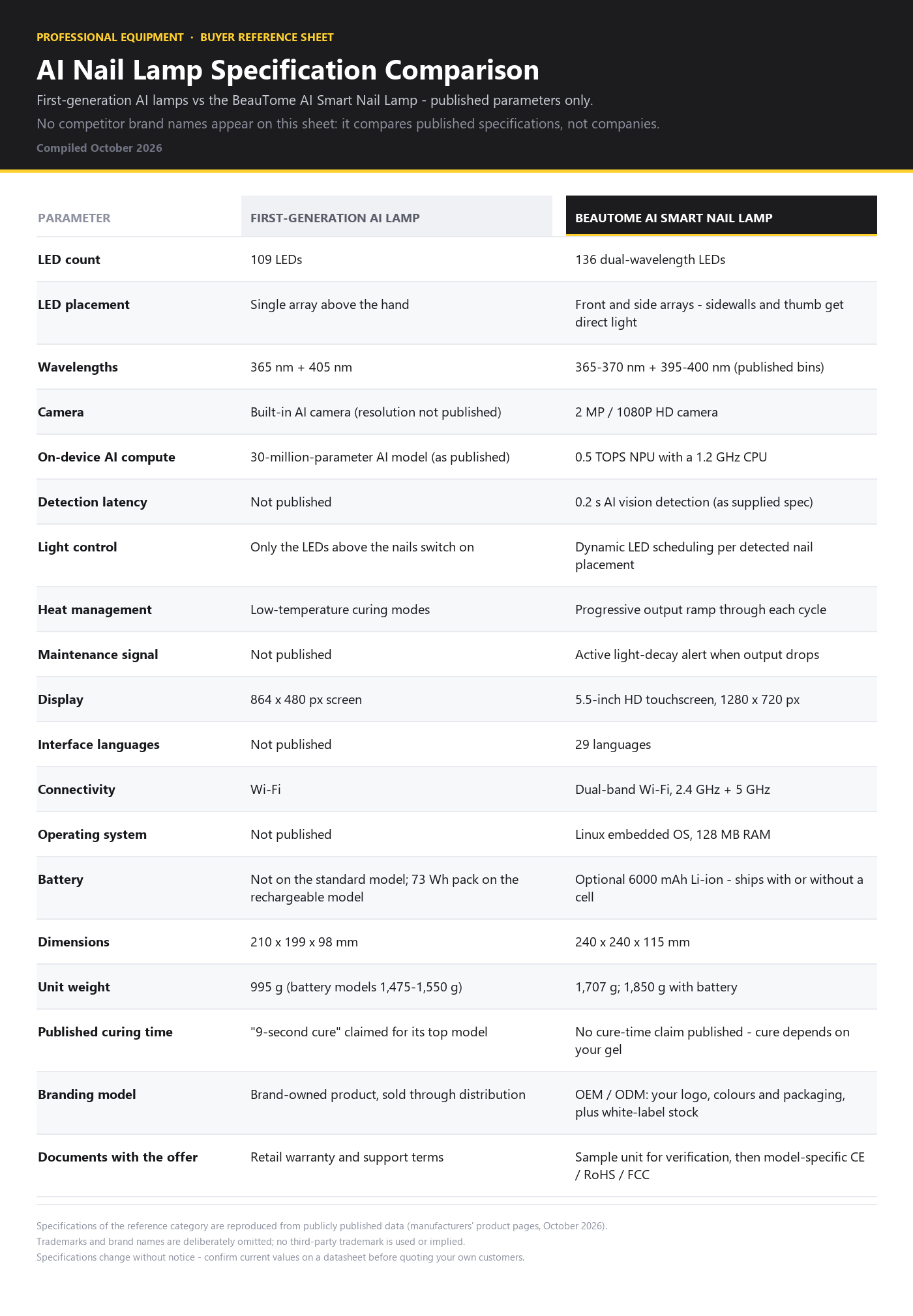
The one-page comparison sheet — share it, or ask us for it as a PDF.
Questions buyers ask us
Which products is this table comparing?
The right column is our current production lamp. The middle column is the specification published by the first generation of AI nail lamps currently sold to professionals. We have deliberately left brand names out: the useful question for a buyer is what the parameters are, not who publishes them, and we do not want a public page to read as an attack on another company. In a private conversation we are happy to talk about the market in detail.
Does a higher LED count mean a faster cure?
Not on its own. Diode count mainly determines coverage and evenness — how much of the nail, including the sidewalls and the thumb, receives light without the hand being repositioned. Curing speed depends on the irradiance that actually reaches the gel, how well the wavelength matches that gel’s photoinitiators, and layer thickness. That is why we count 136 diodes in two wavelength bands, arranged front and side, rather than chasing a single bigger number.
Is 395–400 nm better than 405 nm?
Neither is universally better; what matters is whether the lamp’s output matches the photoinitiator package in the gel you sell. 405 nm sits further into the visible violet band, which some users perceive as brighter. Our published bins are 365–370 nm and 395–400 nm, keeping output inside the band most professional formulations are built around. If your gel line is unusual, send us a sample of it with your enquiry — we will test it on a sample unit before you commit to volume.
Why is your lamp heavier than the reference model?
It is a slightly larger unit — 240 × 240 × 115 mm against 210 × 199 × 98 mm — and weight follows the housing and the optional cell: 1,707 g without the battery, 1,850 g with it. If desk footprint or shipping weight is the constraint in your market, tell us at the sampling stage; the battery-free build is the lighter configuration and it also removes a set of transport documents.
Can we buy it without the battery?
Yes. The 6000 mAh Li-ion battery is an option, not a fixed part of the product, and it is specified per order. Some markets and some buyers want the cordless version; others prefer to avoid lithium documentation and battery-labelling obligations entirely and take the corded build.
Can we put our own brand on an AI nail lamp?
That is the purpose of this product line. Neutral white-label stock — no logo, white housing — is available now for a small first batch, and logo, colourway and printed packaging follow your volume according to the current thresholds. Share your target market and expected volume and we will come back with the configuration, the terms and the documents that market needs.
Put both lamps on the same desk
Tell us which gels you cure and which market you sell into. We will send a sample unit with the specification sheet and the compliance documents for your market, so the comparison you make is your own.